YouTube Shorts Ideas: 100 Content Ideas That Actually Get Views in 2026
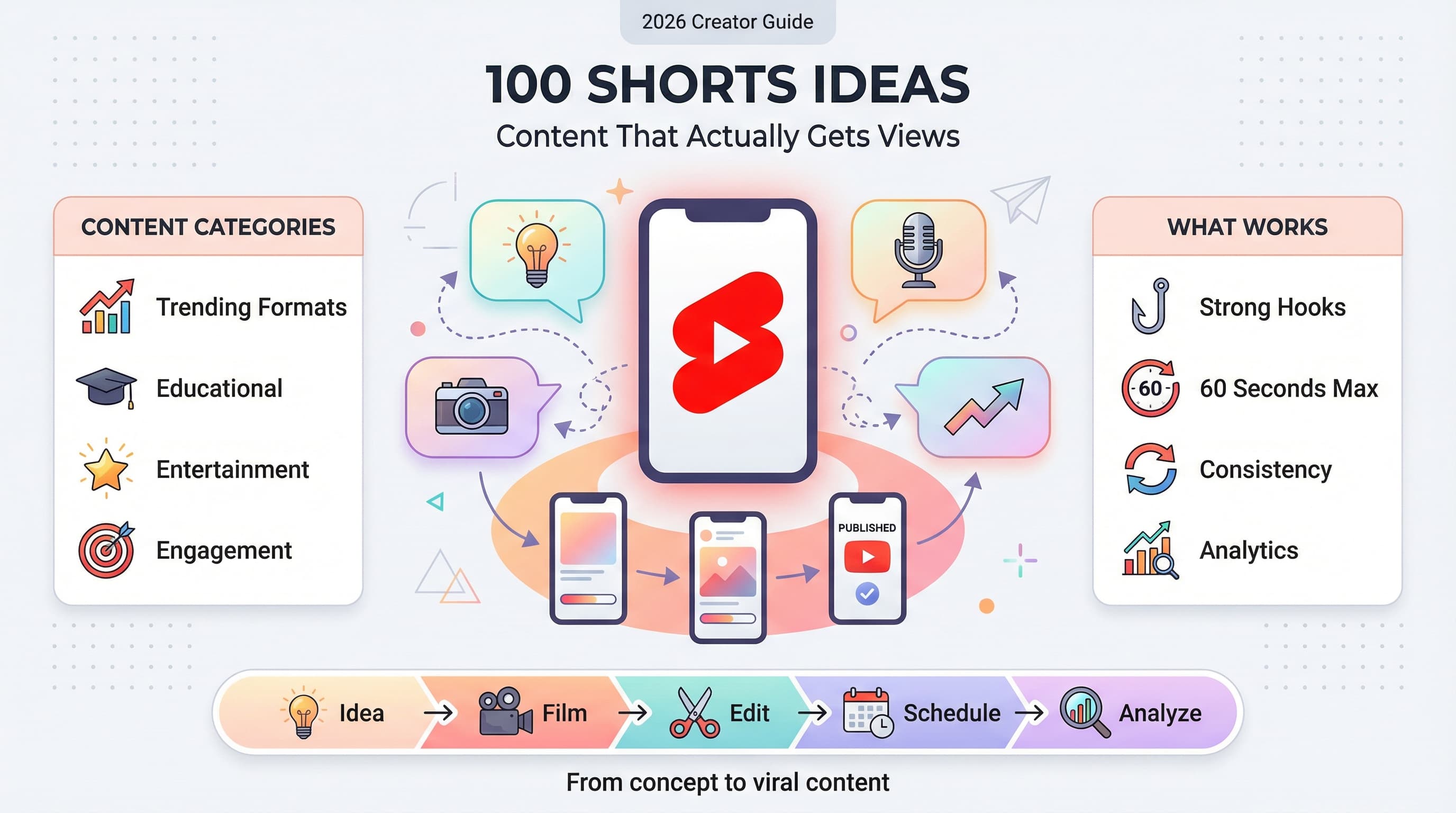
Discover 100 proven YouTube Shorts ideas across every niche. From trending formats to evergreen content that builds subscribers fast.

Quick answer
Get YouTube Shorts ideas from trending topics, how-to tutorials, day-in-the-life vlogs, product reviews, and reaction content.
- •Tutorial and how-to Shorts consistently get the highest completion and save rates
- •Reaction and commentary Shorts drive comments and shares for algorithm reach
- •Day-in-the-life and behind-the-scenes content builds subscriber loyalty
- •Use YouTube Trending and Google Trends to find timely topics for your niche
You opened YouTube Studio, stared at the upload button, and drew a complete blank. Again. Learn more about best time to post on youtube.
The cursor blinks. Your phone camera is ready. But what do you actually film? Learn more about youtube line break generator.
This is the creative block that kills more YouTube channels than bad thumbnails ever will. You know Shorts can explode your channel growth, but coming up with ideas day after day feels like squeezing water from a rock. What if you had a massive list of proven concepts you could pull from whenever inspiration runs dry?
Try Schedulala for free
Schedule posts to Bluesky, Twitter, and 8 other platforms from one dashboard.
Get started for free→See It in Action
This is what scheduling YouTube Shorts looks like in Schedulala
Why YouTube Shorts matter more than ever
Before we dive into the 100 ideas, let's talk about why Shorts deserve your attention in 2026. YouTube now gets over 70 billion daily Shorts views. That's not a typo. Billion with a B.
The algorithm actively pushes Shorts to non-subscribers, which means every Short you post is essentially a free advertisement for your channel. A single viral Short can bring in thousands of subscribers overnight. I've seen channels go from 200 to 20,000 subscribers in a week from one well-timed Short.
The best part? Shorts require less production value than long-form content. No fancy editing. No expensive equipment. Just your phone, a good idea, and 60 seconds or less.
But here's what separates channels that grow from channels that stagnate: consistency. You need to post Shorts regularly, and that means you need a steady stream of ideas. That's exactly what this list provides.
How to use this list effectively
Don't try to film all 100 ideas. That's not the point. Instead, scan through the categories, bookmark the ones that fit your niche, and keep them in a content calendar. When you sit down to create, you'll never face a blank page again.
Each idea includes a brief explanation of why it works and tips for execution. Some ideas work across multiple niches, while others are specific to certain content types. I've organized them by category so you can jump to what's relevant for your channel.
Ready? Let's build your content library.
Trending format ideas (1-15)
These formats are currently performing well across the platform. They tap into existing viewer behavior patterns, which means the algorithm already knows people like them.
1. The 'One Thing' reveal
Start with a hook like "The one thing that changed my [cooking/fitness/business/art]" and deliver a single, specific insight. This format works because it promises instant value and creates curiosity. Keep the reveal genuinely useful, not clickbait. Viewers remember creators who actually deliver on their promises.
2. POV storytelling
Frame your content from the viewer's perspective. "POV: You just started your first day at a new job" or "POV: You're learning guitar and finally nail the F chord." This format creates immediate emotional connection because viewers literally imagine themselves in the scenario. The more specific and relatable, the better it performs.
3. Before and after transformations
Transformations are endlessly satisfying to watch. Show a messy room becoming organized, a plain dish becoming restaurant-worthy, or a rough sketch becoming finished art. The key is making sure both states are clearly visible. Quick transitions work best, no long drawn-out processes.
4. Reply to a comment
Use YouTube's built-in reply feature to respond to interesting comments from your videos. This shows viewers you read their feedback and creates a conversation loop. Pick comments that let you share additional value or clarify common misconceptions. Bonus: the original commenter often becomes a superfan.
5. Day in my life speed runs
Compress an entire day into 60 seconds. Morning routine, work highlights, meals, evening wind-down. These perform well because they satisfy curiosity about how others live. Add timestamps or text overlays to keep viewers oriented. The faster the pace, the more engaging it tends to be.
6. Unpopular opinion drops
State a genuinely unpopular opinion in your niche and briefly explain why you hold it. "Unpopular opinion: meal prepping is overrated if you hate eating the same thing twice." These generate comments because people either agree passionately or want to debate. Just make sure you can actually defend your position.
7. Three levels of difficulty
Show beginner, intermediate, and advanced versions of the same task. A beginner guitar riff, an intermediate version, and an advanced version. A simple workout move, a moderate challenge, and an expert-level variation. This format appeals to viewers at all skill levels and shows your expertise range.
8. The comparison test
"$5 headphones vs $500 headphones" or "Store-bought vs homemade." Direct comparisons tap into our natural desire to know if expensive things are worth it. Be honest with your conclusions. Viewers can smell fake reactions, and authenticity builds trust faster than anything else.
9. Tutorial speed runs
Take a process that normally takes 10 minutes to explain and condense it to 30 seconds. Fast-paced tutorials with text overlays work incredibly well. The key is removing all filler and keeping only the essential steps. If viewers want more detail, they'll check your long-form content.
10. Behind the scenes glimpses
Show what happens before and after your main content. The setup for a photoshoot, the cleanup after a cooking video, the failed takes before you got the perfect shot. People love seeing the reality behind polished content. It humanizes you and builds connection.
11. Duet reactions
React to other content in your niche using split-screen or picture-in-picture. Your facial expressions and brief commentary add value to existing viral content. Just make sure you're adding genuine insight, not just watching and nodding. What can you explain or add that the original creator didn't?
12. The countdown format
"5 apps I can't live without" or "3 mistakes every beginner makes." Countdowns create natural structure and promise a specific amount of value. Keep each item brief (one sentence max) and make sure the final item is your strongest point. Save the best for last to reward viewers who watch to the end.
13. Expectation vs reality
Show what people think something is like versus what it's actually like. What people think working from home looks like versus the reality. What people think learning a language is like versus the actual experience. Relatable content always performs because viewers feel seen.
14. The 'what I would do differently' reflection
Share hindsight wisdom. "If I could restart my fitness journey, here's what I'd change." This format positions you as experienced while helping newcomers avoid your mistakes. Be specific about what you'd do differently and why your original approach didn't work.
15. Trending audio content
Use trending sounds and music clips to ride algorithm waves. The key is adapting the trend to your niche rather than copying it exactly. A trending dance audio becomes a "POV: me when the code finally compiles" for tech creators. Make the trend your own.
Educational content ideas (16-35)
Educational Shorts build authority and attract viewers who want to learn. These viewers often become loyal subscribers because they trust your expertise.
16. Myth busting
Pick a common misconception in your field and debunk it with facts. "No, you don't need 8 glasses of water a day. Here's what research actually says." These videos get shares because people love being the one to share surprising truths. Cite your sources briefly to build credibility.
17. Quick definitions
Explain jargon or technical terms in plain language. "What does aperture actually mean?" or "ROI explained in 20 seconds." These help beginners feel included and show you can communicate complex ideas simply. The best experts make hard things sound easy.
18. Common mistake corrections
Show the wrong way to do something, then the right way. "Most people hold their camera like this. Here's why that's a problem." Visual demonstrations of correct technique are incredibly valuable. Viewers can immediately apply what they learn.
19. Quick history lessons
"The weird history of why we shake hands" or "How the @ symbol ended up in email addresses." Bite-sized history content satisfies curiosity and often goes viral because it's so shareable. Unusual facts beat common knowledge every time.
20. Tool or product reviews in 30 seconds
Give your honest opinion on something you use. Cover what it does, who it's for, and whether it's worth the money. Brutally short reviews respect viewers' time. Skip the unboxing and get straight to the verdict.
21. Science explanations
Break down scientific concepts for general audiences. "Why does the sky change colors at sunset?" Use simple analogies and skip the technical jargon. The best science communicators make complex topics feel accessible and interesting.
22. Workflow reveals
Show your exact process for completing a task. How you edit photos, how you organize your desk, how you plan your meals. Workflow content attracts viewers who want to optimize their own systems. Be specific about tools and steps.
23. Vocabulary builders
Teach useful words or phrases. Works great for language learning channels but also for niche terminology. "5 coffee terms every enthusiast should know." Add pronunciation and usage examples for maximum value.
24. Quick math or calculations
Show mental math tricks, budgeting calculations, or useful formulas. "How to tip 20% instantly without a calculator." Practical math content helps people in real situations, which makes it highly shareable.
25. Skill progressions
Show your journey learning something new. Week 1 of drawing versus week 52. This inspires beginners and shows that expertise comes from practice, not natural talent. Honest progress documentation builds authentic connection.
26. Industry secrets
Share insider knowledge from your profession. "What restaurants don't want you to know about specials" or "How retail stores are designed to make you spend more." Insider content creates a sense of exclusive access that viewers love.
27. Book summaries in 60 seconds
Condense the key insights from books you've read. Cover the main thesis and one actionable takeaway. You're not replacing the book, you're helping viewers decide if they should read it. Always recommend good books genuinely.
28. How things are made
Show production processes for everyday items. How pencils are manufactured, how coffee beans become espresso, how glass is blown. Factory footage and process videos are hypnotic. If you can get access to behind-the-scenes production, that content gold.
29. Comparison explanations
"What's the difference between jam and jelly?" or "UI vs UX explained." Clear up common confusion points in your niche. Use visual comparisons when possible. Side-by-side demonstrations make differences obvious.
30. Life hack demonstrations
Show clever shortcuts that actually work. Not the fake viral hacks, but genuine time-savers you use in real life. Test them on camera to prove they work. Authenticity matters more than ever because viewers have seen too many fake hacks.
31. Career advice snippets
Share specific guidance for your profession. "How to negotiate salary without being awkward" or "What hiring managers actually look for in portfolios." Practical career advice helps people improve their lives, which creates loyal followers.
32. Software shortcuts
Teach keyboard shortcuts, hidden features, or efficiency tricks for popular tools. "Photoshop trick that saves me 10 minutes every edit." Tech tips attract viewers actively looking to improve their skills. Keep demonstrations visual and clear.
33. Cooking science
Explain why certain cooking techniques work. "Why you should salt pasta water" or "The science behind resting meat." Understanding the why helps home cooks adapt recipes rather than just following them blindly.
34. Money saving tips
Share specific ways to save money in your niche. Cheap alternatives to expensive products, free resources, or budget-friendly approaches. Everyone wants to save money, so this content has universal appeal. Be specific with numbers when possible.
35. Beginner guide starters
Create "Start here" content for complete beginners. "First 3 things to learn when starting guitar." This positions you as the guide for newcomers to your niche. New hobbyists actively search for beginner content, making it highly discoverable.
Entertainment and personality ideas (36-55)
Not every Short needs to teach something. Entertainment builds connection and shows your personality, which makes viewers want to stick around.
36. Fails and bloopers
Share your mistakes and laugh at yourself. Failed recipe attempts, workout mishaps, or creative projects that went wrong. Self-deprecating humor is endearing because it shows you don't take yourself too seriously. Perfection is boring. Failure is relatable.
37. Pet content (if applicable)
Pets in content perform well across almost every niche. Your cat interrupting your work, your dog's reaction to your cooking, or any genuine animal moment. Don't force it, but if your pet naturally appears in your life, let them appear in your content.
38. Dramatic recreations
Act out scenarios your audience relates to. "When the client says 'make the logo bigger'" or "When someone asks if you can just teach them piano in five minutes." Exaggerated performances of shared frustrations create community through commiseration.
39. Guess the outcome challenges
Set up a scenario and ask viewers to guess what happens. "Which of these three recipes will fail?" Pause for them to think before revealing the answer. Interactive elements increase watch time and comments because viewers want to see if they guessed correctly.
40. Satisfying process videos
Film inherently satisfying activities. Peeling plastic off new devices, organizing supplies by color, cleaning something really dirty. ASMR-adjacent content has massive appeal. The key is clean visuals and good audio. Let the satisfaction speak for itself.
41. Hot takes on niche topics
Share strong opinions specific to your field. "Sourdough is overrated. There, I said it." Hot takes generate discussion and help viewers understand your perspective. Don't be controversial for controversy's sake, but don't hide your genuine opinions either.
42. Reaction content
React to news, trends, or viral content in your niche. Your genuine first reaction to something interesting has value. Just make sure you're adding perspective, not just making faces. What insight can you provide that others can't?
43. Challenge attempts
Try popular challenges with your own spin. The key is adapting challenges to your niche rather than copying them exactly. A cooking channel attempting a viral recipe challenge. A fitness creator trying a trending workout. Make it yours.
44. Storytelling moments
Share brief personal stories relevant to your content. The time you embarrassed yourself at a work event, the moment you decided to pursue your passion, a funny customer interaction. Stories create emotional investment that pure information doesn't.
45. Ranking content in your niche
"Ranking fast food chicken sandwiches" or "Ranking programming languages by how fun they are." Rankings are inherently debatable, which drives comments. Have clear criteria for your rankings and be prepared to defend your choices.
46. Day in my life variations
Beyond the standard format, try themed variations. "Day in my life but only the frustrating parts" or "Day in my life as a freelancer (the honest version)." Subverting expectations on familiar formats keeps them fresh.
47. Time lapse creations
Set up a camera and create something over hours, then compress it to seconds. Art projects, meal prep, room transformations, gardening progress. Time lapses are inherently fascinating because they show change we normally can't perceive.
48. Responding to hate comments (carefully)
Address criticism with humor or thoughtful responses. This shows confidence and can flip negative energy into entertaining content. Be careful not to punch down or be mean-spirited. The goal is wit, not cruelty.
49. Show and tell content
Share interesting items from your life or collection. Your favorite kitchen tools, vintage items you've collected, or tools of your trade. Physical objects create visual interest and reveal your personality through what you value.
50. First time trying something
Document your genuine first experience with something new. First time trying a viral recipe, using a trendy product, or visiting a hyped location. Authentic first reactions are engaging because they can't be faked. Your learning process helps others learn too.
51. Recreating viral content
Try to recreate something viral with your own skills. A chef recreating a viral food hack. An artist recreating a trending art style. Your expertise adds value to existing viral content while riding its discovery momentum.
52. Unboxing quick cuts
Skip the traditional long unboxing format. Quick cuts of opening packages with immediate first impressions. What's inside, does it look legit, initial verdict. Respect viewers' time by getting to the point immediately.
53. Trend testing
Try trends from your niche and give honest assessments. "I tried the viral [thing] so you don't have to." Your willingness to test things saves viewers time and money while providing entertainment value from your reactions.
54. Outfit or setup reveals
Show your workspace, outfit, gear, or setup. "Everything in my camera bag" or "My desk setup as a remote worker." People are curious about what others use and own. Be honest about what you actually use daily versus what you bought and never touch.
55. Parody content
Create gentle parodies of trends, influencers, or common content formats in your niche. The key is punching up or sideways, not down. Good parody shows deep understanding of what you're parodying. It's commentary, not just mockery.
Engagement-focused ideas (56-70)
These ideas specifically drive comments, shares, and saves. Algorithm engagement signals help your content reach more people.
56. 'This or that' questions
Present two options and ask viewers to choose. "Beach vacation or mountain trip?" or "Would you rather never eat cheese again or never eat chocolate?" These drive comments because everyone has an opinion. End with your own choice to model the engagement you want.
57. Controversial takes (handled well)
Share opinions that divide your audience (without being offensive). "I think [popular thing] is actually overrated because [specific reason]." Controversy drives engagement, but keep it within your niche and back up your position with reasoning. Never be controversial just for attention.
58. Fill in the blank prompts
"The most underrated [thing in your niche] is ______." These encourage viewers to share their own answers in comments. Simple participation formats work because they require minimal effort from viewers while making them feel involved.
59. Rate my setup requests
Show your setup and ask viewers to rate it. Then encourage them to share their own in comments. This creates community interaction and gives you content ideas based on what viewers share. Reciprocity drives engagement.
60. Unpopular opinion requests
Ask viewers to share their unpopular opinions in your niche. "Drop your most unpopular [cooking/fitness/gaming] opinion below." This generates comments and gives you ideas for future content addressing common disagreements in your community.
61. 'What do you think?' endings
End any content with a specific question. Not "Let me know what you think" but "Do you agree that [specific thing]?" Specific questions get more responses than vague invitations. Make responding easy by asking yes/no or choice questions.
62. Guess the price challenges
Show something and ask viewers to guess its cost before revealing. Works for everything from food to equipment to experiences. People love testing their knowledge, and wrong guesses create opportunities for learning moments.
63. Spot the mistake content
Show something with an intentional error and challenge viewers to find it. A cooking technique done wrong, a grammar mistake, a logical flaw. Interactive content keeps viewers engaged because they're actively analyzing rather than passively watching.
64. Community shoutouts
Highlight comments, creations, or achievements from your audience. "Look what [viewer name] made after watching my tutorial." This rewards engagement and encourages others to share their work with you hoping for a feature.
65. Caption this challenges
Post an image or scenario and ask viewers to caption it. The best captions get featured in a follow-up video. Gamification of comments increases participation. People compete for the recognition of being featured.
66. Would you rather scenarios
Present niche-specific dilemmas. "Would you rather only use one lens forever or change lenses every shot?" Make both options legitimately difficult to choose between. Easy choices don't generate discussion.
67. Prediction requests
Ask viewers to predict outcomes. "What do you think this will taste like?" or "Predict my time on this challenge." Then reveal the answer. Predictions create investment because viewers want to see if they were right.
68. Starter pack content
Create visual "starter packs" for types of people in your niche. "The 'I just got my first camera' starter pack." These are shareable because people tag friends who fit the description. Keep them affectionate, not mean-spirited.
69. Memory tests
Show something briefly and quiz viewers on details. "I'm going to show you my desk for 5 seconds. How many books did you count?" Memory challenges are interactive and encourage rewatches, which helps your metrics.
70. Save this for later content
Create reference content worth bookmarking. "Save this spice combination chart" or "Bookmark this keyboard shortcut list." Saves are a strong engagement signal. When content has reference value, viewers return to it repeatedly.
Niche-specific ideas (71-85)
These ideas work particularly well for specific content categories. Find the ones that match your channel focus.
71. Recipe hacks (food creators)
Show shortcuts that make cooking easier without sacrificing quality. The goal isn't replacing proper technique but giving busy people permission to take shortcuts when needed. Be honest about when shortcuts work and when they don't.
72. Workout form checks (fitness creators)
Demonstrate proper form for common exercises. Show the wrong way first, then the right way. Form content helps people exercise safely and effectively. Use multiple angles when possible to show positioning clearly.
73. Code snippets (tech creators)
Share useful code patterns in 60 seconds or less. Focus on one concept per video. Visual code walkthroughs help developers at all levels. Make sure your font is readable on mobile screens.
74. Quick sketches (art creators)
Film yourself drawing something in under a minute. Speed draw content is mesmerizing and educational. Viewers learn by watching your process even when sped up. Add brief commentary about key decisions you made.
75. Style tips (fashion creators)
Quick outfit combinations, color matching advice, or styling rules. Fashion content works best when it's specific and actionable. "Three ways to style one white shirt" beats vague advice about dressing well.
76. Study tips (education creators)
Share effective learning techniques from cognitive science. Spaced repetition, active recall, and other evidence-based methods. Students are always looking for ways to learn more efficiently. Back up advice with research when possible.
77. Travel micro-guides (travel creators)
"Three things you must do in [city]" or "The one restaurant you can't miss in [location]." Specific recommendations beat generic overviews. Viewers planning trips want actionable suggestions they can save and reference.
78. Gaming clips (gaming creators)
Highlight impressive plays, funny moments, or useful strategies. Gaming Shorts need quick hooks because competition is intense. The first two seconds determine if viewers keep watching. Start with the action.
79. Music covers (music creators)
Perform short covers of trending songs. Put your own spin on familiar music. Covers tap into existing song popularity while showcasing your skills. Interesting arrangements stand out more than note-perfect copies.
80. Business lessons (entrepreneur creators)
Share specific lessons from running your business. Revenue transparency, mistakes you made, systems that work. Entrepreneur content performs best when it's specific and honest, not generic motivation.
81. Parenting moments (family creators)
Relatable parenting situations handled with humor. The chaos, the wins, the unexpected moments. Family content builds community among parents going through similar experiences. Keep kids' privacy in mind.
82. DIY quick fixes (home improvement creators)
Simple repairs anyone can do. Fixing squeaky doors, patching small holes, organizing hacks. DIY content saves viewers money and gives them satisfaction from doing things themselves. Safety warnings matter.
83. Book recommendations (bookish creators)
"If you liked [book], read [book]" or "The book that changed how I think about [topic]." Specific recommendations with context help readers find their next favorite book. Don't just list books, explain why.
84. Product photography tips (photography creators)
Show before and after with simple lighting or composition changes. Product photography tips help small business owners and content creators. Demonstrating with everyday items makes techniques accessible.
85. Gardening progress (gardening creators)
Document plant growth over time or show garden transformations. Gardening content taps into satisfying progression and connects with the growing interest in home growing. Seasonal content stays relevant year after year.
Evergreen content ideas (86-100)
These ideas stay relevant regardless of trends. They continue generating views months or years after posting because people search for them consistently.
86. Complete beginner guides
"How to start [your skill] with zero experience." Beginner content has constant demand as new people enter every niche daily. Position yourself as the friendly expert who remembers what it's like to know nothing.
87. Tool recommendations
"The only [tools] you actually need." Equipment recommendations help newcomers avoid buying unnecessary stuff. Be honest about what's essential versus what's nice to have. Budget options deserve attention too.
88. Mistake compilations
"5 mistakes that will ruin your [project/workout/recipe]." Warning content gets saves because people bookmark it for reference. Focus on non-obvious mistakes that genuinely hurt results.
89. Checklist content
Create visual checklists for processes in your niche. "Pre-flight checklist for photographers" or "Weekly meal prep checklist." Checklists are infinitely useful and get saved for repeated reference.
90. Seasonal content (planned ahead)
Create content for holidays and seasons before they arrive. "Summer skincare essentials" or "Holiday gift guide for [your niche]." Seasonal content has predictable spikes you can plan around. Create it early to maximize discovery.
91. Resource compilations
"Free resources every [person in your niche] should know about." Curating valuable free resources positions you as helpful and knowledgeable. Update these periodically as new resources emerge.
92. Day-one essentials
"What I wish I knew on day one of [activity]." Hindsight wisdom helps newcomers skip common early mistakes. Be specific about advice that would have actually changed your path.
93. Glossary terms
Define terms that confuse beginners in your field. A series of definition videos builds over time into a comprehensive glossary. Each video attracts search traffic from people looking up specific terms.
94. Comparison guides
"[Product A] vs [Product B]: which should you buy?" Comparison content helps people make purchasing decisions. Be genuinely objective about pros and cons. Viewers trust creators who point out downsides honestly.
95. Habit-building content
"How I built the habit of [practice]." Process-focused content about developing consistency helps viewers achieve their own goals. Share systems that actually work, not aspirational advice you don't follow yourself.
96. Q&A responses
Answer questions your audience frequently asks. Build a list of common questions and create Shorts addressing each one. Q&A content has built-in relevance because people are already asking these questions.
97. Step-by-step tutorials
Break down processes into clear steps. Number each step and keep explanations brief. Step-by-step content gets saved and referenced repeatedly. Make sure each step is visually clear and easy to follow.
98. Principle explanations
Explain foundational principles in your field. "The rule of thirds explained" or "Why compound interest matters." Principle-based content helps viewers understand why techniques work, not just how to do them.
99. Template walkthroughs
Share templates you use and explain how to customize them. Budget spreadsheets, content calendars, workout plans. Templates provide immediate value and establish you as a systems-thinker in your niche.
100. 'Watch this first' onboarding content
Create a Short that orients new viewers to your channel. "New here? Start with these three videos." Onboarding content helps convert casual viewers into engaged subscribers by directing them to your best work.
How to generate your own ideas (bonus section)
This list gives you 100 starting points, but the real skill is generating ideas consistently. Here are techniques that work.
The comment mining technique
Your best content ideas come from your audience. Read comments on your videos and competitor videos. What questions do people ask? What do they disagree about? What confuses them? Each question is a potential Short. I keep a running document of comment-inspired ideas and never run out of content.
The repurposing framework
Every long-form video contains multiple Shorts. A 15-minute tutorial has at least 5-10 moments that work as standalone clips. Key techniques, interesting results, surprising observations. Extract these moments systematically. You've already done the work, now multiply the value.
The daily documentation habit
Keep your phone ready throughout your day. Interesting moments happen constantly, you just need to capture them. A frustrating problem you solved. A beautiful result you achieved. A funny mistake you made. Real moments beat manufactured content every time.
The trend translation method
When you see a trending format, immediately ask: "How would this look in my niche?" A dance trend becomes a "types of [people in your field]" video. A viral sound becomes the soundtrack for a niche-specific scenario. Translation, not copying, creates original content.
The pain point list
Write down every frustration people experience in your niche. Bad advice they've received. Mistakes they make. Problems they can't solve. Confusing terminology. Each pain point is content waiting to happen. Address real problems, build real audiences.
Common Shorts mistakes to avoid
Ideas matter, but execution determines success. Avoid these errors that kill otherwise good Shorts.
Weak hooks
The first second determines whether viewers stay. "Hey guys, welcome back" loses to "This changed everything." Start with your most compelling moment, not an introduction. Introductions are for long-form content where viewers have already committed.
Test your hooks by watching the first two seconds with sound off. Would you keep watching? If not, your hook needs work. Strong hooks create curiosity, show immediate value, or present something visually arresting.
Too much filler
Every second must earn its place. "Um," "you know," and unnecessary transitions kill momentum. Edit ruthlessly. If a moment doesn't add value, cut it. Shorts reward density. Pack as much value as possible into your time limit.
Watch your Shorts at 2x speed. If anything feels slow even at double speed, it's definitely too slow at normal speed. Trim the fat until only muscle remains.
No clear ending
Shorts that fade out weakly get skipped. End with impact. A final reveal, a call to action, a memorable line. The last three seconds are almost as important as the first three. Leave viewers with something to remember.
Avoid "That's all for today" or "See you in the next one." These endings are forgettable. Better: "Try this today and tell me what happens." Give viewers something specific to do with what they learned.
Ignoring audio quality
Bad audio makes people scroll away instantly. You don't need expensive equipment, but you do need clear speech without echo or background noise. Film in quiet spaces. Get your mouth close to your phone microphone. Edit out ambient noise.
Watch successful Shorts with headphones. Notice how clean the audio is. That's your target. If viewers can't understand you, your content doesn't exist.
Inconsistent posting
One viral Short doesn't build a channel. Consistent posting over time does. Pick a sustainable frequency and stick to it. Three Shorts per week consistently beats twenty Shorts one week and zero the next. The algorithm rewards reliability.
Batch create content when you're feeling creative. Use batch content creation techniques to build a buffer of ready-to-post Shorts. Then you can maintain consistency even during busy or uninspired periods.
Building a sustainable Shorts workflow
Creating Shorts consistently requires systems, not willpower. Here's how to build a workflow that doesn't burn you out.
Batch filming sessions
Set aside dedicated time to film multiple Shorts at once. Set up your lighting and camera once, then record 5-10 ideas back to back. This is far more efficient than filming one Short at a time. Most creators who post daily are batching, not filming every day.
Keep a list of ready-to-film ideas so you never sit down to record without knowing what you're making. The ideas in this article can fill your list for months. During batch sessions, energy and creativity compound. Your fifth take is often better than your first.
Template-based editing
Create editing templates you can reuse. Standard intro animations, text styles, music beds, and outro formats. Templates speed up editing dramatically and create consistent branding across your Shorts. Viewers start recognizing your style.
Most editing apps let you save project templates. Set up your preferences once, then duplicate that template for each new Short. What used to take 30 minutes now takes 10.
Scheduling and automation
Don't post Shorts manually every time. Use scheduling tools to queue content in advance. This lets you maintain consistent posting even when you're busy or traveling. Schedule your YouTube Shorts during your content creation time, then let automation handle the publishing.
Scheduling also lets you post at optimal times without being available at those times. If your audience is most active at 7pm but you're busy then, scheduling solves that problem. Tools like social media automation platforms can handle this entire workflow.
Content calendar planning
Map out your Shorts in advance. A simple spreadsheet with dates, topics, and status works fine. Planning ahead prevents last-minute panic and ensures you cover a variety of content types. Balance trending content with evergreen foundations.
Review your calendar weekly. What performed well? What underperformed? Adjust your future plans based on data, not assumptions. The algorithm tells you what your audience wants if you pay attention.
Repurposing across platforms
A YouTube Short can also be a TikTok, Instagram Reel, and Facebook Reel. Minor adjustments for each platform maximize the value of every piece you create. Schedule content to multiple platforms from a single creation session.
Different platforms have different culture. A Short that works on YouTube might need a different hook for TikTok. But the core content can remain the same, saving you massive amounts of production time.
Analyzing what works
Creation without analysis is guesswork. Here's how to learn from your Shorts performance.
Key metrics to track
Watch time percentage matters more than view count. A Short with 10,000 views and 90% watch time is better than one with 50,000 views and 20% watch time. The algorithm prioritizes content people actually watch, not content that gets clicks but doesn't hold attention.
Also track subscriber conversion (how many viewers subscribe), engagement rate (likes plus comments divided by views), and saves. High save rates indicate content with lasting value that people want to reference later.
Learning from winners
When a Short performs well, study why. What was the hook? What made viewers stay? What drove comments? Look for patterns across your successful content. Double down on what works rather than constantly experimenting with completely new approaches.
Create more content similar to your winners. If tutorial Shorts outperform entertainment Shorts for you, make more tutorials. Play to your strengths while occasionally testing new formats.
Learning from failures
Shorts that flop teach you too. Look at audience retention graphs. Where did viewers drop off? That moment tells you something. Maybe the hook was weak, or the pacing slowed, or the payoff was disappointing. Each failure contains a lesson.
Don't take failures personally. They're data points, not judgments of your worth. Even successful creators have Shorts that flop. The difference is they learn and iterate rather than getting discouraged.
Putting it all together
You now have 100 YouTube Shorts ideas across multiple categories, plus techniques for generating unlimited ideas yourself. That's more content than you could create in months of daily posting.
But ideas without action are worthless. The creators who grow are the ones who actually hit record. Pick three ideas from this list that excite you. Film them this week. Post them. See what happens. Then do it again.
The algorithm rewards consistency over perfection. Your first Shorts won't be your best. That's fine. What matters is building the habit of creating. Skills develop through practice, not planning.
One more thing: don't try to be everywhere at once. Master YouTube Shorts first. Once you have a reliable workflow producing content that performs, then expand to other platforms. Depth beats breadth when you're starting out.
Your next Short is waiting. You have the ideas. You have the strategy. Now create.
Try Schedulala for free
Schedule posts to Bluesky, Twitter, and 8 other platforms from one dashboard.
Get started for free→
![YouTube Shorts Script Templates [Free Download] - 15 Proven Templates That Drive Views](/_next/image?url=%2Fblog%2Fyoutube-shorts-script-templates%2Fheader.jpeg&w=3840&q=75&dpl=dpl_6RiKV7dz1EjMEbYgqheh1pc2YPwv)