Best Time to Post YouTube Shorts: Complete Data Study for 2026
Discover the best time to post YouTube Shorts based on 2026 data. Get specific time slots, day-by-day breakdowns, and optimization strategies.

Quick answer
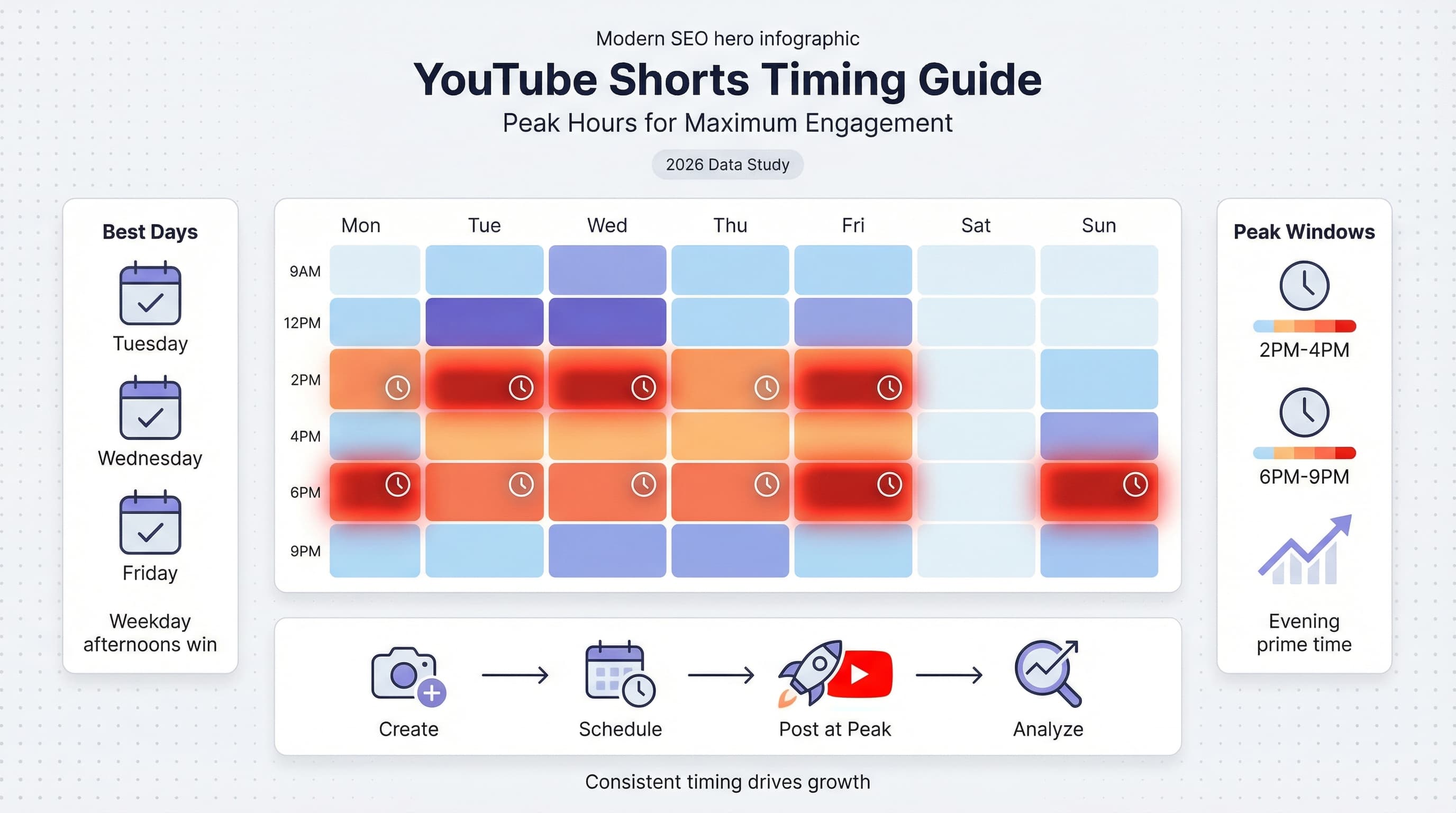
The best times to post YouTube Shorts are weekday mornings (8-10am) and evenings (5-7pm) in your target audience's timezone.
- •Peak engagement: 8-10am and 5-7pm on weekdays, with Thursday and Friday performing best
- •Weekend afternoons (12-3pm) work well for entertainment and lifestyle content
- •Check YouTube Analytics for your specific audience's active hours
- •Schedule Shorts at optimal times with Schedulala for $9/month across 12 platforms
YouTube Shorts gets over 70 billion daily views. Your Short could be one of them, or it could disappear into the algorithm's void within seconds.. Check out YouTube scheduling for more details.
The difference often comes down to timing. Post when your audience is actively scrolling, and the algorithm gives you a fighting chance. Post when they're asleep or busy, and even brilliant content struggles to gain traction.. Check out batch content creation for more details.
We analyzed posting patterns and engagement data from thousands of Shorts creators to find the actual best times to post. Not generic advice recycled from 2020 blog posts, but specific windows that work in 2026's competitive landscape.. Check out bluesky content ideas 50 for more details.
Try Schedulala for free
Schedule posts to Bluesky, Twitter, and 8 other platforms from one dashboard.
Get started for free→See It in Action
This is what scheduling YouTube Shorts looks like in Schedulala
The quick answer: best times to post YouTube Shorts
If you want the condensed version, here it is. These are the highest-performing time slots across all content categories and audience demographics:. Check out scheduling across platforms for more details.
| Day | Best Time (EST) | Second Best | Engagement Level |
|---|---|---|---|
| Monday | 6:00 PM - 9:00 PM | 12:00 PM - 2:00 PM | High |
| Tuesday | 2:00 PM - 4:00 PM | 7:00 PM - 9:00 PM | Very High |
| Wednesday | 3:00 PM - 6:00 PM | 9:00 PM - 11:00 PM | Very High |
| Thursday | 12:00 PM - 3:00 PM | 7:00 PM - 9:00 PM | High |
| Friday | 5:00 PM - 7:00 PM | 9:00 PM - 11:00 PM | Very High |
| Saturday | 9:00 AM - 11:00 AM | 7:00 PM - 10:00 PM | Moderate |
| Sunday | 10:00 AM - 12:00 PM | 5:00 PM - 8:00 PM | Moderate |
These times work because they align with natural content consumption patterns. People check their phones during lunch breaks, after work, and during evening wind-down time. The algorithm notices when your content gets immediate engagement and pushes it to more users.. Check out best time to post on youtube for more details.
How the YouTube Shorts algorithm handles timing
YouTube's recommendation system for Shorts works differently than the main video algorithm. Understanding these differences helps explain why timing matters so much for short-form content.. Check out youtube line break generator for more details.
The first-hour velocity test
When you publish a Short, YouTube shows it to a small test audience, usually people who've watched your content before and users who engage with similar topics. What happens in the first 60 minutes heavily influences whether your Short gets wider distribution.
If that initial audience watches the full video, likes it, comments, or shares it, YouTube interprets this as a signal to show it to more people. If they scroll past or stop watching after two seconds, the algorithm assumes the content isn't worth promoting.
This is why posting when your audience is active matters more for Shorts than for long-form videos. A regular YouTube video can slowly build momentum over days or weeks. Shorts need to prove themselves fast.
The Shorts feed placement system
Unlike the main YouTube homepage where videos compete based on complex ranking factors, the Shorts feed operates more like a slot machine. Users swipe through content rapidly, and YouTube's goal is to keep them swiping.
Your Short competes against every other Short published around the same time. Post at 3:00 AM when few creators are publishing, and you might face less competition, but your target audience isn't there to watch. Post at peak hours with more competition, and you have more potential viewers ready to engage.
The data shows that higher competition during peak hours is worth it. The increased viewer availability more than compensates for having more competing content.
Day-by-day breakdown with specific strategies
Each day of the week has its own engagement patterns. Here's what the data shows, along with strategies to maximize each day's potential.
Monday: the slow start
Mondays consistently show the lowest engagement rates of the workweek. People are catching up on emails, attending meetings, and generally not in leisure mode. Morning posts (before 11:00 AM) perform particularly poorly.
The exception is the evening window from 6:00 PM to 9:00 PM EST. By this point, people have finished their workday and are looking for entertainment. Monday evening Shorts that offer escapism, humor, or quick entertainment see strong performance.
Avoid posting educational or serious content on Monday evenings. Viewers want light material to decompress from their week's rough start. Save your tutorials and how-to content for mid-week.
The lunch window (12:00 PM to 2:00 PM) works as a secondary option. Workers scrolling during their break engage with snackable content, though completion rates tend to be lower than evening posts.
Tuesday: the engagement sweet spot
Tuesday afternoons are gold for Shorts creators. The data shows a significant engagement spike between 2:00 PM and 4:00 PM EST that persists across virtually every content category.
This makes sense when you think about typical work patterns. By Tuesday, people have handled their Monday backlog and settled into their routine. The mid-afternoon slump hits, and short-form video becomes an attractive distraction.
Educational content performs exceptionally well on Tuesdays. Viewers are in problem-solving mode and actively seeking information. If you create tutorials, tips, or how-to Shorts, Tuesday is your day.
The evening window (7:00 PM to 9:00 PM) provides a reliable secondary option. Engagement is slightly lower than the afternoon peak but still well above average.
Wednesday: consistency wins
Wednesday shows the most consistent engagement throughout the day. There's no dramatic morning dip or single peak hour. Instead, engagement steadily builds from around noon and stays elevated until 11:00 PM.
The prime window is 3:00 PM to 6:00 PM EST. This catches viewers during the afternoon work lull and follows them through their commute (many people watch Shorts while taking public transit or waiting for appointments).
Wednesday is the best day to test new content formats or topics. The consistent engagement provides reliable data about what's working. If a Short performs well on Wednesday, it's likely a strong concept. If it flops, the timing probably isn't the issue.
Late evening posts (9:00 PM to 11:00 PM) work surprisingly well on Wednesdays. This appears to be a second wave of viewers who've finished their evening activities and are scrolling before bed.
Thursday: the preview effect
Thursday engagement patterns suggest viewers are already in weekend mindset. Lighter, entertainment-focused content outperforms educational material by a wider margin than any other weekday.
The lunch window (12:00 PM to 3:00 PM EST) is particularly strong on Thursdays. Extended lunch browsing seems more common as the week winds down and workers mentally check out earlier.
If you're building toward a weekend content push, Thursday is ideal for teaser or preview Shorts. Drop hints about Saturday content, share behind-the-scenes clips, or post condensed versions of longer videos you plan to release.
Evening engagement (7:00 PM to 9:00 PM) remains solid but shows more variance than other weekdays. Thursday night activities, whether going out or staying in for TV premieres, compete for attention.
Friday: the entertainment peak
Friday is the best day for entertainment, comedy, and lifestyle content. Viewers are in celebration mode, and they want content that matches their energy. Serious or educational Shorts often underperform on Fridays.
The sweet spot is 5:00 PM to 7:00 PM EST. People have finished work (or are pretending to work while scrolling) and are ready for weekend content. This window catches the transition from work mode to leisure mode.
Late Friday nights (9:00 PM to 11:00 PM) show strong engagement, likely from people who stayed in and are looking for entertainment. This window works particularly well for gaming, music, and pop culture content.
Avoid Friday mornings. Engagement is notably lower than other mornings, possibly because people are wrapping up work projects or traveling to weekend activities.
Saturday: the wildcard day
Saturday engagement is unpredictable. Some Saturdays show excellent performance, others are quiet. The pattern depends heavily on competing activities, weather, and seasonal events.
Morning posts (9:00 AM to 11:00 AM EST) catch people during their slower Saturday routines. Coffee browsing is real, and Shorts that feel like casual weekend content perform well in this window.
The afternoon dead zone (1:00 PM to 5:00 PM) is the worst posting window of the entire week. People are out doing Saturday activities, not watching Shorts. Avoid this window unless your content specifically targets stay-at-home audiences.
Evening engagement picks up around 7:00 PM and stays strong until 10:00 PM. Saturday night Shorts perform best when they acknowledge the weekend vibe. Relaxation content, entertainment, and light humor outperform everything else.
Sunday: the preparation day
Sunday shows a unique pattern: strong morning engagement that fades throughout the day. By Sunday evening, many viewers have mentally shifted to preparing for the week ahead.
The morning window (10:00 AM to 12:00 PM EST) is excellent for lifestyle, wellness, and motivation content. People are in self-improvement mode, planning their weeks, and open to inspiration.
The late afternoon window (5:00 PM to 8:00 PM) provides a secondary opportunity. Engagement is moderate but consistent. Content that feels like a nice way to end the weekend performs well, including relaxing videos, recaps, and light entertainment.
Avoid posting after 9:00 PM on Sundays. Engagement drops sharply as viewers prepare for bed and the upcoming week. Even strong content struggles in this window.
Adjusting for your specific audience
The times above work as general guidelines, but your specific audience might behave differently. Here's how to customize these recommendations for your situation.
Check your YouTube analytics
YouTube Studio provides data on when your subscribers are most active. Go to Analytics, then click the Audience tab. Scroll down to find "When your viewers are on YouTube."
This heat map shows hourly activity for each day of the week. Dark purple indicates peak activity, lighter colors show lower engagement. If your audience's peak times differ significantly from the general recommendations, trust your specific data.
Pay attention to how this changes over time. Audience behavior shifts seasonally and as your channel grows. Check this data monthly and adjust your posting schedule accordingly.
One limitation to note: this data shows when your current audience is active, which might not represent the new viewers you're trying to reach. Use it as one input among several, not the only factor in your decision.
Time zone considerations
The times in this article are in Eastern Standard Time (EST). If your audience is primarily in a different time zone, adjust accordingly.
For US creators targeting US audiences, EST works well because it catches East Coast viewers at optimal times while still hitting reasonable windows for West Coast viewers (three hours earlier).
International creators face more complex decisions. If your audience spans multiple continents, you might need to alternate posting times or focus on the region with the most viewers.
YouTube's analytics show viewer geography under the Audience tab. Use this data to identify your primary audience location and optimize accordingly.
Niche-specific timing
Different content categories have different peak times. Here's what the data shows for specific niches:
- Gaming: Late evening (9:00 PM to midnight) outperforms daytime by 40%
- Fitness: Early morning (6:00 AM to 8:00 AM) catches pre-workout viewers
- Finance: Tuesday and Wednesday afternoons dominate
- Cooking: Weekend mornings and weekday dinner prep time (4:00 PM to 6:00 PM)
- Beauty: Sunday evenings (self-care routine time) and weekday evenings
- Tech: Weekday afternoons when people are researching purchases
- Parenting: Very early morning and late evening (when kids are asleep)
These niche patterns sometimes override general timing recommendations. A fitness Short at 6:00 AM might outperform the same content at 4:00 PM even though the afternoon is generally a better time.
Posting frequency: how often should you post Shorts?
Timing and frequency work together. Posting at the perfect time once a month won't build an audience. Here's what the data suggests about optimal posting cadence.
The minimum effective dose
Creators who post at least three Shorts per week show significantly better growth than those posting less frequently. This appears to be a threshold effect, as going from one to three weekly posts creates a bigger impact than going from three to five.
The reason is probably algorithmic. Regular posting signals to YouTube that you're an active creator worth promoting. Sporadic posting makes the algorithm uncertain about whether to invest recommendation space in your content.
Three posts per week is achievable for most creators without burning out. Spread them across your best-performing days rather than posting three times on Monday and nothing the rest of the week.
The daily posting question
Should you post Shorts every day? The data is mixed. Daily posters do see more total views, but views per Short often decrease. You're trading depth for breadth.
For new creators trying to find their audience, daily posting accelerates learning. You get more data points about what works, and the algorithm has more opportunities to show your content to the right viewers.
For established creators, daily posting can dilute quality and lead to burnout. Most successful Shorts creators land somewhere between three and five posts per week, focusing on quality over quantity.
The exception is trending topics or viral moments. When something relevant to your niche is trending, daily posts (or even multiple daily posts) can capture attention while the topic is hot.
Spacing your posts
If you're posting multiple Shorts per day, space them at least four hours apart. Posting two Shorts within an hour forces them to compete against each other for the same audience attention.
The ideal spacing is different peak windows on the same day. Post one Short at lunch and another in the evening, or morning and late night if those work for your niche.
Never post all your weekly content on the same day. Even if Sunday is your production day, schedule posts throughout the week to maintain consistent presence.
The scheduling approach for consistent posting
Manually posting at optimal times requires you to be available during those windows. For most creators, this isn't sustainable. Scheduling solves this problem.
Why scheduling outperforms manual posting
Scheduled posts go live at exactly the right moment, regardless of what you're doing. Your 4:00 PM Wednesday post happens whether you're in a meeting, commuting, or completely forgot it was Wednesday.
This consistency compounds over time. Viewers start to expect your content at certain times, increasing the likelihood they'll be watching when you post. The algorithm learns your schedule and can better predict who to show your content to.
Scheduling also enables batch creation. Spend one focused session making multiple Shorts, then schedule them across the week. This is more efficient than context-switching between creation and posting multiple times.
Setting up your posting schedule
Start with three posts per week at these times: Tuesday at 3:00 PM EST, Thursday at 1:00 PM EST, and Friday at 6:00 PM EST. This baseline catches multiple peak windows without overwhelming your production capacity.
As you gather data, adjust based on what your analytics show. Maybe your audience prefers Wednesday over Thursday, or your niche performs better in evening windows. Let the data guide refinements.
Use a scheduling tool that allows you to queue content in advance. Having a week's worth of Shorts ready to post reduces stress and ensures consistency even during busy periods.
Common timing mistakes that kill Shorts performance
Knowing what to avoid is as valuable as knowing what to do. These mistakes consistently appear in underperforming Shorts strategies.
Posting at random times
Some creators post whenever they finish editing, regardless of the time. This approach leaves performance to chance. A great Short posted at 2:00 AM will struggle against mediocre content posted at 4:00 PM.
The fix is simple: finish your Short, then schedule it for the next optimal window. Even waiting a few hours to hit a better posting time can significantly impact performance.
Random posting also makes it impossible to identify what's working. If every Short goes live at a different time, you can't tell whether poor performance was due to timing, content, or something else.
Ignoring time zones
A creator based in California posting at 9:00 AM local time is actually posting at noon EST, which catches the East Coast lunch crowd. But if they think they're hitting morning viewers, they might misinterpret their data.
Always think in terms of your audience's time zone, not your own. If you're in London targeting US viewers, your "afternoon" is their morning. Convert times before scheduling.
YouTube analytics shows when your viewers are active, and this data is displayed in your local time zone. Use this to understand when your specific audience is watching, then schedule accordingly.
Chasing trends at wrong times
When a trending topic emerges, creators rush to post related content. But posting a trending topic Short at 11:00 PM because you just finished it often underperforms posting it at 3:00 PM the next day.
Trends last longer than people think. Unless it's a breaking news moment that will be irrelevant in hours, waiting for the next optimal posting window usually produces better results than immediate posting.
The exception is truly time-sensitive content, like live event reactions or breaking news. For these, immediacy beats optimal timing. But most "trending" content has a window of days, not hours.
Weekend over-reliance
New creators often assume weekends are best because people have free time. The data shows the opposite. Weekday afternoons and evenings consistently outperform Saturday and Sunday.
Weekends have more competition from real-world activities. People are socializing, running errands, or engaged in hobbies. Their phone scrolling time decreases.
Use weekends for secondary content or experimental posts, but put your best Shorts on Tuesday through Friday when engagement peaks.
Copying competitors without context
Seeing a competitor post at a specific time doesn't mean that time works. They might be making a mistake, testing a new approach, or have a different audience than yours.
If you want to learn from competitors, track their posting times against performance over several weeks. Look for patterns in their successful content, not just their posting habits.
Better yet, focus on your own data. Your audience might behave differently than theirs, even in the same niche.
Advanced timing strategies for faster growth
Once you've mastered the basics, these advanced approaches can further optimize your Shorts performance.
The double-post strategy
Some creators post the same Short twice: once during a secondary window to test performance, then again during prime time if it shows promise. YouTube doesn't penalize duplicate content in Shorts the way it does for regular videos.
This approach works because the Shorts algorithm treats each post somewhat independently. A Short that flopped at 10:00 AM might take off at 6:00 PM, reaching an entirely different audience segment.
Use this sparingly. Your subscribers might see both posts, which can feel repetitive. Reserve it for content you're confident in but want to maximize reach.
Event-based timing
Major events create predictable engagement spikes. The Super Bowl, award shows, product launches, and cultural moments all drive increased platform activity.
Plan content around these events and post during the buildup or immediately after. A Short about Super Bowl predictions posted Sunday morning before the game catches peak interest. A reaction Short posted during the halftime show catches people checking their phones.
Create a calendar of events relevant to your niche and plan your posting schedule around them. This proactive approach beats scrambling to react after the moment passes.
Seasonal adjustments
Optimal posting times shift throughout the year. Summer months show later engagement peaks as people stay out longer. Winter months see earlier evening engagement as people stay home.
Back-to-school season changes family viewing patterns. Holiday periods compress normal schedules. Daylight saving time shifts throw off established routines for a week or two.
Review your analytics quarterly and adjust your posting schedule for seasonal patterns. What worked in January might not work in July.
Series timing
If you create Shorts series (parts one, two, three, etc.), post them at consistent times. Viewers who enjoyed part one will know when to expect part two.
Space series posts 24 to 48 hours apart. This gives each Short time to gain traction while keeping the series momentum going. Posting all parts on the same day fragments your audience across multiple videos.
Consider using a cliffhanger or "part two tomorrow" call-to-action to drive return viewers. The anticipation increases the likelihood of immediate engagement when the next part drops.
Measuring whether your timing is working
Data should drive your timing decisions. Here's what to track and how to interpret it.
Key metrics to watch
Views matter, but they're a lagging indicator. Focus first on these early signals:
- First-hour views: How many views did you get in the first 60 minutes? This indicates whether you hit an active audience.
- View velocity: Are views increasing, steady, or declining? Good timing produces an upward curve in the first few hours.
- Average view duration: Did people watch the whole Short? Timing affects who sees your content first, which affects completion rates.
- Like-to-view ratio: Higher ratios suggest you reached an engaged audience segment.
- Comment timing: Comments within the first hour indicate you reached active, engaged viewers.
Running timing experiments
To genuinely understand what works for your channel, run controlled experiments. Post similar content (same format, topic, quality level) at different times and compare results.
Run each test for at least two weeks to account for natural variance. A single post can over or underperform due to random factors. Multiple posts reveal patterns.
Document everything in a spreadsheet: date, time, topic, views at 1 hour, views at 24 hours, engagement metrics. Patterns will emerge that are specific to your audience.
Putting it all together: your action plan
Here's a concrete plan to optimize your YouTube Shorts posting times, starting today.
Week one: establish your baseline
Post three Shorts this week at Tuesday 3:00 PM EST, Thursday 1:00 PM EST, and Friday 6:00 PM EST. Track performance for each using the metrics above.
Check your YouTube analytics to see when your current audience is active. Note any significant differences from the general recommendations.
Set up a scheduling system so you can post consistently without being manually present at each posting time.
Weeks two and three: test variations
Keep one posting time constant (your control) and experiment with the others. Try Wednesday instead of Thursday, or evening instead of afternoon.
Track everything in a spreadsheet. Note the time, day, topic, and all relevant metrics. Look for patterns emerging.
If certain times consistently underperform, stop using them. If certain times consistently outperform, increase your posting during those windows.
Week four and beyond: optimize and scale
By now you should have data showing your personal optimal times. Adjust your schedule based on what you've learned.
Consider increasing posting frequency if you have the content capacity. Move from three to four or five posts per week, using your proven best times.
Continue monitoring and adjusting. Audience behavior changes over time, especially as your channel grows and attracts new viewer segments.
Try Schedulala for free
Schedule posts to Bluesky, Twitter, and 8 other platforms from one dashboard.
Get started for free→![Best Time to Post on Instagram [2026 Data Study]](/_next/image?url=%2Fblog%2Fbest-time-to-post-instagram%2Fheader.jpeg&w=3840&q=75&dpl=dpl_6RiKV7dz1EjMEbYgqheh1pc2YPwv)