Bluesky Bio Ideas: 25 Examples That Convert Followers Into Fans
Need Bluesky bio ideas? Here are 25 proven examples that grab attention and convert profile visitors into engaged followers.

Quick answer
Write a Bluesky bio that converts by leading with what you do, adding personality, and including a link to your website or content.
- •Bluesky bios have a 256-character limit, so every word needs to count
- •Lead with your value proposition, not your job title
- •Include relevant keywords since Bluesky search indexes profiles
- •Schedule consistent Bluesky content with Schedulala for $9/month across 12 platforms
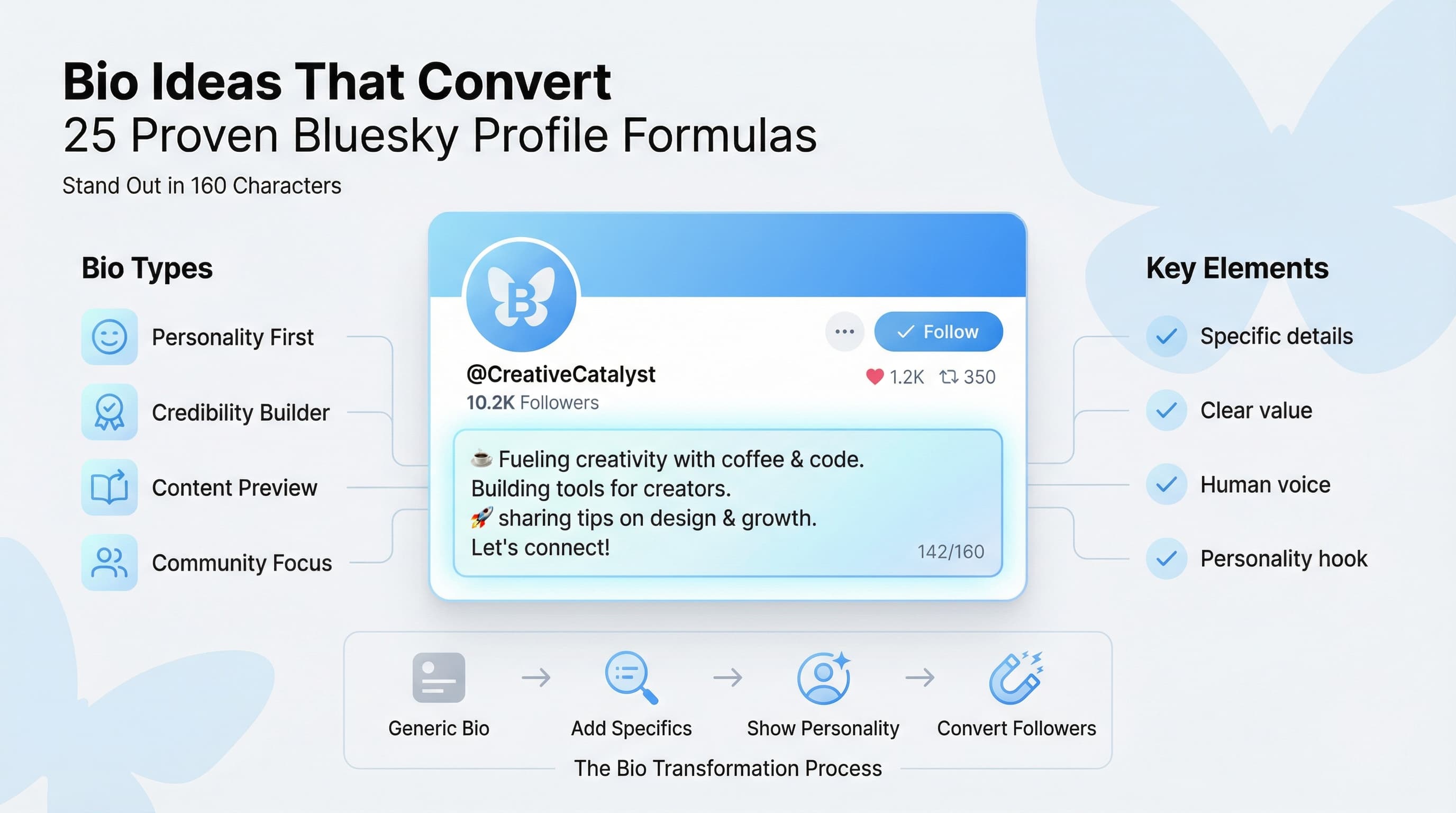
Your Bluesky bio is doing more work than you think. In 160 characters or less, it has to explain who you are, why someone should care, and give them a reason to hit that follow button. Try our Bluesky scheduling.
See It in Action
This is what scheduling a Bluesky post looks like in Schedulala
Most people treat their bio like an afterthought. They slap together a job title and maybe a hobby, then wonder why their follower count stays flat. See our youtube shorts ideas 100 guide.
The bios that actually convert? They're intentional. They're specific. And they often break the "rules" that everyone else follows. Our how to repurpose content can help.
I've analyzed hundreds of high-performing Bluesky profiles to find what separates forgettable bios from ones that make people instantly click follow. Here are 25 bio formulas that work, with real examples you can adapt for your own profile. Learn more about bluesky content ideas 50.
Try Schedulala for free
Schedule posts to Bluesky, Twitter, and 8 other platforms from one dashboard.
Get started for free→Why your Bluesky bio matters more than you think
Before we get into the examples, let's talk about why this tiny piece of text carries so much weight. Learn more about bluesky font generator.
When someone lands on your Bluesky profile, they've already shown interest. Maybe they liked something you said, or someone they follow interacted with your post. They're curious. Your bio is the deciding factor between "eh, not for me" and "this person seems interesting.". Try our bluesky line break generator.
On Bluesky specifically, the culture tends to reward authenticity over polish. The platform grew from people fleeing the corporate feel of other social networks. That means your bio should feel like a real person wrote it, not a marketing department.
A good Bluesky bio does three things: it tells people what you're about, it gives them a reason to care, and it hints at your personality. Miss any of these, and you're leaving followers on the table.
The "What I Do" bios
Let's start with the straightforward approach. These bios lead with what you actually do, but they do it with enough specificity to stand out from generic job titles.
1. The specific niche expert
Example: "I help SaaS companies write emails that don't get deleted. 47% average open rates. Dad jokes enthusiast."
Why it works: Instead of "email marketer" or "copywriter," this bio specifies the exact niche (SaaS), the exact deliverable (emails), and backs it up with a concrete number. The dad jokes line adds personality without trying too hard.
Adapt it by: Replacing the niche and metric with your own. If you don't have metrics yet, use the number of clients served, years of experience, or projects completed. "500+ blog posts for B2B tech companies" works just as well.
2. The problem solver
Example: "Your website is confusing people. I fix that. UX designer who talks like a human."
Why it works: It starts with a problem the reader might have, positions you as the solution, and adds a personality differentiator. The line "talks like a human" subtly criticizes other designers who hide behind jargon.
Adapt it by: Identifying the core problem you solve and stating it bluntly. Don't soften it. "Your spreadsheets are a mess. I organize them." Direct beats diplomatic on Bluesky.
3. The unexpected combination
Example: "Lawyer by day, sourdough obsessive by night. I post about contracts and carbs."
Why it works: The contrast creates intrigue. Two seemingly unrelated interests make you memorable. It signals that you're a real person with a life outside work, which matters on a platform built on genuine connection.
Adapt it by: Finding your own unexpected pairing. The further apart they seem, the better. "Accountant who does stand-up comedy" or "Data scientist and amateur beekeeper."
4. The anti-title
Example: "I don't know what a 'growth hacker' is either. I help startups get more customers. That's it."
Why it works: It calls out industry BS, which resonates with Bluesky's somewhat cynical-of-corporate-speak user base. The self-deprecating humor builds trust, and the simple explanation of what you do is refreshing.
Adapt it by: Picking a buzzword in your industry that annoys you and rejecting it. Then say what you actually do in plain English.
Bluesky bios don't support line breaks in the same way some platforms do. Use periods or vertical bars (|) to create visual separation between ideas. "Writer | Runner | Terrible cook" reads cleaner than a run-on sentence.
The personality-first bios
These bios prioritize voice and vibe over credentials. They work especially well for personal accounts, creators, and anyone whose personality is their brand.
5. The honest self-assessment
Example: "Chronically online. Opinions about fonts that no one asked for. Trying to read more books."
Why it works: It's relatable and unpretentious. The "chronically online" admission is honest (anyone on Bluesky probably is), the font opinions signal a creative field without being boring about it, and the reading goal shows self-improvement without being preachy.
Adapt it by: Admitting something mildly unflattering about yourself, sharing a weird passion, and mentioning a current goal. The combination feels human.
6. The running joke
Example: "I have strong opinions about semicolons and I'm not sorry. Editor. Cat person. Will die on grammar hills."
Why it works: It commits to a bit. The semicolon thing is specific enough to be funny, and "will die on grammar hills" suggests entertaining future content about language debates.
Adapt it by: Picking something small that you care way too much about and owning it. "I have feelings about PowerPoint transitions" or "Will argue about pizza toppings."
7. The anti-bio
Example: "Still figuring it out. Posts may include: design stuff, my dog, complaints about software."
Why it works: It's disarmingly honest. Most bios try to project confidence and expertise. This one admits uncertainty, which can actually build more trust. The "posts may include" format sets expectations without being boring.
Adapt it by: Starting with an honest admission of uncertainty, then giving a quick preview of your content mix. It works best if you genuinely post varied content.
8. The list of obsessions
Example: "Currently obsessed with: mechanical keyboards, sci-fi book covers from the 70s, and making the perfect omelette."
Why it works: "Currently obsessed with" is more engaging than "I like." It suggests passion and implies your interests evolve. The specific details (70s sci-fi covers, not just "sci-fi") make it memorable.
Adapt it by: Listing three current obsessions with as much specificity as possible. "Coffee" is boring. "Third-wave Ethiopian pour-overs" is interesting.
9. The one-liner
Example: "I peaked in 2019."
Why it works: It's bold, funny, and leaves people curious. Single-line bios only work if the line is genuinely good, but when they hit, they hit hard. This one got the account I found it on thousands of followers.
Adapt it by: This is high-risk, high-reward. Don't force a one-liner if you don't have a great one. But if you can distill your vibe into one memorable sentence, it can be incredibly effective.
The credibility builders
Sometimes you need to establish expertise. These bios build trust without sounding like a LinkedIn summary.
10. The social proof drop
Example: "Wrote that article about AI art that went viral. Now I write more stuff. Newsletter has 12k readers."
Why it works: It leads with a specific achievement that people might recognize, then grounds it with a concrete number. The casual tone ("more stuff") keeps it from sounding braggy.
Adapt it by: Referencing your most recognizable work or achievement, then following with a relevant metric. If you don't have viral content, use "Featured in [Publication]" or "Trusted by [Notable Client]."
11. The humble brag done right
Example: "Somehow convinced Harvard Business Review to publish me. I write about remote work and pretend I know things."
Why it works: The credible publication name is there, but the framing ("somehow convinced") adds self-deprecation. The "pretend I know things" line is charming and makes the impressive credit feel more approachable.
Adapt it by: Taking your most impressive credential and undermining it slightly with humor. The credential still registers, but you don't come across as insufferable.
12. The experience qualifier
Example: "20 years in advertising. Survived 4 recessions and countless bad ideas. Now I consult."
Why it works: The time frame establishes expertise, and "survived" implies wisdom earned through difficulty. It tells a mini-story of career evolution that makes you seem seasoned without being old and out of touch.
Adapt it by: Using your years of experience but pairing it with something that shows you've seen things. "10 years in startups. Watched 3 fail, helped 2 exit" is more interesting than "10 years of startup experience."
13. The before-and-after
Example: "Former burnout victim. Now I help founders work less and actually enjoy their companies."
Why it works: The transformation narrative is compelling. It shows you understand the problem from the inside and positions your current work as the solution you wish you'd had.
Adapt it by: Identifying a struggle your audience faces that you've overcome, then connecting it to what you do now. "Former terrible public speaker" or "Recovered overthinker" can both work.
On Bluesky, people are generally skeptical of empty credentials. "Award-winning" means nothing without context. "Best-selling" has been watered down. If you're going to mention achievements, be specific. "Won a Webby in 2022" beats "award-winning designer."
The content preview bios
These bios focus on telling people exactly what they'll get if they follow you. Great for building an audience around specific topics.
14. The content menu
Example: "Here for: photography tips, gear reviews, and the occasional sunrise photo that took way too long to edit."
Why it works: It sets clear expectations. Someone interested in photography knows exactly what they're signing up for. The self-aware joke about editing time adds personality.
Adapt it by: Listing 2-3 content categories you consistently post about, then adding one personal or funny element to round it out.
15. The value proposition
Example: "I break down complex tax stuff so you don't have to google it at 2am. CPA with too many opinions."
Why it works: The benefit to the reader is immediate and clear. The "2am google" detail is relatable to anyone who's been confused about taxes (everyone). It positions you as the person who makes hard things easy.
Adapt it by: Identifying the midnight-panic-search your audience does and positioning yourself as the solution. "So you don't have to [painful thing]" is a great formula.
16. The teaching promise
Example: "Teaching myself to code in public. Follow along for wins, fails, and tutorials that assume you know nothing."
Why it works: "Learning in public" builds community. People love following a journey. The promise of beginner-friendly content removes intimidation for new followers who want to learn too.
Adapt it by: If you're learning something, document it. If you're already expert-level, promise content that meets people where they are. "No jargon, just answers" type energy.
17. The curator
Example: "I read 100+ newsletters so you don't have to. Weekly roundups of the best marketing thinking. Founder @CompanyName."
Why it works: Curation is valuable. If you can position yourself as a filter for a firehose of content, people will follow for the convenience. The specific number (100+) makes it credible.
Adapt it by: Identifying information overload in your niche and positioning yourself as the person who sorts through it. "I test every new productivity app so you don't have to" or "I watch every Apple keynote and summarize the 3 things that matter."
The community builder bios
These bios focus on connection over personal brand. They work well for people who want to build community rather than just broadcast.
18. The conversation starter
Example: "Ask me about starting a podcast with zero budget. I made every mistake so you don't have to. DMs open."
Why it works: It invites interaction. "Ask me about" is an explicit invitation that lowers the barrier to starting a conversation. Mentioning DMs are open signals you're accessible.
Adapt it by: Picking a topic you genuinely enjoy helping people with and inviting questions about it. Then actually respond when people ask.
19. The niche identifier
Example: "Connecting indie game devs with players who actually appreciate their work. Also, I review cozy games."
Why it works: It positions you as a connector within a specific community. This attracts both game devs and players who fit that niche. The "cozy games" detail adds specificity and warmth.
Adapt it by: Identifying the specific corner of the internet you want to bring together and naming it explicitly. "For people who love analog photography in a digital world" type framing.
20. The inside joke
Example: "If you know, you know. (It's about mechanical pencils.) Engineer at Day Job."
Why it works: Inside jokes create instant belonging for people who get it. The parenthetical explanation includes outsiders while still maintaining the joke. It signals "my people will find me."
Adapt it by: Referencing something that only your target audience would understand, then deciding whether to explain it. Either can work depending on how niche you want to go.
The professional-personal hybrid bios
These bios balance work and life, which tends to perform well on Bluesky where purely professional content often falls flat.
21. The work-life split
Example: "Product designer @ Figma. Outside work: trail running, bad pottery, and strong opinions about snacks."
Why it works: The employer name provides credibility, but the personal interests show you're more than a job title. "Bad pottery" is endearing because it shows you try things without needing to be good at them.
Adapt it by: Leading with your professional credential, then pivoting to personal interests with similar energy to your work content. The interests should feel authentic, not curated for impressiveness.
22. The time-based split
Example: "9-5: making spreadsheets at a Fortune 500. Evenings: writing a newsletter about leaving Fortune 500s."
Why it works: The contrast creates narrative tension. It hints at a journey (wanting to leave corporate) that people might want to follow. It's also honest about still being in the day job, which is relatable.
Adapt it by: Showing the gap between where you are and where you're going. It works especially well if you're building something on the side.
23. The role + reality
Example: "CEO, which mostly means answering emails and wondering if I'm doing this right. Building @StartupName."
Why it works: It deflates the impressive title with reality. Most founders feel like they're figuring it out as they go, and admitting that builds trust with other founders and employees alike.
Adapt it by: Taking your job title and following it with what you actually do day-to-day, especially if it's less glamorous than the title implies.
The creative format bios
These bios play with format to stand out. Use with caution, because gimmicks only work if the content behind them is solid.
24. The review format
Example: "★★★★☆ 'Knows too much about fonts for their own good. Would follow again.' - my mom, probably"
Why it works: The fake review format is unexpected and memorable. The self-deprecating content and fake attribution ("my mom") keep it from feeling try-hard.
Adapt it by: Writing a fake review of yourself that's funny but also communicates something true about your content. Don't give yourself 5 stars. That's the joke.
25. The loading screen
Example: "Loading personality... 87% complete. In the meantime: designer, dog parent, recovering perfectionist."
Why it works: The tech metaphor is clever, and "loading" suggests you're a work in progress, which is disarmingly honest. The backup info ensures people still know what you're about.
Adapt it by: Using a format reference from your industry (progress bar, recipe format, code comment) but making sure it actually contains real information about you.
Creative formats are memorable when done well but cringe when done poorly. If you're not sure yours is landing, test it with a friend first. And don't force a format just to be different. A solid straightforward bio beats a clever-but-confusing one every time.
How to pick the right bio style for you
With 25 options, you might be wondering which approach fits your situation. Here's a quick framework.
If you're building a personal brand around expertise, lean toward the credibility builders or content preview styles. Your bio should establish why you're worth listening to on your topic.
If you're just on Bluesky to be social and connect with interesting people, the personality-first bios will serve you better. You don't need to prove anything. You just need to seem like someone worth talking to.
If you're representing a business or building an audience for professional reasons, the professional-personal hybrids strike the right balance. Pure corporate bios don't work on Bluesky, but you can still be professional while showing personality.
If you're a creator or building a community, the content preview and community builder styles help set expectations and attract the right followers.
| Your Goal | Best Bio Styles | Key Elements |
|---|---|---|
| Build thought leadership | Credibility builders, Content preview | Specific achievements, clear topic focus |
| Make friends and connections | Personality-first, Community builders | Humor, relatability, conversation invites |
| Grow a professional audience | Hybrid bios, Value proposition | Credential + personality balance |
| Promote a business/product | Problem solver, Niche expert | Clear value prop, specific audience |
| Document a journey | Teaching promise, Before-and-after | Transparency, progress, invitation to follow along |
Common Bluesky bio mistakes to avoid
Before you write your new bio, here are the patterns that consistently underperform.
The empty buzzword bio
"Passionate entrepreneur | Thought leader | Making the world a better place" tells people absolutely nothing. What kind of entrepreneur? Thought leader in what? How are you making anything better? Every word in your bio should carry specific meaning.
The resume dump
"MBA from Wharton | Former McKinsey | Harvard BA | Board member at 3 non-profits" might impress on LinkedIn, but on Bluesky it comes across as status-seeking. If your credentials matter, weave them in naturally, but don't lead with a list of achievements.
The vague mystery
"I write things." Cool. What things? For whom? Why should I care? Vagueness isn't intriguing. It's just confusing. People won't follow you hoping to figure out what you're about. They'll just leave.
The copy-paste bio
If your Bluesky bio is identical to your Twitter, LinkedIn, and Instagram bios, you're probably not serving any platform well. Each platform has its own culture. On Bluesky, you can be less polished and more personality-forward than on LinkedIn.
The outdated info
"Working on my next book" hits different when your last book came out in 2019 and there's been no update since. Keep your bio current, or use evergreen language that won't age poorly.
Beyond the bio: making your whole profile work
Your bio is one part of the equation. To really convert profile visitors into followers, everything needs to work together.
Your display name should be readable and recognizable. If you go by a nickname or brand name, use that. If you're building professional credibility, your real name usually works better. Avoid cute substitutions like "J0hn Sm1th" that make you hard to search for.
Your profile photo matters more than you'd think. Faces outperform logos for personal accounts. Good lighting beats perfect styling. And please, no tiny group photos where people have to squint to figure out which one is you.
Your banner image is often overlooked but can reinforce your bio. A photographer might use a stunning shot they took. A writer might include a quote from their work. A founder might show their product. Or you can skip it entirely. A solid color or simple pattern is better than a cluttered mess.
Your pinned post functions as an extended bio. Use it to link to your best work, your newsletter signup, or whatever you want new visitors to see first. Update it when you have something new worth highlighting.
Pull up your Bluesky profile on your phone (where most people will see it). Read your bio out loud. Does it sound like a real person? Does it make you want to follow yourself? If you cringe or get bored, it's time for a rewrite.
Writing your bio: a step-by-step approach
If you're staring at a blank bio field, here's a process that works.
First, write down three things: what you do (or want to be known for), what makes your perspective different, and one personal detail that shows you're a human with interests.
Second, draft five versions of your bio. Seriously, five. Don't settle on your first attempt. Try different structures from the examples above. See which feels most natural when you read it out loud.
Third, cut anything generic. "Passionate about" can almost always be deleted. Same with "Love to" and "Enthusiast." Replace them with specific details or cut them entirely.
Fourth, test your bio with a friend who doesn't know you well. Ask them what they'd expect you to post about based on your bio. If their answer surprises you, your bio isn't communicating clearly.
Fifth, publish it and revisit in a month. See if your actual posts match what your bio promises. If there's a disconnect, update accordingly.
The bottom line on Bluesky bios
Your Bluesky bio won't make or break your presence on the platform. But a good one removes friction. It answers the "should I follow this person?" question quickly and clearly.
The best bios I've seen share a few qualities: they're specific rather than vague, they sound like a real person wrote them, and they give you a reason to care.
Pick one of the 25 formulas above that fits your situation, adapt it to your voice, and don't overthink it. You can always change it later. The important thing is to have something better than the generic placeholder you wrote when you first signed up.
A converting Bluesky bio is specific, personality-forward, and sets clear expectations for what you'll post about. Pick a formula that matches your goals, make it unmistakably you, and keep it fresh as your presence evolves.
Try Schedulala for free
Schedule posts to Bluesky, Twitter, and 8 other platforms from one dashboard.
Get started for free→