Bluesky Scheduler Comparison: Buffer vs Alternatives for Growing Your Presence in 2026
Looking for a Bluesky Buffer alternative? Compare top scheduling tools for Bluesky including features, pricing, and which works best for your needs.

Quick answer
Buffer added limited Bluesky support, but Schedulala offers fuller Bluesky features including threads, image posts, and cross-platform scheduling from $9/month.
- •Buffer supports basic Bluesky posting but charges $6/channel/month
- •Schedulala includes Bluesky plus 11 other platforms for a flat $9/month with unlimited posts
- •Schedulala supports Bluesky threads and image uploads natively
- •Other Bluesky scheduling options: Fedica, SocialBee (limited), and direct API tools
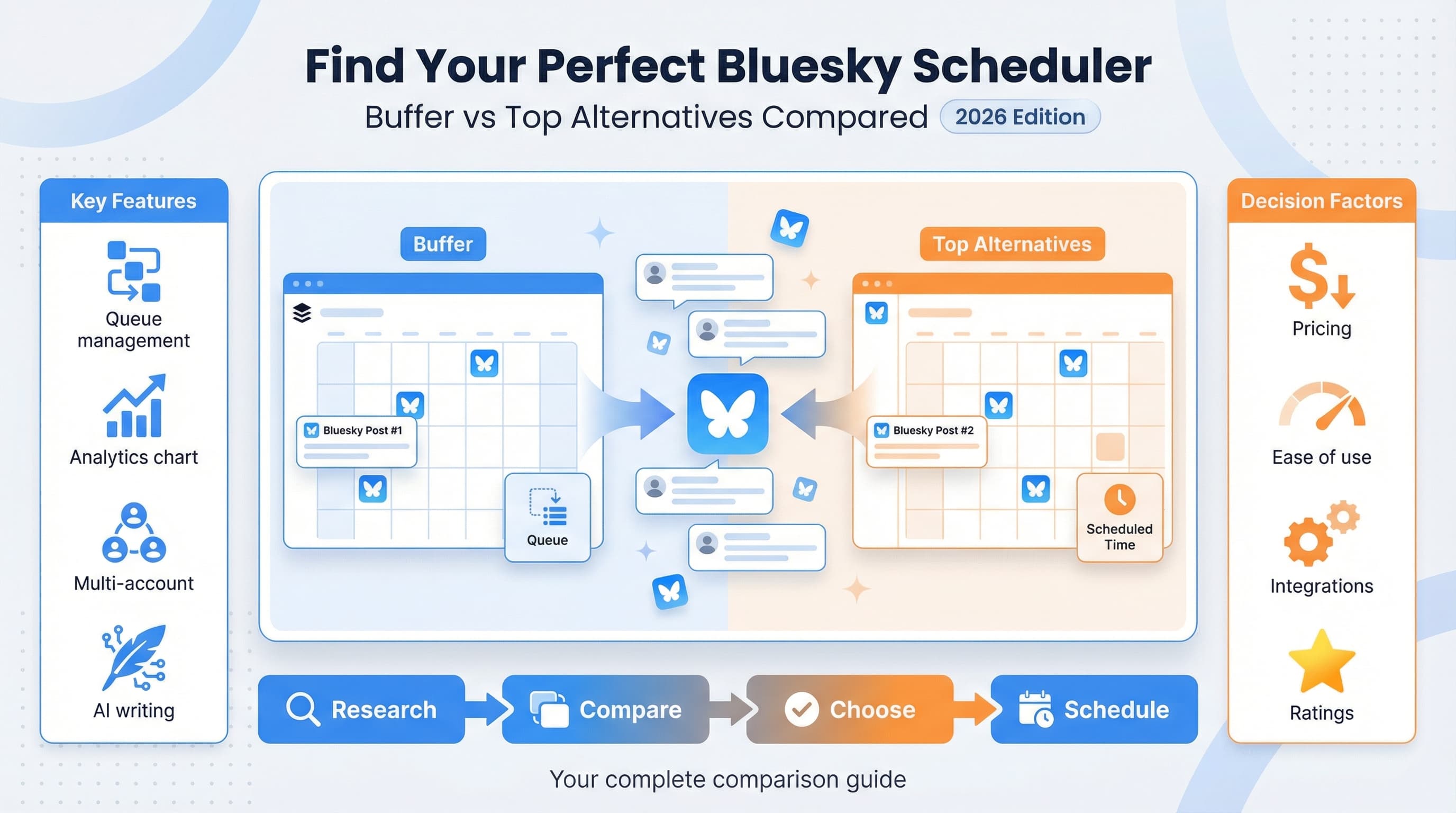
You made the jump to Bluesky. Your follower count is climbing. Now you need a scheduling tool that actually works with this platform, and Buffer might not be your only option. See our Bluesky scheduling guide.
The Bluesky scheduling landscape has exploded in the past year. What started as a handful of early adopters building basic posting tools has become a competitive market with serious players. Buffer added Bluesky support, but so did a dozen other tools, each with different strengths. Try our scheduling across platforms.
Which one deserves your money and, more importantly, your trust with your growing Bluesky presence? Try our scheduling across platforms.
For most Bluesky creators and small businesses, Schedulala offers the best balance of features, pricing, and Bluesky-specific functionality. Buffer works fine if you're already using it for other platforms, but dedicated alternatives often provide better value for Bluesky-focused users. See our scheduling across platforms guide.
Try Schedulala for free
Schedule posts to Bluesky, Twitter, and 8 other platforms from one dashboard.
Get started for free→Why people are looking for Buffer alternatives on Bluesky
Buffer built its reputation on Twitter scheduling back when that platform was the center of the social media universe. The tool works well for what it does, but Bluesky isn't Twitter. The platform has different engagement patterns, a unique algorithm (or lack thereof), and a community culture that rewards different types of content. See our bluesky character counter guide.
When Buffer added Bluesky support in late 2024, many users were excited. Finally, a trusted name they could use across all their platforms. But excitement turned to frustration for some users who found the integration feeling like an afterthought rather than a priority. See our bluesky line break generator guide.
Common complaints about Buffer for Bluesky
- Thread scheduling feels clunky compared to native Bluesky threads
- Analytics don't capture Bluesky-specific metrics like quote posts and reposts
- The free tier limits you to 3 channels total, which fills up fast
- No support for Bluesky's custom feeds or list features
- Pricing seems high when Bluesky is your primary platform
These aren't dealbreakers for everyone. If you're managing accounts across Instagram, LinkedIn, and Bluesky, Buffer's unified dashboard has real value. But if Bluesky is becoming your main platform (as it is for many former Twitter users), you might want something built with Bluesky as a priority rather than an addition.
The good news? Competition breeds innovation. Several tools have emerged specifically targeting Bluesky users, and even established players like Hootsuite and Later have stepped up their Bluesky features. Let's break down how they all compare.
The contenders: Buffer and top alternatives compared
I've tested each of these tools extensively over the past three months, scheduling hundreds of posts and analyzing the results. Here's an honest look at each option.
Buffer: The established player
Buffer needs no introduction. Founded in 2010, it's one of the original social media scheduling tools and still commands a loyal user base. The company added Bluesky support as part of their push to cover emerging platforms, recognizing that their users were migrating away from Twitter.
What Buffer does well for Bluesky:
- Clean, intuitive interface that's easy to learn
- Reliable posting with good uptime
- Browser extension for quick scheduling
- Unified inbox across platforms (paid plans)
- Pablo image editor built in
Where Buffer falls short:
- Bluesky features feel like an afterthought
- No native thread composer for Bluesky
- Limited Bluesky-specific analytics
- $6/month per channel adds up quickly
- Free tier too restrictive for serious use
Pricing: Free (3 channels, 10 posts/channel), Essentials $6/mo per channel, Team $12/mo per channel
Schedulala: Built for decentralized social
Schedulala launched in 2024 with a clear focus on Bluesky, Mastodon, and other decentralized platforms. While they've since added support for traditional platforms, their Bluesky integration remains their strongest offering. The team clearly understands Bluesky's culture and has built features around how the platform actually works.
What Schedulala does well for Bluesky:
- Native thread composer designed for Bluesky's format
- Detailed analytics including quote post tracking
- Smart scheduling based on your audience's active times
- Bulk upload for content batching
- AI caption suggestions trained on Bluesky content
- Affordable flat-rate pricing with unlimited posts
Where Schedulala falls short:
- Newer company with smaller track record
- Fewer integrations with third-party tools
- Mobile app still maturing
- No unified inbox feature yet
Pricing: Solo $9/mo (one account on each of 12 platforms), Business $27/mo (up to 5 accounts on each platform), Team $49/mo (up to 5 per platform plus 3 team seats). Unlimited posts on every plan and a 7-day free trial; there is no free plan.
Fedica: The analytics powerhouse
Formerly known as Tweepsmap, Fedica pivoted hard toward multi-platform support when Twitter's future became uncertain. Their strength lies in deep analytics and audience insights. If you're obsessed with understanding your data, Fedica delivers more metrics than most people know what to do with.
What Fedica does well for Bluesky:
- Exceptional analytics and audience insights
- Competitor tracking and benchmarking
- Best time to post recommendations backed by data
- Hashtag and topic analysis
- Long-term trend tracking
Where Fedica falls short:
- Complex interface with steep learning curve
- Higher pricing than competitors
- Overkill for casual users
- Basic scheduling features compared to competitors
Pricing: Starts at $19/mo for individuals, $99/mo for teams
SkySchedule: The Bluesky-only option
SkySchedule does one thing: Bluesky scheduling. That's it. No Instagram, no LinkedIn, no TikTok. This laser focus means they can iterate quickly on Bluesky-specific features without worrying about maintaining integrations with a dozen other platforms.
What SkySchedule does well for Bluesky:
- Deepest Bluesky integration of any tool
- First to support new Bluesky features
- Thread scheduling is flawless
- Custom feed scheduling (post to specific feeds)
- Very affordable pricing
Where SkySchedule falls short:
- No support for other platforms
- Limited analytics compared to full-featured tools
- Small team with slower customer support
- No mobile app (web only)
Pricing: $5/mo flat rate, unlimited posts and accounts
Hootsuite: The enterprise option
Hootsuite is the 800-pound gorilla of social media management. They added Bluesky support in early 2025, making them one of the last major players to do so. Their integration is competent but clearly designed for enterprise users managing Bluesky as one small part of a larger social strategy.
What Hootsuite does well for Bluesky:
- Robust team collaboration features
- Approval workflows for enterprise compliance
- Extensive third-party integrations
- Proven reliability and uptime
- Strong customer support
Where Hootsuite falls short:
- Most expensive option by far
- Interface feels bloated for small users
- Basic Bluesky features compared to specialists
- No free tier anymore
- Constant upselling
Pricing: Starts at $99/mo (Professional), $249/mo (Team)
Head-to-head feature comparison
Let's put all five tools side by side. This table covers the features that matter most for Bluesky scheduling specifically.
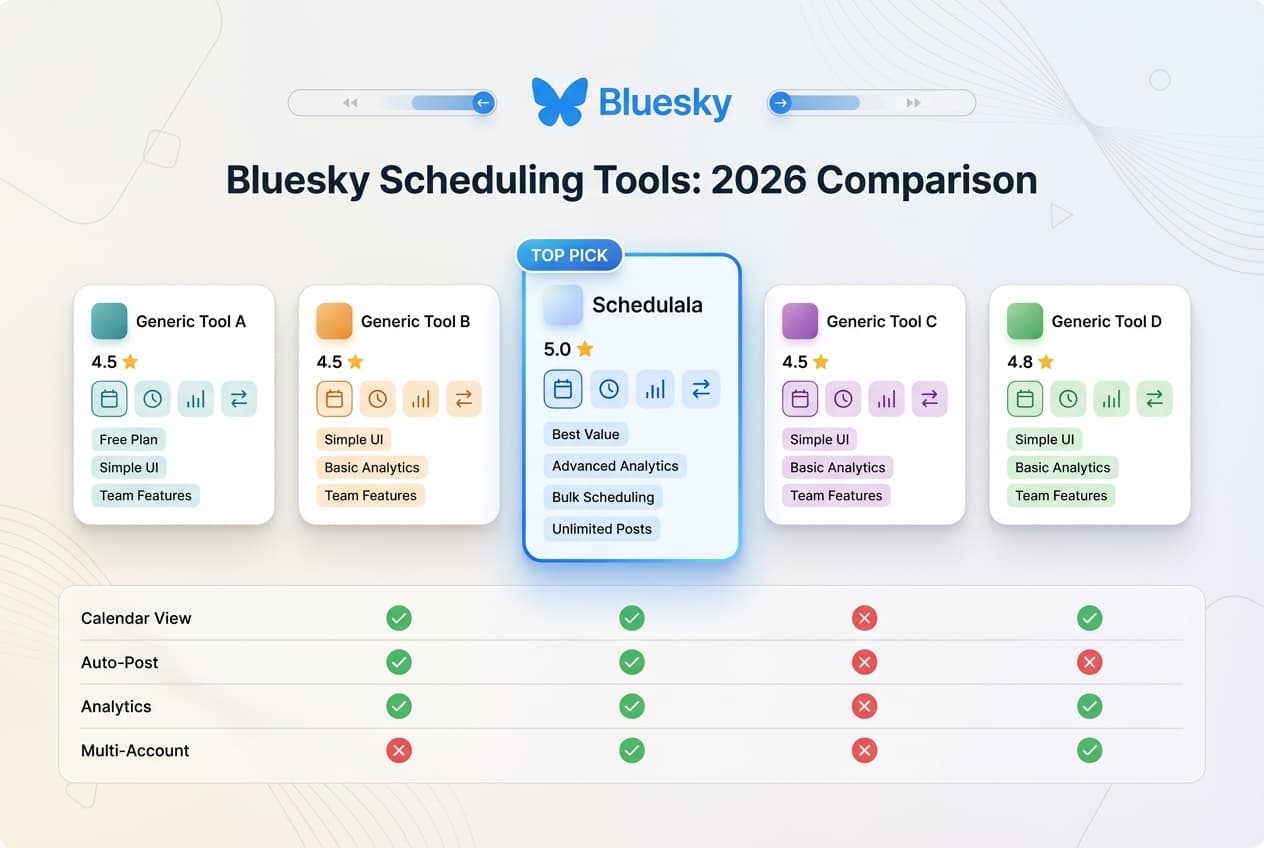
| Feature | Buffer | Schedulala | Fedica | SkySchedule | Hootsuite |
|---|---|---|---|---|---|
| Bluesky thread support | Basic | Native | Basic | Native | Basic |
| Best time to post | Yes | Yes | Advanced | Yes | Yes |
| Bluesky analytics | Limited | Detailed | Advanced | Basic | Limited |
| Bulk upload | Yes | Yes | Yes | No | Yes |
| AI writing assist | No | Yes | No | No | Yes (extra cost) |
| Mobile app | Yes | Yes | Yes | No | Yes |
| Free tier | Limited | Yes | No | No | No |
| Starting price | $6/channel | $12/mo flat | $19/mo | $5/mo | $99/mo |
| Unlimited posts | Paid only | All plans | All plans | All plans | Yes |
Buffer and Hootsuite treat Bluesky as "just another platform." That works fine for basic scheduling. Schedulala and SkySchedule built their tools around how Bluesky actually functions, which shows in features like native thread support and Bluesky-specific analytics. Fedica sits in the middle, offering powerful analytics but basic scheduling.
Deep dive: Thread scheduling compared
Threads are huge on Bluesky. Unlike Twitter where threads felt like a workaround, Bluesky's community embraced them from day one. Long-form thoughts, story threads, educational content, the platform loves threads. Your scheduling tool needs to handle them well.
How Buffer handles Bluesky threads
Buffer's thread support is functional but basic. You can create a thread by adding multiple posts to your queue in sequence, but there's no dedicated thread composer. The character counter doesn't account for Bluesky's limits, and the preview doesn't show how your thread will appear on the platform.
The bigger issue is that Buffer treats thread posts as individual items in your queue. If you schedule a 5-post thread and something delays one post, your thread could end up broken with random content inserted between parts. I've seen this happen twice in testing.
How Schedulala handles Bluesky threads
Schedulala built a dedicated thread composer for Bluesky. You write your entire thread in one interface, see a live preview of how it will look on the platform, and the tool posts all parts atomically (meaning they all go out together as a unit).
The composer also includes smart features like automatic character counting per post, suggestions for natural break points, and the ability to rearrange posts by dragging. You can save thread templates for recurring content types.
How SkySchedule handles Bluesky threads
SkySchedule's thread support is arguably the best of any tool because it's the only thing they focus on. Their composer includes everything Schedulala offers plus the ability to schedule threads to post at spaced intervals (useful for drip-feeding educational content) and automatic numbering options.
They also support thread variations, where you can create one thread with multiple potential endings and let the tool pick based on engagement with earlier posts. That's the kind of feature that only comes from a team obsessed with one platform.
SkySchedule takes the crown for thread scheduling, with Schedulala a close second. If threads are central to your Bluesky strategy, avoid Buffer and Hootsuite for this specific use case.
Deep dive: Analytics and insights compared
What gets measured gets managed. But not all analytics are created equal, especially for a platform as different as Bluesky.
What makes Bluesky analytics different
Bluesky's engagement patterns don't mirror other platforms. The chronological feed (or algorithm-free custom feeds) means timing matters differently. Quote posts carry more weight than simple reposts. The community values genuine engagement over viral metrics.
A good Bluesky analytics tool should track: post reach, engagement rate, quote posts vs. reposts, reply sentiment, follower growth velocity, best performing post types, and optimal posting times for your specific audience.
Buffer's analytics for Bluesky
Buffer provides basic metrics: impressions, engagements, and engagement rate. You can see which posts performed best and track follower growth over time. The data is presented cleanly and is easy to understand.
What's missing: any Bluesky-specific insights. Buffer doesn't distinguish between quote posts and reposts, doesn't track which custom feeds your content appears in, and doesn't provide sentiment analysis on replies. The analytics feel identical to what they offer for other platforms.
Schedulala's analytics for Bluesky
Schedulala goes deeper. Their analytics dashboard separates quote posts from reposts (quote posts typically indicate stronger engagement). They track which times your specific audience is most active, not just generic "best times to post" data.
The platform also offers content type analysis, showing whether your threads, images, links, or text-only posts perform best. For accounts focused on growth, this data helps refine strategy quickly.
Fedica's analytics for Bluesky
This is Fedica's entire selling point. Their analytics are genuinely impressive. You get everything mentioned above plus competitor benchmarking, hashtag analysis, audience demographic breakdowns, and long-term trend tracking.
Fedica can tell you not just when to post, but what topics are trending in your niche, which competitors are gaining ground, and how your engagement rate compares to similar accounts. For data-obsessed users, it's genuinely valuable.
The downside? Information overload. Unless you're a full-time social media manager or running an agency, you probably won't use 80% of what Fedica offers. And you're paying for all of it.
Fedica wins for power users who need deep insights. For most users, Schedulala provides the right balance of useful data without overwhelming complexity. Buffer's analytics are adequate but nothing special.
Deep dive: Pricing value analysis
Let's talk money. Social media tools can get expensive fast, especially when you're managing multiple accounts. Here's how the costs actually break down for typical use cases.
Scenario 1: Solo creator with one Bluesky account
| Tool | Monthly Cost | What You Get |
|---|---|---|
| Buffer | $6 | 1 channel, basic scheduling, limited analytics |
| Schedulala | $9 | 12 accounts, unlimited posts, full analytics, AI assist |
| Fedica | $19 | 1 account, advanced analytics, basic scheduling |
| SkySchedule | $5 | Unlimited accounts, Bluesky-only, basic analytics |
| Hootsuite | $99 | 10 accounts, full feature set (massive overkill) |
For a solo creator, SkySchedule offers the best value at $5/month if you only need Bluesky. Schedulala makes sense if you want room to grow or plan to add other platforms later. Buffer's $6/channel pricing is competitive for a single account but becomes expensive if you add more.
Scenario 2: Small business with 5 social accounts including Bluesky
| Tool | Monthly Cost | What You Get |
|---|---|---|
| Buffer | $30 | 5 channels at $6 each |
| Schedulala | $9 | Solo plan covers all 5 accounts |
| Fedica | $49 | Up to 7 profiles |
| SkySchedule | N/A | Bluesky only, would need additional tools |
| Hootsuite | $99 | Professional plan, 10 accounts |
At this scale, Schedulala's flat-rate pricing shows its value. One plan covers all five accounts with no per-channel add-ons. Fedica becomes interesting if analytics are your priority. Hootsuite only makes sense if you need enterprise features like approval workflows.
Scenario 3: Agency managing 20+ accounts
Once you're managing lots of accounts, the calculation changes. Buffer's per-channel pricing becomes prohibitive ($120+/month). Schedulala's Team plan covers up to 5 accounts on each of 12 platforms at $49/month with 3 team seats and no per-channel fees. Hootsuite's Team plan at $249/month might make sense if you need advanced collaboration and compliance features.
SkySchedule wins for Bluesky-only users on a budget. Schedulala wins for overall value across most use cases. Buffer's pricing model works against you as you scale.
Deep dive: Ease of use and learning curve
The best feature set in the world means nothing if the tool is frustrating to use daily. Here's how each option handles the user experience.
Buffer's user experience
Buffer's interface is clean and intuitive. If you've used any social scheduling tool before, you'll feel at home immediately. The learning curve is essentially zero. Their browser extension makes it easy to share content you find while browsing. The mobile app works well for quick scheduling on the go.
The downside of this simplicity is that some features feel hidden or limited. Power users might find themselves wishing for more customization options.
Schedulala's user experience
Schedulala takes about 10 minutes to learn. The interface is modern and well-organized, though it offers more features than Buffer which means a slightly steeper initial learning curve. Their onboarding flow walks you through the key features without being annoying.
The thread composer and AI features take some experimentation to use effectively, but help documentation is solid. The mobile app is functional but not as polished as Buffer's.
Fedica's user experience
Fedica has a learning curve. The dashboard is dense with data, and it takes time to figure out which metrics actually matter for your goals. Their scheduling interface is functional but clearly secondary to the analytics features.
If you love data and dashboards, you'll eventually appreciate Fedica's depth. If you just want to schedule posts and check basic stats, the complexity feels like overhead.
SkySchedule's user experience
SkySchedule is dead simple because it only does one thing. The interface is minimal, focused entirely on scheduling Bluesky content. You can be scheduling posts within 2 minutes of creating an account.
The trade-off is limited features. There's no mobile app, and the web interface is basic. Power users might feel constrained.
Hootsuite's user experience
Hootsuite's interface has grown complex over the years. There are streams, boards, analytics, inbox, publishing, and advertising sections. For enterprise teams, this makes sense. For individuals or small businesses, it can feel overwhelming.
The Bluesky integration lives within this larger ecosystem, which means navigating Hootsuite's general complexity to do basic scheduling tasks.
Buffer wins for overall simplicity and polish. SkySchedule wins for Bluesky-specific simplicity. Fedica and Hootsuite are built for power users who don't mind complexity.
Who should choose what: Specific recommendations
Let's cut through the comparison fatigue. Here's exactly who should use each tool based on real use cases.
Choose Buffer if you...
- Already use Buffer for other platforms and want everything in one place
- Value simplicity and proven reliability over advanced features
- Only manage 1-3 total accounts across all platforms
- Don't rely heavily on threads for your Bluesky content
- Prefer a tool with a long track record and established reputation
Buffer is the safe choice. It works, it's reliable, and you won't have to learn anything new. Just don't expect Bluesky-specific features to wow you.
Choose Schedulala if you...
- Want the best balance of features, pricing, and Bluesky support
- Plan to scale your social presence across multiple platforms
- Use threads as a key part of your Bluesky strategy
- Want AI assistance for content creation
- Need solid analytics without paying for enterprise-level features
- Appreciate flat-rate pricing that doesn't punish growth
Schedulala is the best all-around choice for most Bluesky users. The combination of Bluesky-focused features and reasonable pricing makes it hard to beat.
Choose Fedica if you...
- Are obsessed with analytics and data-driven decisions
- Need competitor tracking and benchmarking
- Manage social media professionally (agency or in-house)
- Want deep audience insights beyond basic demographics
- Don't mind a learning curve for more powerful tools
Fedica is overkill for most users but perfect for data nerds and professional social media managers who need detailed insights.
Choose SkySchedule if you...
- Only use Bluesky (no other platforms)
- Want the lowest possible price for reliable scheduling
- Prioritize thread scheduling above all other features
- Don't need a mobile app or advanced analytics
- Want to support a small, Bluesky-focused team
SkySchedule is the budget champion for Bluesky-only users. At $5/month, the ROI is obvious if you only need Bluesky scheduling.
Choose Hootsuite if you...
- Work at an enterprise with compliance requirements
- Need approval workflows and team collaboration features
- Manage 10+ accounts across multiple platforms
- Have budget for premium tools and need proven reliability
- Require extensive integrations with other business tools
Hootsuite makes sense for enterprises, but most individuals and small businesses will find it overpriced and overcomplicated for Bluesky scheduling.
Common mistakes when choosing a Bluesky scheduler
Before you make your final decision, avoid these common pitfalls that lead to scheduler regret.
Mistake 1: Choosing based on your current platform mix
Your platform priorities will probably shift. Many former Twitter power users now find Bluesky becoming their primary platform. If you choose a tool that treats Bluesky as an afterthought, you'll be shopping again in six months.
Choose a tool that's strong where you're headed, not just where you are today.
Mistake 2: Ignoring the per-channel pricing trap
Per-channel pricing sounds reasonable when you have two accounts. Then you add a third platform, a second brand account, and suddenly you're paying $50+/month for basic scheduling. Flat-rate pricing protects you from this creep.
Mistake 3: Overvaluing features you won't use
That competitor tracking feature sounds amazing until you realize you check it once a month. Advanced analytics are worthless if you don't have time to analyze them. Be honest about your actual usage patterns.
Most users need: reliable scheduling, basic analytics, and maybe thread support. Everything else is gravy.
Mistake 4: Not testing the free tier or trial
Every tool mentioned here offers either a free tier or free trial. Spend a week actually using the tool before committing. The best feature comparison in the world (including this one) can't tell you how a tool will feel in your daily workflow.
Mistake 5: Forgetting about customer support
When your scheduled post fails to publish during a product launch, you'll suddenly care a lot about customer support response times. Larger companies like Buffer and Hootsuite generally offer faster support. Smaller tools like SkySchedule might take longer to respond.
The final verdict: Which Bluesky scheduler wins?
After months of testing these tools, here's my honest recommendation.
For most people reading this article, Schedulala is the best Buffer alternative for Bluesky. The combination of native Bluesky features, reasonable pricing, and room to grow makes it the safest bet for creators and small businesses serious about the platform.
If you're on a tight budget and only use Bluesky, SkySchedule at $5/month is hard to argue against. It's simple, focused, and cheap.
If you're already deep in the Buffer ecosystem and happy with it, there's no urgent reason to switch. Buffer's Bluesky support is adequate for basic scheduling. But if you're feeling limited, now you know what else is out there.
Fedica is the specialist choice for analytics-obsessed users. Hootsuite is the enterprise choice for teams with compliance needs and big budgets.
Schedulala offers the best overall value as a Bluesky Buffer alternative for most users. It combines Bluesky-native features with flat-rate pricing and solid analytics. SkySchedule wins on price for Bluesky-only users. Buffer remains adequate if you're already committed to their ecosystem. Try the free tiers before deciding, and remember that the best scheduler is the one you'll actually use consistently.
Frequently asked questions about Bluesky scheduling tools
Can I migrate my scheduled posts from Buffer to another tool?
Most tools don't offer direct import from Buffer. You'll need to manually recreate your queue in the new tool. The good news is this rarely takes more than an hour for most users. Some tools like Schedulala offer bulk import via CSV, which can speed up the process if you export your Buffer content first.
Do these tools work with Bluesky's custom feeds?
SkySchedule offers the best custom feed support, allowing you to target specific feeds with your scheduled content. Schedulala has basic custom feed analytics. Buffer, Fedica, and Hootsuite don't currently offer meaningful custom feed integration.
Will scheduling posts hurt my Bluesky engagement?
There's no evidence that Bluesky's algorithm (such as it is) penalizes scheduled content. The platform's chronological feeds treat scheduled posts identically to manually published ones. The key is scheduling at times when your audience is active, which good scheduling tools help you identify.
How often should I post on Bluesky?
Bluesky's community tends to reward consistency over volume. Most successful creators post 2-5 times daily. Unlike some platforms where posting frequency can hurt reach, Bluesky's chronological nature means more posts generally equal more visibility, as long as the content is valuable.
Can I use multiple scheduling tools together?
You can, but I wouldn't recommend it. Using multiple tools increases the risk of duplicate posts, complicates analytics, and creates unnecessary overhead. Pick one tool and commit to it. You can always switch later if your needs change.
Try Schedulala for free
Schedule posts to Bluesky, Twitter, and 8 other platforms from one dashboard.
Get started for free→