How to Repurpose Content Across Social Platforms
Learn how to repurpose social media content across multiple platforms. Step-by-step guide with templates to maximize reach and save time.

Quick answer
Repurpose social media content by adapting one piece of content into multiple formats for different platforms to maximize reach and save time.
- •Turn a blog post into an Instagram carousel, Twitter thread, and YouTube Short
- •Resize videos from 16:9 to 9:16 for Shorts, Reels, and TikTok
- •Adjust captions, hashtags, and tone for each platform's audience and character limits
- •Schedule repurposed content across 12 platforms with Schedulala for $9/month
You spent two hours creating that perfect Instagram post. The engagement was solid, but now what?
Most creators make one piece of content and call it done. That's leaving 80% of your potential reach on the table.
What if that single post could work across TikTok, LinkedIn, Twitter, and Pinterest without starting from scratch?
Try Schedulala for free
Schedule posts to Bluesky, Twitter, and 8 other platforms from one dashboard.
Get started for free→The content repurposing framework
The 1-to-8 rule
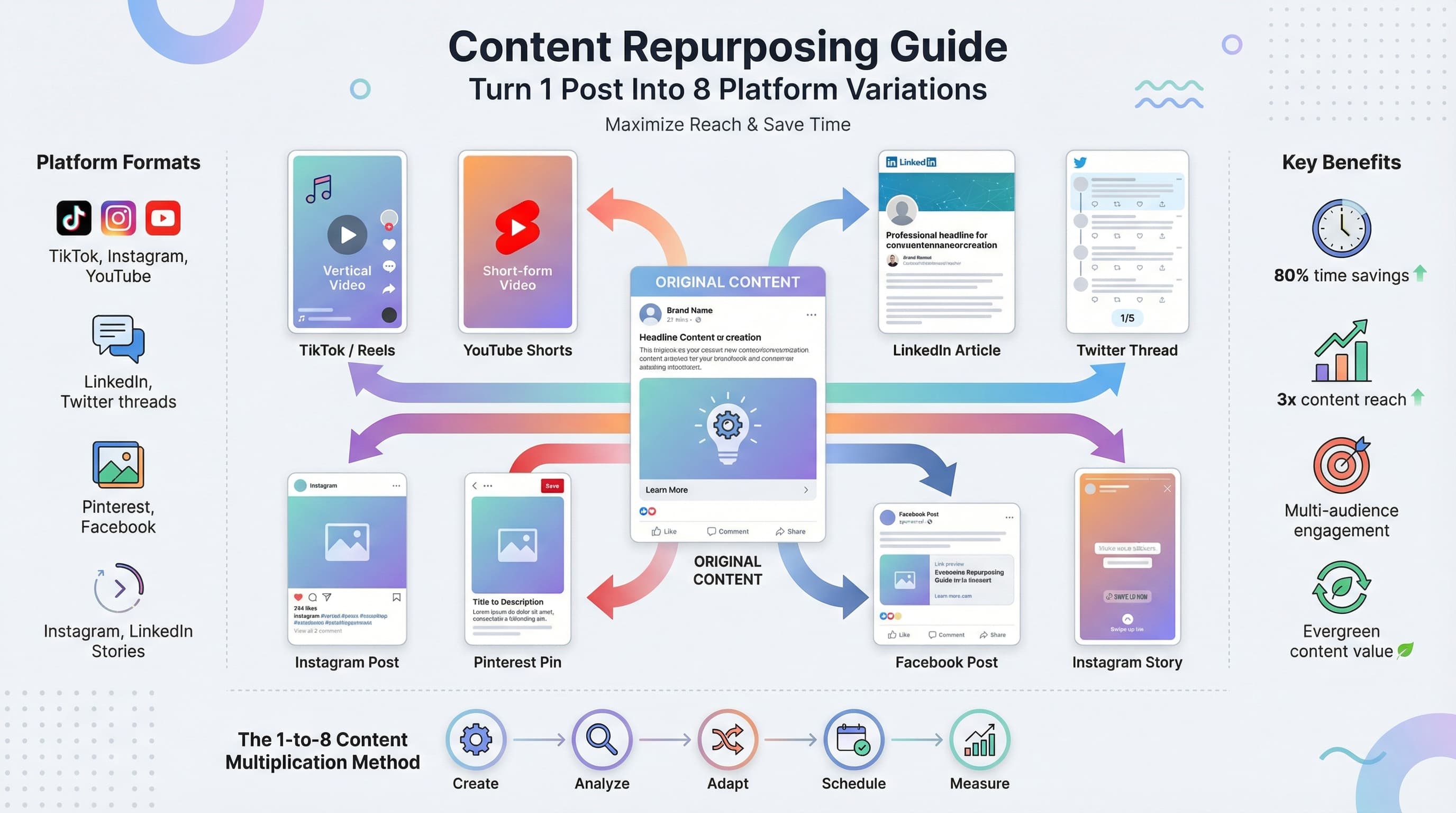
Every piece of content you create should generate at least 8 different posts across platforms. One video becomes a TikTok, Instagram Reel, YouTube Short, Twitter thread, LinkedIn article, Pinterest graphic, blog post excerpt, and email newsletter section.
The key is understanding that each platform rewards different formats and styles. Your job is adapting the core message, not recreating it.
Platform-specific adaptations
Step-by-step repurposing process
Step 1: Content audit and selection
Look at your top-performing posts from the last 3 months. Sort by engagement rate, not just total likes. A post with 500 likes and 50 comments often beats one with 1000 likes and 10 comments.
Focus on evergreen content that isn't tied to specific dates or trends. Educational posts, behind-the-scenes content, and personal stories typically work best for repurposing.
Step 2: Extract the core elements
Break down your original content into these components: main message, supporting points, visuals, call-to-action, and emotional hook. These become your raw materials for adaptation.
Write a one-sentence summary of the post's value. If you can't summarize it clearly, your audience won't understand it either.
Step 3: Platform-specific adaptation
Use this template for each platform: Hook + Value + Proof + Action. The hook changes based on platform culture, but the value remains consistent.
LinkedIn example: "After analyzing 500+ social media campaigns..." TikTok example: "Nobody talks about this social media mistake..." Same insight, different entry points.
Step 4: Content formatting
Vertical video works on TikTok, Instagram Stories, and YouTube Shorts. Square posts fit Instagram feeds and Facebook. Horizontal works for LinkedIn and Twitter video.
Text posts need platform-appropriate length. Twitter: under 280 characters. LinkedIn: 1300 characters for optimal engagement. Instagram: front-load the first line, hide details after "more."
| Platform | Ideal Length | Best Format | Key Element |
|---|---|---|---|
| TikTok | 15-60 seconds | Vertical video | Trending audio |
| 30 seconds | Reel/Carousel | Visual appeal | |
| 1-3 minutes | Native video/Text | Professional insight | |
| Under 2 minutes | Video/Thread | Conversation starter | |
| Static | Vertical graphic | Text overlay |
Advanced repurposing strategies
The content ecosystem approach
Think of your content as a web, not individual posts. A single topic becomes a pillar page on your website, multiple social posts, email sequences, and podcast episodes. Each piece reinforces the others.
Create topic clusters where 5-7 related posts all link back to one comprehensive guide. This builds authority and improves search rankings while maximizing your content investment.
Seasonal recycling
Your best content from last year can work again with minor updates. Holiday posts, year-end reviews, and seasonal tips have built-in recycling opportunities.
Track content performance by month. That post that flopped in January might crush it in June when your audience is in a different mindset.
Format transformation
Turn customer testimonials into quote graphics. Transform how-to posts into step-by-step carousels. Convert lists into video countdowns. The same information becomes fresh when the format changes.
User-generated content is particularly powerful here. A customer's Instagram story becomes your LinkedIn case study, Twitter testimonial, and email newsletter feature.
Tools and workflow optimization
Batch creation workflow
Set aside 2-3 hours monthly for batch content creation. Create all variations of your top 5 posts during this session.
Use templates for consistent formatting across platforms. Save caption templates, hashtag sets, and visual styles that work. Don't reinvent the wheel every time.
Scheduling and distribution
Space out your repurposed content. Don't post the same message on three platforms within an hour. Spread them across days or weeks to avoid audience overlap fatigue.
Use multi-platform scheduling tools to maintain consistent timing without manual posting. Plan your content calendar around peak engagement times for each platform.
Common repurposing mistakes to avoid
Copy-paste syndrome
Posting identical content across platforms kills engagement. Each platform has its own culture, audience expectations, and algorithm preferences.
What works on LinkedIn's professional audience will feel out of place on TikTok's entertainment-focused users. Adapt the tone, not just the format.
Over-repurposing quality content
Not every post deserves the full repurposing treatment. Focus on content that demonstrated clear value through engagement, saves, shares, or website traffic.
Track which repurposed content performs best. Some posts work better as single-platform content, and that's fine.
Ignoring platform-specific features
Instagram Stories, LinkedIn polls, Twitter Spaces, and TikTok effects are platform-unique opportunities. Generic content can't leverage these engagement boosters.
Build platform-specific elements into your repurposing workflow. The extra effort pays off in algorithm favor and audience engagement.
Measuring repurposing success
Key metrics to track
Compare engagement rates, not absolute numbers. A repurposed post that gets 50% of your original's engagement rate is performing well, considering it required 20% of the creation effort.
Track reach expansion across platforms. Your goal is exposing your message to net-new audiences, not just recycling to the same followers.
Content lifecycle optimization
Monitor which formats drive the most website traffic, email signups, or sales. Double down on high-converting repurposing strategies and eliminate low-performers.
Use content calendar planning to map out repurposing schedules 30-60 days in advance. This prevents last-minute scrambling and ensures consistent posting.
Your repurposing action plan
Week 1: Content audit
Review your last 3 months of content. Identify your top 10 posts by engagement rate. These become your repurposing goldmine.
Create a simple spreadsheet tracking original post, platforms shared, and performance metrics. This becomes your repurposing database.
Week 2: Template creation
Build caption templates for each platform. Include hook formulas, hashtag sets, and call-to-action variations. Templates ensure consistency while saving time.
Design visual templates for quote graphics, step-by-step carousels, and video thumbnails. Consistent branding across repurposed content builds recognition.
Week 3: Batch repurposing
Take your top 5 pieces of content and create platform-specific versions. Focus on quality adaptations rather than rushing through quantity.
Schedule these across the next month, spacing them appropriately to avoid audience fatigue while maintaining posting consistency. Our guide on bulk scheduling social media posts covers tools and techniques to upload everything in one session.
Try Schedulala for free
Schedule posts to Bluesky, Twitter, and 8 other platforms from one dashboard.
Get started for free→