Bluesky Starter Packs: The Complete Guide to Building, Finding, and Using Them
Learn how to create, discover, and use Bluesky starter packs to grow your network and help others find great accounts to follow.

Quick answer
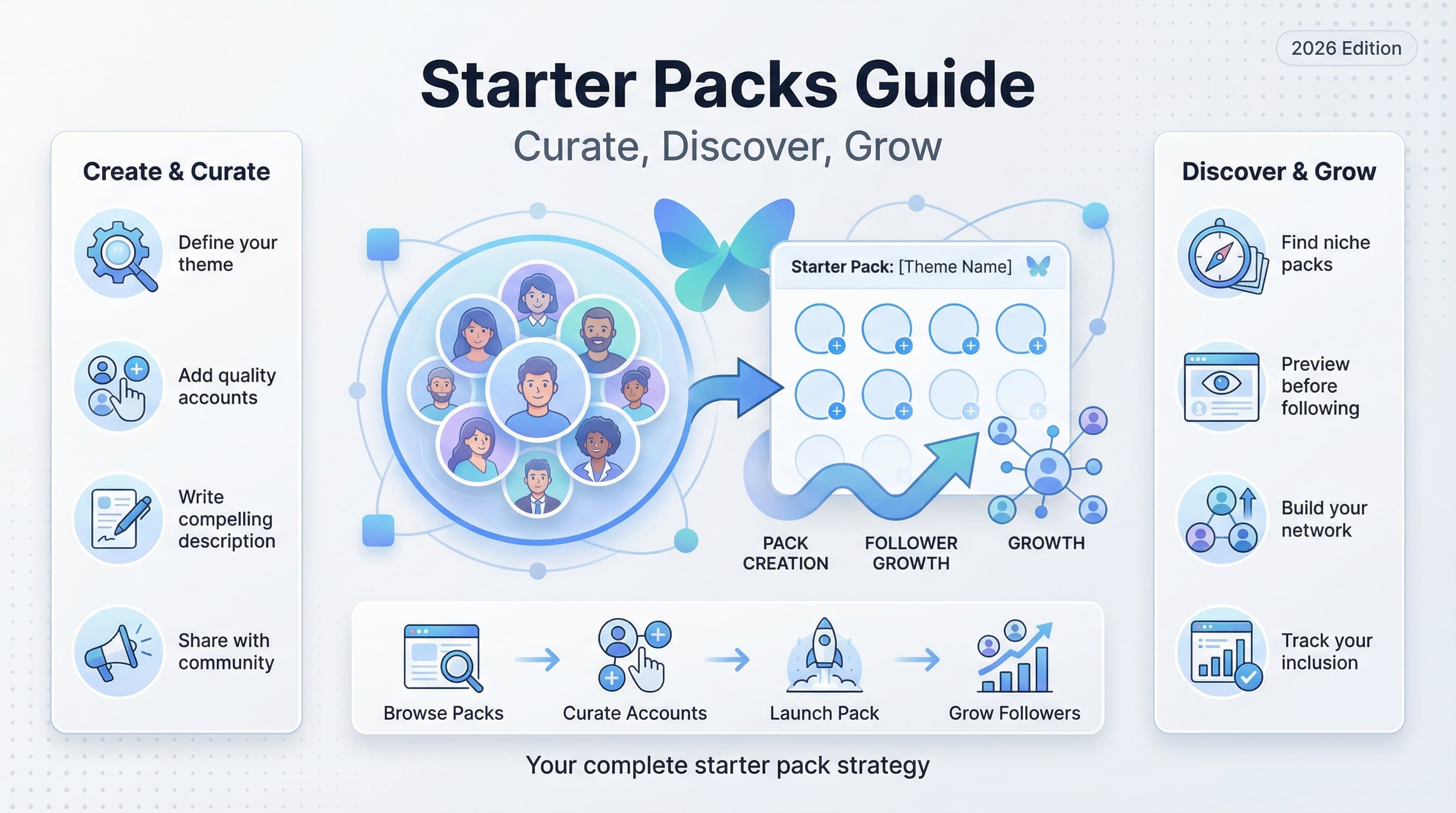
Bluesky starter packs are curated lists of accounts that new users can follow all at once to quickly build a relevant feed.
- •Anyone on Bluesky can create a starter pack with up to 150 recommended accounts
- •Starter packs appear on your profile and can be shared via link
- •Creating a niche starter pack helps you get discovered by new Bluesky users
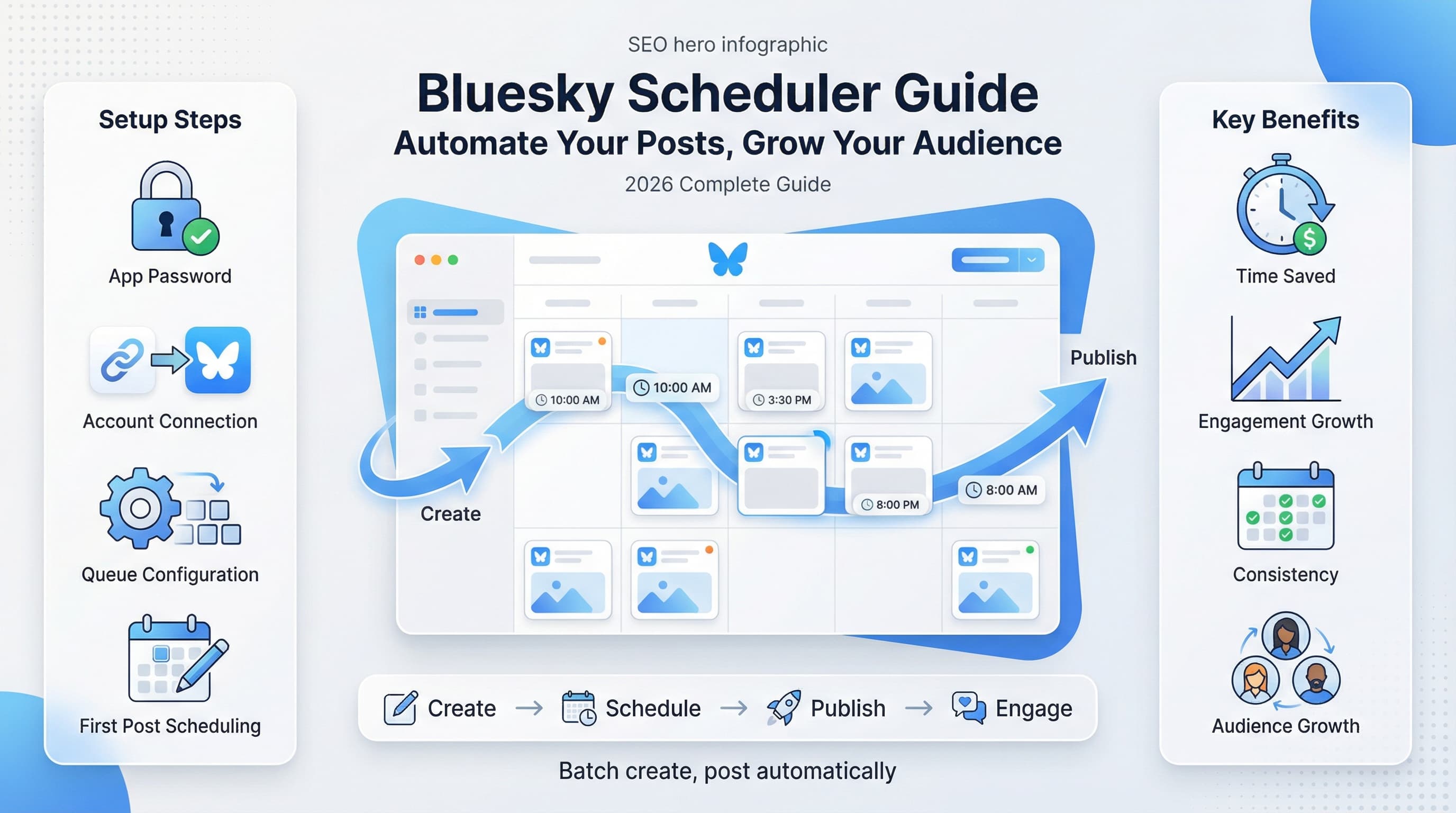
- •Schedule Bluesky posts with Schedulala for $9/month; one of the few schedulers supporting Bluesky
You just joined Bluesky and your feed is empty. You follow three people, two of them haven't posted in weeks, and you're staring at a timeline that feels like a ghost town. Sound familiar? See our Bluesky scheduling guide.
See It in Action
This is what scheduling a Bluesky post looks like in Schedulala
This is the new user experience problem that every social platform faces. And Bluesky solved it with one of the most clever features I've seen in years: starter packs. Try our scheduling across platforms.
Starter packs let anyone curate a list of accounts around a theme, making it dead simple for newcomers to find their people. But they're not just for new users. If you're a creator, a community builder, or someone who wants to help others discover great content, starter packs are a powerful tool you should be using. Try our batch content creation.
Try Schedulala for free
Schedule posts to Bluesky, Twitter, and 8 other platforms from one dashboard.
Get started for free→What exactly are Bluesky starter packs?
A starter pack is a curated collection of Bluesky accounts bundled together with a name, description, and shareable link. When someone opens that link, they see all the accounts in the pack and can follow them all with a single tap. If they don't have a Bluesky account yet, the link walks them through signup and then automatically follows everyone in the pack. Try our scheduling across platforms.
Think of starter packs like a welcome wagon for specific communities. There are starter packs for journalists, indie game developers, climate scientists, romance authors, tech podcasters, and pretty much any niche you can imagine. Each one represents someone's answer to the question: "If you're interested in X, who should you follow?". See our bluesky bio generator guide.
Why starter packs work so well
Traditional follow suggestions on social platforms are algorithmic. They show you popular accounts, accounts your friends follow, or accounts that paid for promotion. The results feel generic and often miss the mark entirely. Our bluesky line break generator can help.
Starter packs flip this model. They're human-curated, community-driven, and built around actual expertise. When a veteran science journalist creates a starter pack of trusted science communicators, that recommendation carries weight. When a longtime indie game developer bundles together the best voices in that space, newcomers get instant access to years of network-building knowledge.
The social proof is baked in. You're not following random suggestions from an algorithm. You're following a vetted list from someone who actually knows the space.
How to find starter packs worth following
Finding good starter packs takes a bit of hunting, but there are several reliable methods that'll connect you with quality curation.
Method 1: Check profile pages
Bluesky shows starter packs directly on user profiles. If someone has created a starter pack, you'll see a "Starter Packs" tab on their profile page. This is gold for discovery because you can find packs created by people you already trust.
Start with accounts you follow who are active community members in your areas of interest. Check their profiles for starter packs. Often, the most engaged users in a community have created packs to help newcomers find the same great accounts they follow.
Method 2: Search directly on Bluesky
Bluesky's search function includes starter packs. Search for terms related to your interests along with "starter pack" and you'll find packs that mention those topics in their titles or descriptions. Try searches like "climate starter pack" or "writers starter pack" to see what's available.
The search results aren't always comprehensive, but they're a good starting point. Pay attention to who created each pack and how many people have used it. Packs from established community members with high usage numbers are usually higher quality.
Method 3: External directories
Several community members have built external websites that aggregate and categorize starter packs. Blueskydirectory.com and similar sites let you browse packs by category, making discovery much easier than searching blindly.
These directories aren't official Bluesky products, but they're maintained by dedicated community members who regularly update their listings. They're particularly useful for finding packs in niche categories that might not surface easily in Bluesky's native search.
Method 4: Ask your network
Sometimes the best discovery method is the simplest one: ask. Post a question about starter packs in your area of interest and you'll often get recommendations from people who've already done the research.
Bluesky's community is generally helpful with this kind of question, especially if you're specific about what you're looking for. Instead of asking for "good starter packs," ask for "starter packs for people interested in amateur astronomy" or whatever your specific niche is.
Creating your own starter pack: step by step
Creating a starter pack is straightforward, but creating a good one takes some thought. Here's how to build a pack that people will actually want to use.
Step 1: Access the starter pack creator
On desktop, click your profile icon and select "Starter Packs" from the menu. Then click "Create a Starter Pack." On mobile, tap your profile, then tap "Starter Packs" in your profile tabs, then tap the plus button to create new.
You can create up to 20 starter packs per account. If you're deeply involved in multiple communities, this gives you room to create packs for each one without running into limits.
Step 2: Choose your theme and audience
Before adding accounts, get clear on who this pack is for. "Tech people" is too broad. "Frontend developers who post about React and CSS" is specific. "Writers" is vague. "Science fiction and fantasy authors who share publishing industry insights" is useful.
The more specific your theme, the more valuable your pack becomes. Generic packs compete with thousands of others. Niche packs serve communities that might not have many options.
Write your title and description with newcomers in mind. Someone unfamiliar with the topic should understand exactly what they'll get by following this pack. Avoid insider jargon unless you're creating a pack specifically for people who already know the field.
Step 3: Select your accounts (minimum 3, maximum 150)
Start typing a username or display name to search for accounts to add. Each pack needs at least 3 accounts but can hold up to 150. Most effective packs fall somewhere between 15 and 50 accounts.
Quality matters more than quantity. A pack with 30 consistently excellent accounts beats a pack with 150 mixed-quality accounts. Every account you add should be someone you'd genuinely recommend to a newcomer in that space.
Consider including yourself if you're an active voice in the community. It's not egotistical to include your own account in a pack you're creating. You're essentially saying "I'm part of this community too," which is valuable context for people who find your pack.
Step 4: Optionally add a custom feed
Starter packs can include a custom feed in addition to the account list. This is powerful because it gives newcomers an instant curated timeline, not just a list of people to follow.
If a relevant custom feed already exists, you can attach it to your pack. For example, a journalism starter pack might include a custom feed that aggregates news posts from major outlets. This gives new users immediate value before they've even built up their own following network.
Creating custom feeds is a separate skill, but if you've already built one for your community, linking it to your starter pack makes that pack significantly more useful.
Step 5: Save and share
Once you save your pack, Bluesky generates a unique link you can share anywhere. The link works for both existing Bluesky users and people who haven't signed up yet, making it perfect for sharing on other platforms.
The share link format is bsky.app/starter-pack/[your-handle]/[pack-id]. You can share this link on Twitter, in Discord servers, in email newsletters, or anywhere you want to help people find their way into your community on Bluesky.
Starter pack best practices from successful creators
After looking at dozens of popular starter packs and talking to people who've created successful ones, clear patterns emerge. Here's what separates good packs from great ones.
Be ruthlessly selective
The urge to include everyone is strong, especially if you have friends in the community you're curating. Resist it. Every account you add dilutes the pack's focus. Include only accounts that consistently post valuable content related to your theme.
A good filter: would you recommend this account to a stranger who asked for the single best person to follow in this space? If the answer is "well, sort of, sometimes," that account probably shouldn't be in your pack.
Update regularly
Communities evolve. Accounts go inactive, change focus, or leave the platform. New voices emerge. A starter pack that was perfect six months ago might be stale today.
Set a reminder to review your pack monthly. Remove accounts that have stopped posting or drifted off-topic. Add new voices that have proven themselves valuable. Your pack's reputation depends on staying current.
Write a compelling description
Your description is a sales pitch. It should answer: Who is this pack for? What will I get by following these accounts? Why should I trust this curation?
Bad description: "Some cool science accounts." Good description: "50 working scientists who share their research, explain scientific concepts, and discuss the daily realities of academic life. Curated by a PhD student with 10 years in the field."
The second version tells you exactly what you're getting and establishes why the curator knows what they're talking about.
Consider different pack sizes for different purposes
Small packs (3-15 accounts) work well for "the absolute best" or "start here" recommendations. They're low-commitment and easy for newcomers to process.
Medium packs (15-50 accounts) work well for covering a topic comprehensively without overwhelming. This is the sweet spot for most community packs.
Large packs (50-150 accounts) work well for broad communities where variety matters more than focus. These are good for topics like "Black creators on Bluesky" or "LGBTQ+ accounts" where inclusivity is part of the value.
| Pack Size | Best For | Example Use Case |
|---|---|---|
| 3-15 accounts | Essential recommendations | "The 10 climate scientists everyone should follow" |
| 15-50 accounts | Comprehensive community coverage | "Indie game developers community" |
| 50-150 accounts | Broad, inclusive communities | "Writers of color on Bluesky" |
Using starter packs strategically for growth
Starter packs aren't just a community service. They're a legitimate growth tool for creators and brands. Here's how to use them strategically without being spammy about it.
Create packs that showcase your expertise
When you curate a high-quality starter pack, you're demonstrating that you know the space. You're positioning yourself as a connector, someone who understands who the important voices are and can help newcomers navigate.
This positions you as an authority in subtle but powerful ways. People who discover a community through your pack will associate you with quality. They'll see your name every time someone shares or references your pack.
Get included in other people's packs
Being included in popular starter packs is one of the fastest ways to gain followers on Bluesky. When someone uses a pack with 30 accounts, you potentially gain a new follower who was specifically looking for content like yours.
The way to get included is simple: be genuinely valuable to your community. Post consistently useful content. Engage with others in your niche. Build a reputation as someone worth following. Pack creators are always looking for quality accounts to include.
You can also directly ask pack creators if they'd consider including you, but only if you've already established yourself. Asking to be included when you have 50 followers and three posts won't work. Asking after you've been actively posting quality content for months might.
Use packs for event or project promotion
Running a conference? Create a starter pack of all the speakers. Launching a podcast network? Bundle all the podcast accounts together. Starting a group project? Make it easy for interested people to follow everyone involved.
Temporary starter packs for events can drive significant engagement. Share the pack in your event marketing, include it in confirmation emails, mention it in your opening remarks. You're giving attendees a frictionless way to stay connected with everyone they met.
Coordinate with your community
Sometimes the best starter packs are collaborative efforts. Work with other community members to create an "official" pack that represents your space. This distributes the promotion work and ensures broader buy-in.
When multiple people promote the same pack, it gains legitimacy faster. Instead of three competing packs for the same niche, you have one well-curated pack that everyone recommends.
Common mistakes to avoid
I've seen a lot of starter packs that could have been great but fell short because of avoidable errors. Here's what to watch out for.
Mistake 1: Creating packs that are too broad
"Great accounts to follow" tells me nothing. "Tech news" competes with a thousand other packs. The more specific you can be, the more valuable your pack becomes to people searching for exactly that thing.
If your pack description doesn't immediately tell someone whether they should use it, your description isn't specific enough. "Scientists" is broad. "Astrophysicists who explain space concepts for general audiences" is specific and useful.
Mistake 2: Including inactive accounts
Nothing kills a starter pack's reputation faster than including accounts that haven't posted in months. Someone uses your pack, follows 30 people, and discovers that 10 of them are basically abandoned. They won't trust your recommendations again.
Before adding anyone, check when they last posted. If it's been more than two weeks, think twice. If it's been more than a month, don't include them unless you know they're coming back.
Mistake 3: Treating packs as "set and forget"
Your starter pack is only as good as its last update. Communities change constantly. The hot new voice who joined three months ago isn't in your pack yet. The account you included who pivoted to posting about something completely different is still there.
Regular maintenance isn't optional. Block out 15 minutes each month to review your pack and make updates. Your pack's long-term usefulness depends on this.
Mistake 4: Stuffing packs with friends
It's tempting to use your starter pack to boost your friends' follower counts. Don't. Every account in your pack should earn its place by being genuinely valuable to the pack's stated purpose.
If your friend posts great content related to your pack's theme, include them. If they're tangentially related at best, leave them out. Your pack's quality depends on ruthless curation, not social obligations.
Mistake 5: Not promoting your pack
Building a great starter pack and never telling anyone about it is like writing a great book and hiding it in your closet. Promotion isn't bragging. It's how people discover useful resources.
Share your pack when you create it. Mention it occasionally in relevant conversations. Add it to your bio. Share it on other platforms where your community gathers. If your pack is genuinely useful, promoting it is a service, not self-promotion.
Advanced starter pack strategies
Once you've mastered the basics, there are more sophisticated ways to use starter packs for community building and growth.
Create tiered packs for different audience levels
Instead of one big pack, create a series: "Beginner's guide to [topic]," "Intermediate [topic] voices," and "Deep cut [topic] experts." This lets people self-select based on their knowledge level and follow progressively as they learn more.
Tiered packs also let you include more accounts total without overwhelming newcomers. Someone just getting started can follow the beginner pack, then come back for the intermediate pack when they're ready for more.
Build complementary packs that reference each other
If you're deeply involved in a community, create multiple packs that work together. "Game developers who make RPGs," "Game developers who make puzzle games," "Game developers who discuss business." Link to your other packs in each description.
This creates a network of related packs that capture different segments of your broader community. Someone who finds one pack might explore the others, following more accounts and giving you credit for comprehensive curation.
Use packs for onboarding new community members
If you run a Discord server, a newsletter, or any kind of community, create a starter pack specifically for your members. When someone new joins, point them to the pack as part of your onboarding process.
This solves the "I joined but don't know who to follow" problem that keeps people from becoming active members. You're essentially giving them an instant community timeline on Bluesky that complements whatever other platforms you use.
Track your pack's performance
Bluesky shows how many people have used your starter pack. Monitor this number over time to see if your promotion efforts are working. If the number isn't growing, your pack isn't reaching new people, and you should try different promotion strategies.
Also pay attention to whether people included in your pack thank you or share it. High-quality packs generate social proof as the people included appreciate being featured and share the pack with their own audiences.
Starter packs and your broader social media strategy
Starter packs are one piece of a larger puzzle. Here's how they fit into a comprehensive approach to building your presence on Bluesky.
Combine with consistent posting
A starter pack might get you discovered, but your content keeps people following. The followers you gain from being included in packs will unfollow if you don't deliver value consistently.
Maintain a regular posting schedule. Share your expertise, engage with others in your space, and be the account that people are glad they followed. The starter pack gets you in the door. Your content keeps you there.
Coordinate across platforms
If you're active on multiple platforms, starter packs help consolidate your Bluesky strategy. Share your Bluesky starter pack on Twitter, Threads, LinkedIn, or wherever your audience currently lives.
This serves two purposes: it helps your existing audience find you on Bluesky, and it helps grow the broader community you're curating. Every new Bluesky user who joins through your pack becomes a potential member of the community you're building.
Automate related tasks
Managing an active Bluesky presence takes time. Starter packs help with discovery, but you still need to post consistently, engage with comments, and stay active. This is where scheduling tools become valuable.
Instead of manually posting throughout the day, you can batch your content creation and schedule posts in advance. This frees up time for the community-building work that starter packs support, like curating, engaging, and promoting.
The bottom line on Bluesky starter packs
Starter packs solve a real problem: helping people find their community on a new platform. They're good for newcomers who need guidance, good for community builders who want to welcome new members, and good for creators who want to establish authority in their space.
If you're serious about Bluesky, you should be using starter packs in both directions. Find and follow packs to build your own feed. Create packs to help others and establish yourself as a connector in your communities.
Start with one pack in your area of expertise. Make it genuinely useful. Promote it consistently. Update it regularly. That single pack can become a significant source of followers and reputation over time.
The accounts that get included in popular starter packs share a common trait: they consistently post valuable content that serves their community. No shortcut replaces that. But starter packs can accelerate your growth once you've earned your place in them.
Try Schedulala for free
Schedule posts to Bluesky, Twitter, and 8 other platforms from one dashboard.
Get started for free→