Bluesky vs Twitter (X): Which Platform Should You Use? 2026
Bluesky has 26M users, decentralized moderation, and custom feeds. X has 600M users but algorithm chaos. See which platform wins for you.

Quick answer
Bluesky offers a decentralized, ad-free experience with custom feeds, while Twitter/X has a larger audience but charges for features and limits reach.
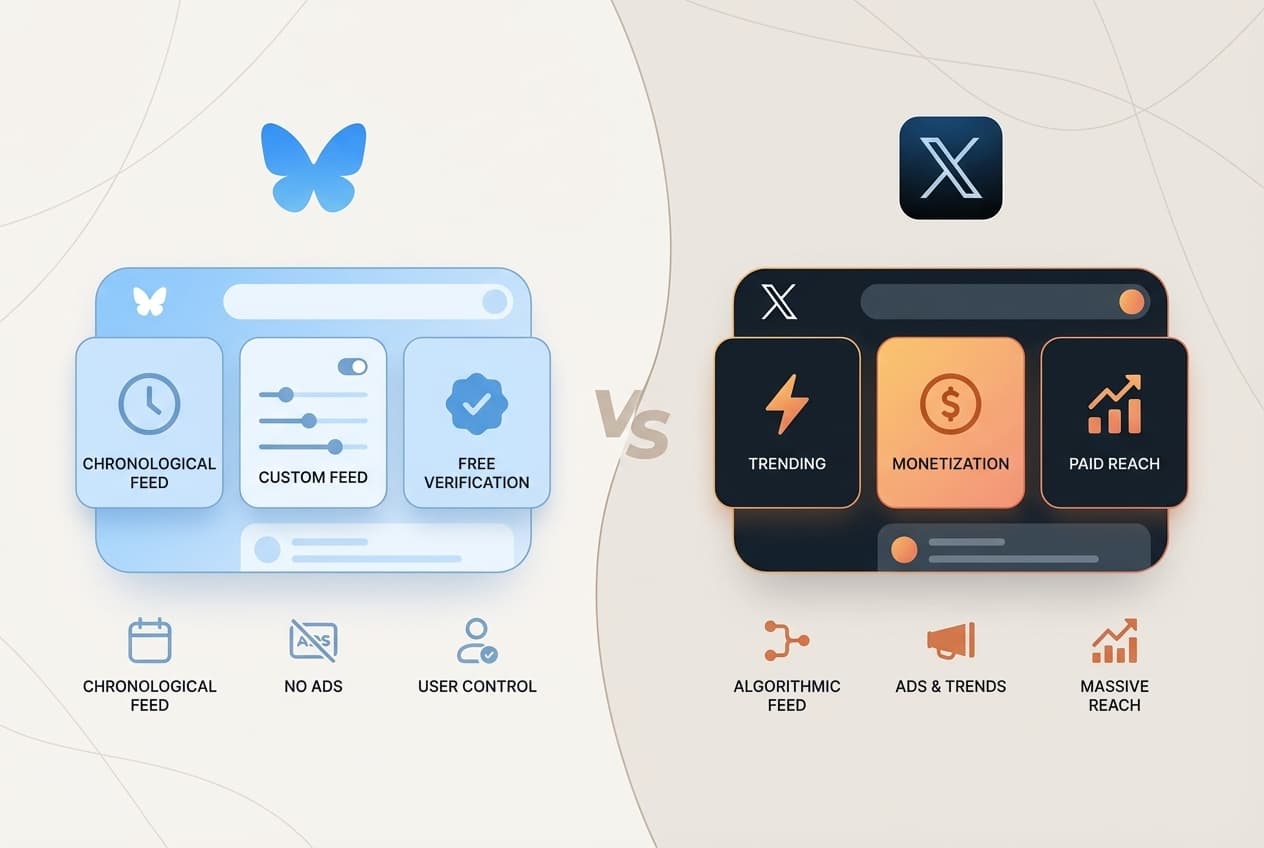
- •Bluesky: free verification via domain handles, no ads, open API, custom feeds
- •Twitter/X: 500M+ users, paid verification ($8/month), algorithmic suppression of external links
- •Bluesky engagement rates are higher per follower for most accounts
- •Schedulala supports both Bluesky and Twitter/X scheduling for $9/month
Bluesky started as the "Twitter alternative" for people fed up with X (formerly Twitter).
But in 2026, it's become a legitimate platform in its own right — with millions of active users and a distinct culture.
So which platform should you actually use?
Try Schedulala for free
Schedule posts to Bluesky, Twitter, and 8 other platforms from one dashboard.
Get started for free→Quick Comparison
| Factor | Bluesky | Twitter (X) |
|---|---|---|
| Monthly Active Users | ~25 million | ~500 million |
| Character Limit | 300 | 280 (up to 25,000 for Premium) |
| Algorithm | Chronological + custom feeds | Algorithmic 'For You' default |
| Verification | Domain-based (free) | Paid ($8-16/month) |
| Ads | None | Heavy ad load |
| Monetization | Not yet available | Creator payouts, subscriptions |
| API Access | Free and open | Expensive, restricted |
| Moderation | Decentralized, user-controlled | Centralized, inconsistent |
| Vibe | Tech-savvy, conversational | News, hot takes, chaos |
Platform Overview
What is Twitter (X)?
Twitter — rebranded to "X" in 2023 — is the original microblogging platform.
Founded in 2006, it became the go-to place for real-time news, public discourse, and hot takes.
After Elon Musk's acquisition in 2022, Twitter underwent significant changes: mass layoffs, paid verification, algorithm shifts, and controversial policy changes.
What is Bluesky?
Bluesky started as a Twitter-funded research project in 2019.
Built on the AT Protocol, it offers users more control — custom feeds, portable accounts, and decentralized moderation.
It's grown to roughly 25 million users, with strong adoption among tech workers, journalists, and creators who left Twitter.
Feature Comparison
Character Limits
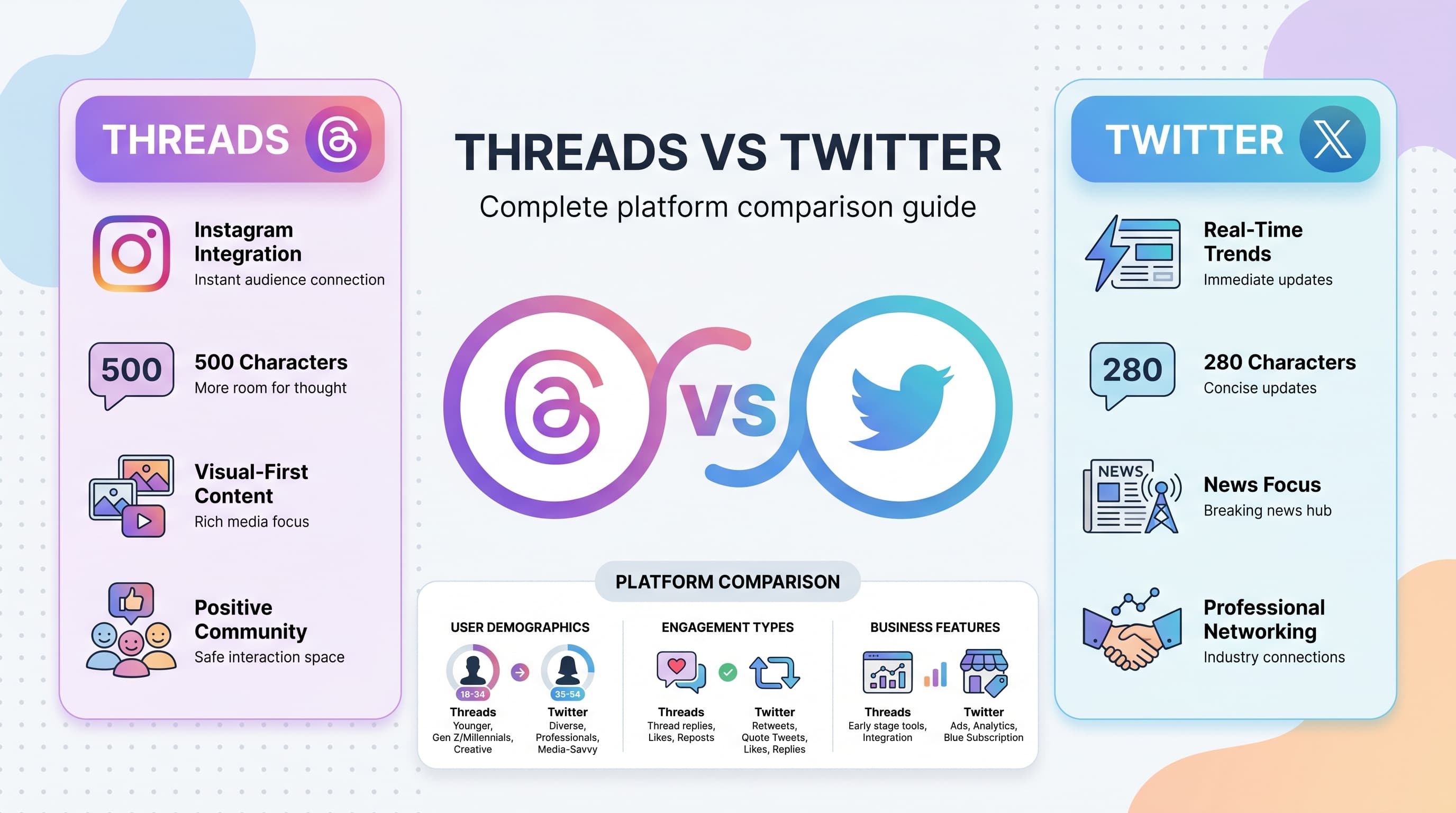
Twitter: 280 characters for free users. Premium gets up to 25,000.
Bluesky: 300 characters for everyone. No paid tier needed.
Images and Media
Twitter: Up to 4 images, GIFs, videos up to 2:20. Polls available.
Bluesky: Up to 4 images, GIFs. Video support is newer. No polls yet.
Threading
Twitter: Native thread support. Click "Add another post" to chain tweets.
Bluesky: Native thread support, similar functionality.
See It in Action
This is what scheduling a Bluesky thread looks like in Schedulala
Direct Messages
Twitter: Full DM functionality with encryption available.
Bluesky: DMs launched late 2024. Basic but improving.
Verification
Twitter: Blue checkmark requires X Premium ($8-16/month).
Bluesky: Domain-based verification. Set your handle to your domain. Free and proves identity.
Search
Twitter: Full-text search of all public posts. Advanced operators available.
Bluesky: Search has improved but still not as powerful.
Algorithm Comparison
Twitter's Algorithm
Twitter defaults to an algorithmic "For You" feed that prioritizes:
- Engagement (likes, retweets, replies)
- Recency (newer posts favored)
- Relationship (accounts you interact with)
- Content type (video and images often boosted)
- Premium status (paying users get some boost)
You can switch to "Following" for chronological posts from accounts you follow, but the app pushes you toward "For You."
The algorithm rewards engagement-bait, controversy, and viral potential. This creates a specific type of content culture.
Bluesky's Algorithm
Bluesky takes a radically different approach: you choose your algorithm.
The default feed is mostly chronological (accounts you follow, in order). But Bluesky lets you:
- Create custom feeds based on keywords, users, or behavior
- Subscribe to community-created feeds
- Pin multiple feeds and switch between them
Popular custom feeds include topic-specific feeds (tech, art, sports), "quiet follows" (posts only, no reposts), and curated discovery feeds.
This means less viral chaos, more control, but also less automatic discovery. (For more on how this works, see our guide to the Bluesky algorithm.)
Which Algorithm is Better?
Choose Twitter if: You want maximum reach and don't mind playing the algorithm game. Your content can go viral more easily.
Choose Bluesky if: You want a calmer experience and more control. You're building genuine community over chasing virality.
Audience Comparison
Who's on Twitter?
Twitter's audience is broad:
- Journalists and media
- Politicians and political junkies
- Brands and marketers
- Celebrities and public figures
- General public (global)
Who's on Bluesky?
Bluesky's audience is more niche (for now):
- Tech workers and developers
- Journalists (especially those who left Twitter)
- Artists and creative professionals
- LGBTQ+ community
- Early adopters and Twitter refugees
Which Audience is Right for You?
Choose Twitter if: You need mass reach, your audience is general/mainstream, or you're in news/politics/sports.
Choose Bluesky if: Your audience is tech-savvy, creative, or you value community over raw numbers.
Consider both if: You want to diversify and not rely on a single platform.
Learn more about Bluesky for business.
Growth Potential
Growing on Twitter
Twitter offers more raw growth potential:
- Larger user base (20x Bluesky's size)
- Viral mechanics (retweets, quote tweets, algorithmic amplification)
- Trending topics and hashtags
- Search discoverability
Growing on Bluesky
Bluesky is earlier-stage, which means:
- Less competition for attention
- Easier to get noticed by being helpful/interesting
- Community-building matters more than going viral
- Custom feeds can surface your content
Long-Term Outlook
Twitter: Established but uncertain. Policy changes and algorithm shifts create instability. Still the bigger platform.
Bluesky: Growing steadily with strong retention. The decentralized model could be the future — or it could plateau. High upside, more risk.
Monetization Comparison
Twitter Monetization
Twitter offers several creator monetization options:
- Creator Payouts: Share of ad revenue based on engagement (requires Premium)
- Subscriptions: Charge followers for exclusive content
- Tips: Receive tips via integrated payment options
To access most features, you need X Premium ($8-16/month) and must meet eligibility requirements (follower counts, activity thresholds).
Bluesky Monetization
Bluesky currently has no native monetization features.
No ads, no creator fund, no subscriptions, no tipping — yet.
This could change as the platform grows, but for now, any monetization must happen externally (driving traffic to your website, newsletter, etc.).
Which is Better for Making Money?
Twitter wins for direct platform monetization — it's the only option right now.
However: Many creators find Bluesky audiences more willing to follow external links (newsletter signups, product pages) because there's less noise competing for attention.
If you're building toward external monetization (courses, products, services), both platforms can work.
Content Strategy Differences
What works on each platform differs significantly.
What Works on Twitter
- Hot takes and strong opinions
- News commentary and real-time reactions
- Threads (educational or storytelling)
- Controversy (unfortunately)
- Quote tweets with commentary
- Visual content (images, short video)
- Engagement bait (polls, questions)
The algorithm rewards content that sparks engagement — including arguments. "Dunk tweets" often outperform thoughtful content.
What Works on Bluesky
- Genuine conversation and replies
- Helpful, educational content
- Community participation
- Niche expertise
- Humor (without meanness)
- Cross-posts from Twitter (works surprisingly well)
- Personal, authentic posts
The chronological feed means you don't need to game an algorithm. Consistency and quality matter more than virality. (Check our best time to post on Bluesky guide for timing tips.)
Adapting Your Content
If you're posting to both platforms:
Don't: Copy-paste everything identically. The cultures are different.
Do: Adapt your tone slightly. Bluesky is more conversational. Twitter is more performative. The same core message can be framed differently.
Should You Use Bluesky, Twitter, or Both?
Here's a framework for deciding:
Use Twitter If:
- You need maximum reach right now
- Your audience is mainstream/general
- You're in news, politics, sports, or entertainment
- You want platform monetization
- You're comfortable with the algorithm game
Use Bluesky If:
- You value community over scale
- Your audience is tech-savvy or creative
- You want more control over your experience
- You're tired of Twitter's chaos
- You're playing the long game on a growing platform
Use Both If:
- You want to diversify your social presence
- You can maintain consistent posting on multiple platforms
- You want to capture audiences in different places
- You're building a brand that shouldn't depend on one platform
Many creators are doing exactly this: treating Twitter as the reach platform and Bluesky as the community platform.
Managing Both Platforms
If you decide to use both Bluesky and Twitter, you'll want a system to manage them efficiently.
Posting manually to each platform is time-consuming. A scheduling tool lets you:
- Write content once and adapt for each platform
- Schedule posts in advance
- Maintain consistency without daily effort
- Track what's working where
Tools like Schedulala let you schedule to both Twitter/X and Bluesky (plus 8 other platforms) from one dashboard. You can plan a week of content in one session.
Learn how to schedule posts on Bluesky or compare the best Bluesky scheduling tools.
See It in Action
This is what scheduling a Bluesky post looks like in Schedulala
Frequently Asked Questions
Is Bluesky better than Twitter?
"Better" depends on your goals. Bluesky offers a calmer experience with more user control. Twitter offers more reach and monetization. Many users prefer Bluesky's vibe but need Twitter's audience.
Is Bluesky replacing Twitter?
Not yet — and maybe not ever in terms of raw size. But Bluesky has carved out a meaningful niche, especially among tech and creative communities. It's a legitimate alternative, not a full replacement. Considering other decentralized options? See our Mastodon vs Bluesky comparison.
Can I use the same content on both?
Yes, but consider adapting slightly. Bluesky's culture is more conversational, Twitter's is more performative. The same idea can be framed differently for each audience.
Should I delete Twitter and move to Bluesky?
Only if you're certain your audience will follow. For most creators, maintaining both platforms (even if you prefer one) is safer than abandoning an established presence.
How do I cross-post efficiently?
Use a scheduling tool like Schedulala that supports both platforms. Write your content once, adapt it for each platform's character limits and style, and schedule both from one place.
Which platform has better engagement?
Bluesky typically has higher engagement rates (engagement per follower). Twitter has higher absolute engagement due to platform size. Quality vs. quantity.
Final Verdict
Twitter is still the bigger platform with more reach, more features, and actual monetization.
If you need scale, it's hard to ignore.
Bluesky offers a better user experience, more control, and a growing community that actually feels like a community.
If you're playing the long game, it's worth building a presence now.
The social media landscape is shifting.
Creators who diversify now will be better positioned no matter which platform wins.
Try Schedulala for free
Schedule posts to Bluesky, Twitter, and 8 other platforms from one dashboard.
Get started for free→