Mastodon vs Bluesky: Which Decentralized Platform Wins?
We compared Mastodon and Bluesky head to head. Mastodon has instances and a learning curve. Bluesky feels like old Twitter. Here's who wins and why.

Quick answer
Bluesky feels like Twitter with a simple onboarding flow, while Mastodon requires choosing a server and has a steeper learning curve.
- •Bluesky: single network, Twitter-like UX, custom feeds, domain verification
- •Mastodon: federated servers (instances), steep onboarding, strong privacy focus
- •Bluesky is growing faster with 20+ million users; Mastodon has about 10 million accounts
- •Schedulala supports Bluesky scheduling; Mastodon scheduling is also available for $9/month
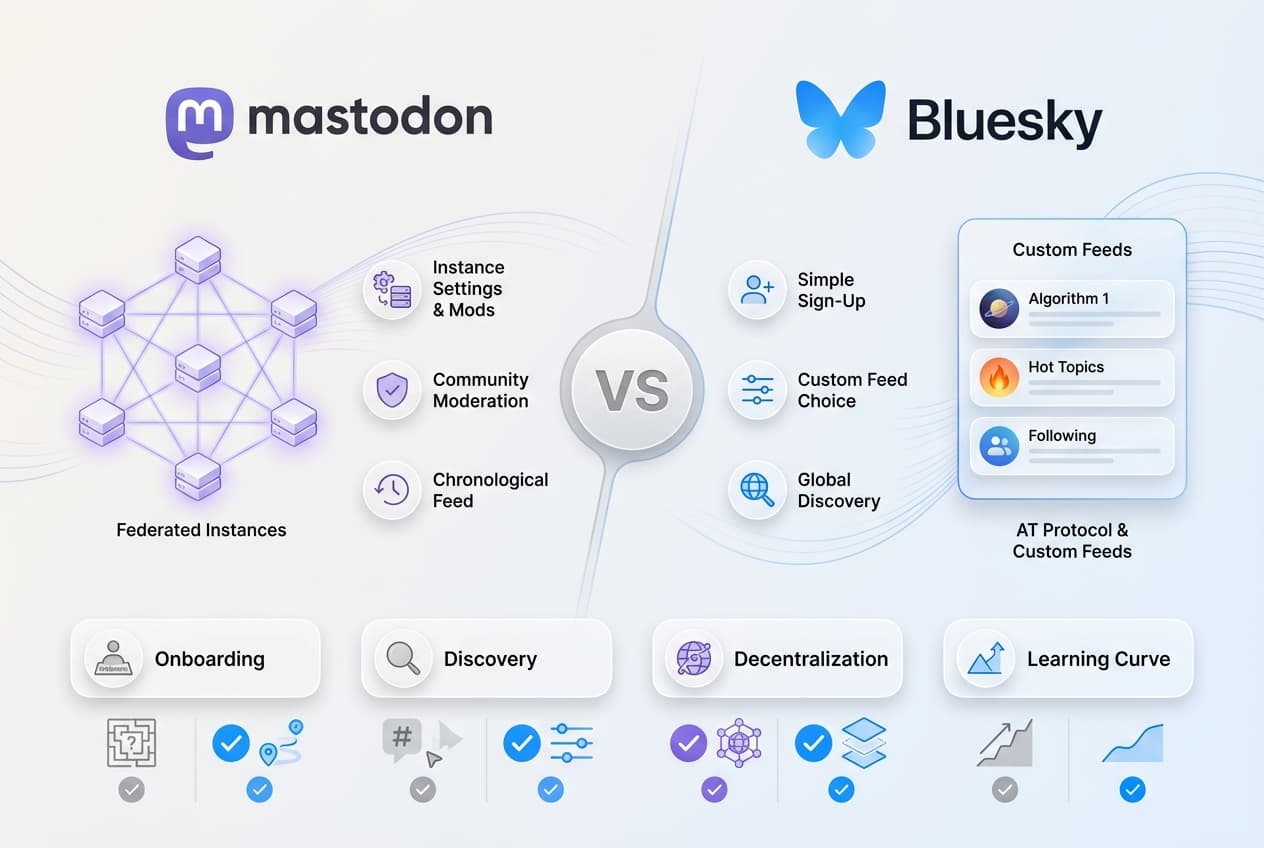
Both Mastodon and Bluesky promise an alternative to centralized social media. Both are decentralized. Both emerged as Twitter alternatives.
But they're fundamentally different platforms with different philosophies, different experiences, and different audiences.
So which one should you use?
This comparison breaks down Mastodon vs Bluesky across everything that matters.
Try Schedulala for free
Schedule posts to Bluesky, Twitter, and 8 other platforms from one dashboard.
Get started for free→Quick Comparison
Mastodon
- Launched 2016
- ~10-15 million users
- Federated (ActivityPub)
- Complex onboarding (choose a server)
- 500 character limit
- Chronological only
- Steep learning curve
Bluesky
- Launched 2023 (public)
- ~25 million users
- Protocol-based (AT Protocol)
- Simple onboarding
- 300 character limit
- Chronological + custom feeds
- Minimal learning curve
What Is Mastodon?
Mastodon launched in 2016 as an open-source, decentralized social network. It runs on the ActivityPub protocol, which means it's part of the larger "Fediverse" — a network of interconnected platforms.
How Mastodon Works
Unlike traditional social media, Mastodon doesn't have one central server. Instead, it's made up of thousands of independent "instances" (servers) run by different people and organizations.
When you join Mastodon, you choose an instance, create an account on that instance, and can follow and interact with users on other instances. Your experience varies based on which instance you choose — each has its own rules, moderation, and community culture.
Mastodon's Philosophy
- True decentralization — no single company controls it
- User ownership — you can move your account between instances
- Community moderation — each instance sets its own rules
- Anti-algorithm — strictly chronological feeds
- Privacy — more control over your data
What Is Bluesky?
Bluesky started as a Twitter-funded research project in 2019 and launched publicly in 2023. It's built on the AT Protocol, a new decentralized protocol designed to be more user-friendly than existing options.
How Bluesky Works
Bluesky feels like a traditional social network: sign up at bsky.app, create your account, start posting and following.
The decentralization happens at the protocol level. While most users are on the main Bluesky server today, the AT Protocol allows for future federation and portability.
Bluesky's Philosophy
- User experience first — decentralization shouldn't mean complexity
- Algorithmic choice — you pick your feed algorithms
- Portable identity — your account can move between providers
- Open development — transparent roadmap and communication
- Familiar feel — Twitter-like experience by design
Ease of Use
This is where the platforms differ most dramatically.
Mastodon: Complex Onboarding
Joining Mastodon requires decisions before you even start: Which instance do I choose? What if I choose wrong? Why can't I see everyone? What's this @ format with the instance included?
For tech-savvy users, this is fine. For average users, it's confusing.
Bluesky: Familiar Experience
Joining Bluesky works like any social network: go to bsky.app, create account, done.
The handle format (@user.bsky.social) is similar to Twitter. The interface is familiar. There's no server selection or federation to understand upfront.
Winner: Bluesky
For ease of use, Bluesky wins decisively. You can be posting within 2 minutes. Mastodon requires research and decisions before you start.
Features Comparison
Posting Features
Mastodon: 500 character limit (varies by server), up to 4 images, video support (varies), polls, content warnings, post editing.
Bluesky: 300 character limit, up to 4 images, limited video, no polls, no content warnings, no post editing.
Winner: Mastodon — more posting features, especially content warnings and editing.
Discovery Features
Mastodon: Hashtags important for discovery, limited opt-in search, instance-dependent trending.
Bluesky: Hashtags not used for discovery, full-text search, Discover feed, custom feeds (major feature).
Winner: Bluesky — better discovery with search and custom feeds. Learn more about how Bluesky's algorithm works.
Feed Experience
Mastodon: Chronological only, local timeline (your instance), federated timeline (all federated content).
Bluesky: Chronological (Following feed), custom feeds (user choice), no local/federated timelines.
Winner: Tie — depends on preference. Mastodon offers local/federated timelines. Bluesky offers algorithmic choice.
Audience Comparison
Who's on each platform matters for your decision.
Mastodon's Audience
- Tech enthusiasts — open source advocates, developers
- Privacy advocates — people avoiding Big Tech
- Academics and researchers — many university instances
- Niche communities — topic-specific instances
The audience skews older, more technical, and more privacy-focused.
Bluesky's Audience
- Twitter refugees — people who left during/after the Musk acquisition
- Tech workers — especially startup and VC communities
- Journalists and media — many news professionals active
- Creators and artists — especially digital artists
The audience skews younger, more mainstream (within tech), and more active.
Winner: Depends on Your Goals
For tech/privacy niche: Mastodon. For broader reach: Bluesky. For academic/research: Mastodon. For media/journalism: Bluesky.
Growth Potential
How easy is it to build an audience on each platform?
Growing on Mastodon
Challenges: Fragmented audience across instances, discovery is harder (opt-in search, hashtag-dependent), no algorithmic amplification, smaller overall user base, culture is skeptical of self-promotion.
Advantages: Strong niche communities, loyal engaged users, less competition for attention, high-quality interactions.
Growth is slower and requires active community participation.
Growing on Bluesky
Challenges: Still smaller than Twitter, no paid promotion options, platform is evolving rapidly.
Advantages: Better discovery (search, Discover feed, custom feeds), more familiar to Twitter users, unified platform = unified audience, higher engagement rates, less saturated.
Growth is easier than Mastodon but still requires consistent effort.
Winner: Bluesky
For pure growth potential, Bluesky is easier. The unified platform and better discovery features make building an audience more straightforward.
For Business and Creators
If you're using social media professionally, here's how the platforms compare.
Mastodon for Business
Pros: Strong for tech/developer audiences, community-focused engagement, no advertising = organic only, can run your own instance for brand control.
Cons: Fragmented audience harder to reach, anti-promotional culture, complex to explain to stakeholders, fewer business tools, limited scheduling tool support.
Best for: Tech companies, open source projects, privacy-focused brands.
Bluesky for Business
Pros: Easier to use for teams, growing mainstream audience, better discovery features, more scheduling tools available, familiar Twitter-like workflow.
Cons: Still smaller than Twitter, no advertising yet, analytics are limited, platform is young/evolving.
Best for: Startups, creators, media companies, small businesses wanting Twitter alternative.
Winner: Bluesky
For most businesses, Bluesky is more practical. The familiar experience, better tools, and unified audience make it easier to execute.
Learn more: Bluesky for Business: Getting Started Guide
Should You Use Mastodon, Bluesky, or Both?
Choose Mastodon If:
- You're deeply committed to decentralization principles
- Your audience is in tech, academia, or privacy communities
- You want to be part of the broader Fediverse
- You don't mind the learning curve
- You value content warnings and post editing
Choose Bluesky If:
- You want the easiest transition from Twitter
- Your audience is mainstream or creator-focused
- You prioritize simplicity over ideology
- You want better discovery and growth tools
- You're building a business/creator presence
Use Both If:
- You have different audiences on each
- You want to hedge your bets
- You have the capacity to manage multiple platforms
Our Recommendation
For most users — especially creators and businesses — Bluesky is the better choice in 2026.
It's easier to use, has better growth potential, and doesn't require understanding federation. The platform is growing faster and has stronger mainstream momentum.
Mastodon is great for specific niches and users who prioritize decentralization ideology. But for practical social media use, Bluesky wins on user experience.
See It in Action
This is what scheduling a Bluesky post looks like in Schedulala
Frequently Asked Questions
Can I cross-post between Mastodon and Bluesky?
Yes, with some tools. But the cultures are different — consider adapting content rather than identical cross-posting.
Is Mastodon dying because of Bluesky?
No. Mastodon has a committed user base and continues to grow, just slower than Bluesky. They serve somewhat different audiences.
Which is more decentralized?
Mastodon is more decentralized today (thousands of independent instances). Bluesky is designed for decentralization but currently more centralized in practice.
Can I move from Mastodon to Bluesky?
You can create a Bluesky account and start fresh. There's no direct migration path for followers or content.
Which has better engagement?
Both can have good engagement. Bluesky tends to have higher activity rates. Mastodon has deeper but more niche engagement.
Will they ever connect to each other?
Possibly. There's discussion about bridging AT Protocol and ActivityPub, but nothing concrete yet.
Final Verdict
Mastodon: Best for ideologically committed users, tech communities, and those who want true decentralization today.
Bluesky: Best for everyone else — especially creators, businesses, and anyone wanting a simple Twitter alternative.
If you're choosing between them, start with Bluesky unless you have specific reasons to prefer Mastodon.
Try Schedulala for free
Schedule posts to Bluesky, Twitter, and 8 other platforms from one dashboard.
Get started for free→Start Building on Bluesky
If you've decided Bluesky is right for you, the next step is creating consistent content.
Schedulala lets you schedule Bluesky posts alongside 9 other platforms — so you can maintain presence everywhere without the daily grind.