Instagram Threads vs Twitter: Complete Comparison for Social Media Marketers
Compare Instagram Threads vs Twitter features, audience, reach, and marketing potential. Which platform should you choose for your brand in 2026?

Two platforms are battling for the crown of real-time conversations. Instagram Threads launched with a bang, promising to be the Twitter killer we've all been waiting for. Our Instagram scheduling can help.
See It in Action
This is what scheduling an Instagram post looks like in Schedulala
But can Meta's text-based platform actually dethrone the bird app? After months of testing both platforms for social media marketing, the answer isn't as clear-cut as you might think. See our telegram engagement tips get guide.
Try Schedulala for free
Schedule posts to Bluesky, Twitter, and 8 other platforms from one dashboard.
Get started for free→Platform overview and positioning
Instagram Threads: The Meta alternative
Threads launched in July 2023 as Meta's direct response to Twitter's chaos. Built on Instagram's infrastructure, it promised seamless integration with your existing Instagram audience and a cleaner, less toxic environment for conversations. Try our how to repurpose content.
The platform hit 100 million users in just 5 days, making it the fastest-growing social app in history. But those initial numbers don't tell the whole story. Learn more about scheduling across platforms.
Key positioning: Visual-first conversations with Instagram integration, aiming for a more positive community atmosphere. Learn more about best time to post on instagram.
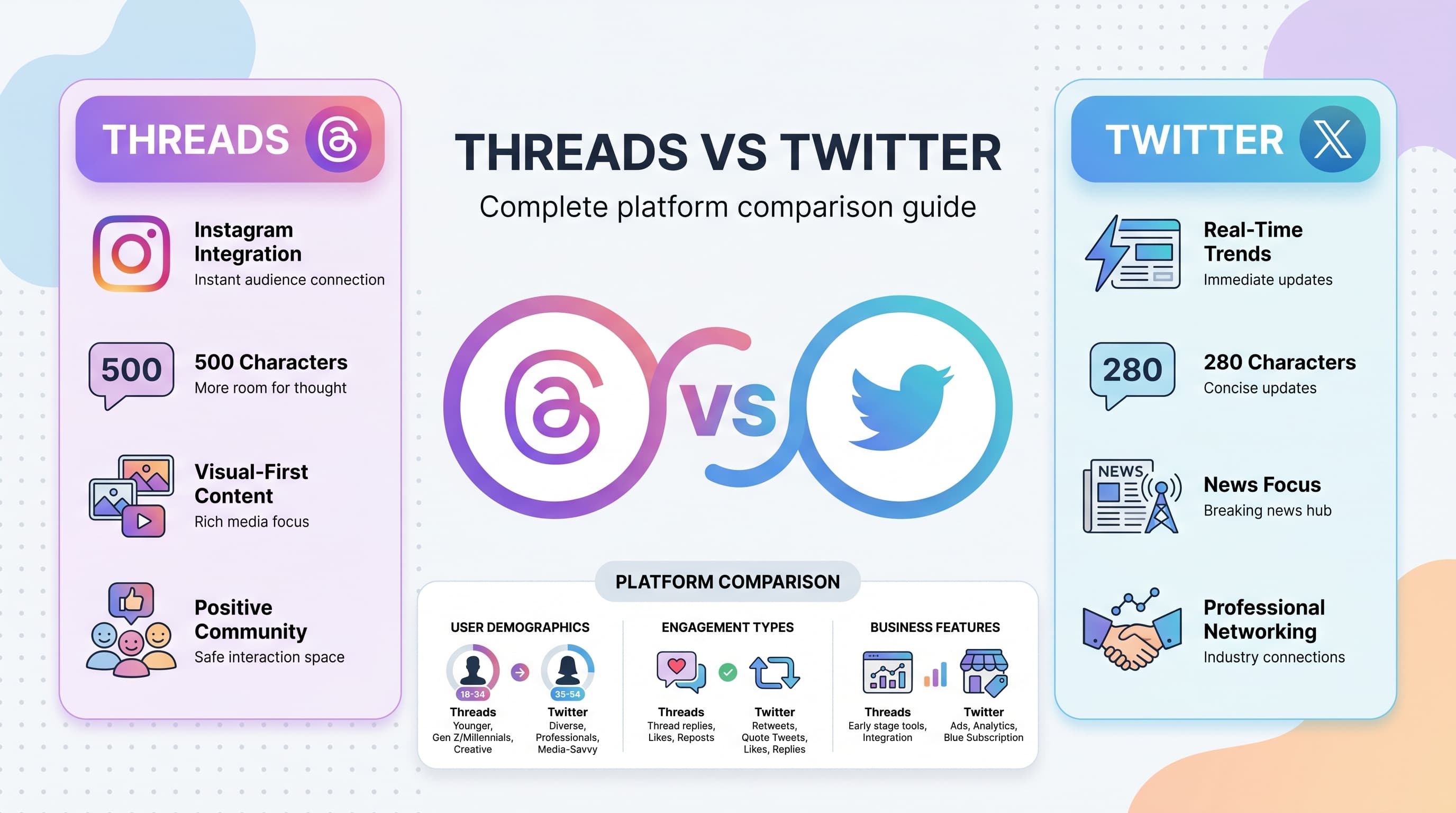
- 500 character limit per post (expandable to 2,200 in some regions)
- Direct Instagram integration for cross-posting and audience sharing
- No trending topics or robust search functionality (by design)
- Algorithm-heavy feed with limited chronological options
- Visual content emphasis with photo and video support
Twitter/X: The established conversation hub
Twitter has been the go-to platform for real-time conversations since 2006. Despite ownership changes and feature experiments, it remains the primary destination for news, trending topics, and public discourse. Our instagram engagement calculator can help.
With 450 million monthly active users as of 2024, Twitter has maintained its position as the internet's town square, even through significant platform changes and policy shifts.
Key positioning: Real-time information hub with powerful discovery tools and established community behaviors.
- 280 character limit for regular posts (longer for premium users)
- Robust trending system showing real-time conversations
- Advanced search capabilities for content discovery
- Multiple timeline options including chronological and algorithmic
- Established creator economy with monetization features
User base and audience demographics
Understanding each platform's audience is crucial for making the right choice for your brand. The demographics tell a fascinating story about user behavior and expectations.
| Metric | Instagram Threads | Twitter/X |
|---|---|---|
| Monthly Active Users | 150M (as of Q1 2024) | 450M |
| Average Age | 28 years | 33 years |
| Gender Split | 60% female, 40% male | 52% male, 48% female |
| Primary Use Case | Lifestyle sharing, casual conversation | News, professional networking |
| Daily Active Users | 45M | 250M |
| Time Spent (daily) | 8 minutes average | 31 minutes average |
| Creator Adoption | High (Instagram crossover) | Very High |
The numbers reveal a critical insight: Threads attracts Instagram users looking for text-based conversations, while Twitter maintains its grip on users seeking real-time information and professional networking.
Geographic distribution also differs significantly. Threads saw massive adoption in markets where Instagram is dominant, particularly among younger demographics in the US, Brazil, and India. Twitter maintains stronger presence in news-heavy markets like Japan, the UK, and among professional communities globally.
For marketers, this means your choice should align with your target demographic's platform preferences, not just follower counts or engagement rates.
Content features and capabilities
The content creation experience shapes how your brand can express itself and engage with audiences. Each platform has taken different approaches to text, media, and interaction design.
Text and formatting options
Threads gives you 500 characters by default, with expansion to 2,200 characters available in select regions. The platform supports basic text formatting, mentions, and hashtags, but keeps things visually clean with minimal formatting options.
Twitter sticks to 280 characters for regular users, with longer posts available for premium subscribers. The platform offers more robust text formatting, including the ability to create threads that connect multiple posts into longer narratives.
Visual content integration
This is where Threads shows its Instagram DNA. Photo and video integration feels natural and polished, with Instagram's powerful editing tools and filters available. You can create visually rich posts that feel more like Instagram stories than traditional tweets.
Twitter handles media well but focuses more on quick, contextual sharing. Images and videos serve the conversation rather than dominating it. The platform excels at real-time photo sharing during events or breaking news.
Video capabilities differ substantially. Threads leverages Instagram's video infrastructure, supporting longer clips with better quality. Twitter optimizes for quick, shareable video moments that complement real-time conversations.
Scheduling and automation support
Twitter has mature third-party tool support, with most social media schedulers offering robust Twitter integration. You can schedule tweets, manage multiple accounts, and access detailed analytics through various tools.
Threads launched with limited third-party support, though this is rapidly improving. The platform's tight integration with Instagram means some scheduling tools can cross-post content, but native Threads scheduling is still developing.
For brands managing multiple social accounts, Twitter's established ecosystem makes it easier to maintain consistent posting schedules and measure performance across campaigns.
Algorithm and content discovery
How people find your content determines your potential reach and engagement. The algorithmic approaches of these platforms couldn't be more different.
Feed algorithms and content prioritization
Threads uses an Instagram-style algorithm that prioritizes content from accounts users interact with frequently. The algorithm heavily weights visual content and tends to surface posts from verified creators and accounts with existing Instagram followings.
The platform deliberately avoids promoting controversial or news-heavy content, instead favoring lifestyle, entertainment, and positive community interactions. This creates a calmer environment but limits viral potential for breaking news or trending topics.
Twitter offers both algorithmic and chronological timeline options. The algorithmic feed considers engagement signals, recency, and relevance to trending conversations. Twitter's algorithm is more likely to surface breaking news, trending topics, and viral content.
The platform's real-time nature means fresh, timely content gets significant algorithmic boosts, especially during trending events or breaking news cycles.
Search and discovery features
This is where Twitter maintains a significant advantage. The platform's robust search functionality lets users find specific tweets, topics, or conversations from years past. Advanced search operators, trending topics, and real-time hashtag tracking make Twitter invaluable for content discovery.
Threads deliberately limited search functionality at launch, with basic keyword search rolling out slowly. You can't search for specific time periods, advanced operators, or browse comprehensive trending topics. This design choice reduces information overload but limits content discoverability.
For brands building thought leadership or wanting their content to be discoverable months later, Twitter's search capabilities provide lasting value that Threads currently can't match.
Hashtag effectiveness
Twitter hashtags remain powerful discovery tools. Well-chosen hashtags can expose your content to relevant audiences and help you join trending conversations. The platform's hashtag culture is well-established, with users actively following and searching hashtag-based content.
Threads hashtags work differently. While the platform supports hashtags, their discovery impact is minimal compared to Instagram or Twitter. Threads seems to prioritize account relationships and content quality over hashtag optimization.
This means your hashtag strategy needs adjustment when moving between platforms. Twitter requires strategic hashtag use for maximum reach, while Threads focuses more on content quality and existing relationships.
Engagement and community features
How users interact with your content and build communities around your brand varies significantly between these platforms.
Interaction mechanisms
Threads uses Instagram-familiar interactions: likes, comments, reposts, and quotes. The platform emphasizes positive interactions and makes it easy to share content to Instagram Stories, creating cross-platform engagement opportunities.
The comment system encourages longer, more thoughtful responses rather than quick reactions. This can lead to higher-quality discussions but potentially lower overall engagement numbers.
Twitter offers likes, replies, retweets, and quote tweets. The platform's interaction culture tends toward quick, witty responses and rapid-fire conversations. Twitter's quote tweet feature is particularly powerful for adding context or commentary to shared content.
Twitter's interaction speed creates viral potential but can also lead to misunderstandings or pile-on behaviors that Threads actively tries to discourage.
| Engagement Type | Threads Approach | Twitter Approach |
|---|---|---|
| Likes | Instagram-style hearts, positive focus | Quick approval, high volume |
| Comments | Longer, thoughtful responses encouraged | Rapid-fire conversational style |
| Sharing | Repost + Instagram Stories integration | Retweets + quote tweets with commentary |
| Direct Messages | Integrated with Instagram DMs | Standalone Twitter DM system |
| Live Interactions | Limited real-time features | Twitter Spaces, live tweeting events |
Community building tools
Twitter offers more mature community features. Twitter Communities allow niche groups to form around specific interests, while Twitter Spaces provides live audio conversations. The platform's list feature helps users organize accounts they follow into themed groups.
Threads relies heavily on Instagram's community infrastructure. While you can't create dedicated Threads communities, the platform's integration with Instagram means your existing Instagram community can easily engage with your Threads content.
For building new communities from scratch, Twitter's dedicated community features provide more tools. For leveraging existing Instagram communities, Threads offers seamless cross-platform engagement.
Business and marketing capabilities
The marketing potential of each platform depends on advertising options, analytics capabilities, and business-specific features.
Advertising and promotion options
Twitter offers comprehensive advertising solutions through Twitter Ads Manager. You can create promoted tweets, follower campaigns, website traffic campaigns, and app install campaigns. The platform provides detailed targeting options based on interests, demographics, keywords, and even specific events or conversations.
Twitter's advertising strength lies in real-time marketing opportunities. You can quickly create ads around trending topics, breaking news, or viral conversations.
Threads launched without native advertising options, though Meta has indicated ads are coming. Currently, businesses must rely on organic reach and cross-promotion from Instagram ads that drive traffic to Threads content.
The lack of Threads advertising means organic content strategy becomes even more critical. You can't pay to boost underperforming posts or target specific audiences beyond your organic reach.
Analytics and performance measurement
Twitter Analytics provides detailed insights into tweet performance, audience demographics, and engagement patterns. Third-party tools like Hootsuite, Buffer, and Sprout Social offer even deeper analytics for Twitter content.
You can track hashtag performance, identify your most engaging content types, and monitor competitor activity. Twitter's API access allows for custom analytics solutions and automated reporting.
Threads analytics are basic, integrated with Instagram Insights. You can see basic engagement metrics, reach, and audience demographics, but detailed performance analysis requires manual tracking or third-party tools.
The analytics limitation makes it harder to optimize Threads content strategy or prove ROI to stakeholders who want detailed social media performance reports.
Business account features
Twitter offers verified business accounts, Twitter for Business resources, and integration with customer service workflows. Many businesses use Twitter as a customer support channel, with tools designed for managing high-volume customer interactions.
Threads business features are limited, though accounts linked to Instagram business profiles get some additional capabilities. The platform focuses more on personal expression than business communication, which may limit its utility for customer service or B2B marketing.
Content strategy differences
Your content approach needs to match each platform's culture and user expectations. What works on Twitter might flop on Threads, and vice versa.
Optimal content types for each platform
Threads content that performs well includes behind-the-scenes posts, lifestyle content, positive community interactions, and visually rich posts with thoughtful captions. The platform rewards authenticity and personal connection over viral content or breaking news.
Think Instagram captions with more conversation potential. Personal stories, beautiful imagery with context, and community-focused content tend to generate the most engagement.
Twitter content thrives on timeliness, wit, and conversation-starting potential. Breaking news, industry insights, quick tips, and content that taps into trending topics perform best. The platform rewards content that generates replies and retweets.
Twitter users expect rapid-fire information sharing, real-time commentary on events, and content that adds to ongoing conversations rather than starting entirely new topics.
Posting frequency and timing
Twitter benefits from frequent posting, with many successful accounts posting 5-15 times daily. The platform's fast-moving feed means content has a short lifespan, so consistent posting maintains visibility.
Peak Twitter engagement typically occurs during commute hours (7-9 AM, 5-6 PM) and lunch breaks (12-1 PM), with variations by time zone and audience type.
Threads performs better with less frequent, higher-quality posts. The algorithm prioritizes engagement quality over quantity, so 1-3 thoughtful posts daily often outperform frequent posting.
Threads engagement patterns follow Instagram more closely, with evening posts (6-9 PM) and weekend content often seeing higher engagement rates.
Voice and tone considerations
Threads encourages a more personal, authentic voice. Users expect brands to be more human and less corporate. The platform's positive community focus means overly promotional or aggressive content gets buried by the algorithm.
Twitter allows for more varied brand voices, from professional and informative to witty and sarcastic. The platform's real-time nature means you can adapt your voice to match current events or trending conversations.
Many brands find success using different voice strategies on each platform: more personal and lifestyle-focused on Threads, more timely and conversation-driven on Twitter.
Cross-platform integration strategies
Smart brands don't choose one platform exclusively. The key is understanding how to leverage each platform's strengths while maintaining consistent brand messaging across channels.
Content repurposing approaches
From Twitter to Threads: Take your best-performing Twitter threads and expand them into longer-form Threads posts with visual elements. Twitter's character limitations often mean you're summarizing complex ideas that can be fully explored on Threads.
From Threads to Twitter: Break down successful Threads posts into Twitter thread series. The personal stories and insights that work on Threads can be repackaged as Twitter threads that provide value while driving traffic back to your Threads account.
Visual content bridge: Use the same visual assets across both platforms but adjust the accompanying text for each platform's culture. Instagram-quality visuals work great on Threads, while simplified versions with punchy captions work better on Twitter.
Audience migration tactics
Threads advantage: If you have a strong Instagram presence, migrating followers to Threads is seamless. Use Instagram Stories to highlight your best Threads content and encourage followers to engage on both platforms.
Twitter advantage: Use Twitter's discovery features to find and engage with your target audience, then provide value that encourages them to follow you across platforms. Twitter Lists and advanced search help identify potential followers who might also enjoy your Threads content.
Cross-pollination strategy: Share different types of exclusive content on each platform. Use Twitter for real-time updates and industry insights, Threads for behind-the-scenes content and community building. This gives followers incentive to follow you on both platforms.
Who should choose what: specific use cases
Your choice between Threads and Twitter should align with your specific goals, audience, and content strategy. Here's how to decide based on your situation.
Choose Threads if you're:
Lifestyle or consumer brands looking to build authentic community connections. Threads' positive, Instagram-integrated environment works perfectly for fashion, food, travel, wellness, and entertainment brands.
Already successful on Instagram with an engaged following. The seamless integration makes Threads a natural extension of your existing Instagram strategy, letting you deepen relationships with current followers.
Focused on visual storytelling with text context. If your brand relies heavily on beautiful imagery, photography, or video content, Threads provides the perfect balance of visual focus with conversation potential.
Building long-term community rather than chasing viral moments. Threads rewards consistent, authentic engagement over trending topic participation.
Choose Twitter if you're:
B2B or professional services companies building thought leadership. Twitter's professional networking culture and real-time information sharing make it ideal for consultants, agencies, SaaS companies, and industry experts.
News, media, or information-focused brands. Twitter's real-time nature and discovery features are unmatched for breaking news, industry updates, or educational content that needs to be discoverable long-term.
Customer service oriented businesses. Twitter's established customer service culture and tools make it the better choice for brands that need to handle customer inquiries and support requests publicly.
Event-driven marketing strategies. If your marketing relies on real-time engagement around events, launches, or trending topics, Twitter's infrastructure and user behavior support this approach.
Use both platforms if you:
Have diverse audience segments with different platform preferences. Use Twitter for professional audiences and industry peers, Threads for customers and community members.
Create varied content types that suit different platforms. Share industry news and insights on Twitter, behind-the-scenes content and community updates on Threads.
Have the resources to maintain authentic presence on both platforms. Don't spread yourself thin - it's better to be excellent on one platform than mediocre on both.
Common mistakes to avoid
Many brands make critical errors when choosing between or managing these platforms. Here are the biggest mistakes and how to avoid them.
Platform selection errors
Following hype instead of audience data: Don't choose Threads just because it's Meta's new platform, or stick with Twitter just because it's established. Look at where your actual audience spends time and engages with brands like yours.
Ignoring content fit: Your content type should drive platform choice. If you create primarily news-focused or B2B content, Threads' algorithm will likely suppress your reach regardless of how well you execute the strategy.
Underestimating resource requirements: Both platforms require consistent, high-quality content to succeed. Don't launch on both platforms unless you can maintain authentic engagement on each.
Content strategy mistakes
Direct cross-posting without adaptation: Copying the same content across platforms ignores each platform's unique culture and optimization requirements. What works on Twitter rarely works unchanged on Threads.
Wrong posting frequency: Applying Twitter's high-frequency posting strategy to Threads often backfires. The platforms reward different posting patterns and content depth.
Ignoring platform-specific features: Not using Twitter's hashtags and trending topics, or failing to leverage Threads' Instagram integration, means missing key engagement opportunities.
Measurement and optimization errors
Using the same KPIs for both platforms: Threads and Twitter require different success metrics. Twitter's fast engagement suits impression and click-through tracking, while Threads' relationship focus needs longer-term community growth metrics.
Not tracking cross-platform attribution: Many brands fail to measure how their Twitter activity influences Instagram/Threads performance and vice versa. Cross-platform attribution reveals the true value of multi-platform strategies.
Premature platform abandonment: Both platforms require time to build momentum. Don't abandon a platform after a few weeks of low engagement without first optimizing your content strategy for that platform's specific requirements.
Future outlook and platform evolution
Understanding where these platforms are heading helps inform your long-term social media strategy investment.
Threads development roadmap
Meta has committed to adding advertising capabilities, enhanced search functionality, and desktop applications for Threads. The company is also testing integration with ActivityPub, which could make Threads compatible with other decentralized social networks.
Expected developments include: Native advertising platform integration with Instagram ads, advanced search and trending topics (with content quality filters), direct messaging improvements, and enhanced business account features.
Timeline: Most business-critical features are expected by late 2024 or early 2025, making this a crucial period for early adoption and community building on the platform.
Twitter/X evolution trajectory
Twitter continues evolving its creator economy features, subscription services, and integration with payment systems. The platform is investing heavily in video content, live audio features, and creator monetization tools.
Current focus areas: Enhanced creator revenue sharing, improved algorithm transparency, expanded verification system, and integration with financial services for creator monetization.
Long-term vision: Twitter aims to become a comprehensive creator economy platform, competing with YouTube and TikTok for creator attention and revenue sharing.
Strategic implications: Both platforms are moving toward creator-focused features, but Twitter's head start in monetization tools gives it advantages for creators seeking immediate revenue opportunities.
Try Schedulala for free
Schedule posts to Bluesky, Twitter, and 8 other platforms from one dashboard.
Get started for free→The choice between Instagram Threads and Twitter isn't about picking the "winner" in some social media battle. It's about understanding where your audience lives, what content you create best, and how each platform serves your marketing goals.
Twitter remains unmatched for real-time conversations, professional networking, and content discovery. Threads offers unprecedented integration with Instagram's visual-first audience and a more positive community environment.
The brands succeeding on both platforms aren't trying to do the same thing in two places. They're using Twitter for timely, discoverable content and Threads for deeper community relationships. That's the real competitive advantage in 2024's social media landscape.