Later Pricing vs Competitors 2026: Who Actually Wins on Value?
Compare Later pricing with Buffer, Hootsuite, Sprout Social & more. See which social media scheduler offers the best value for your budget in 2026.

Quick answer
Later starts at $25/month for 1 user and 1 social set, while competitors like Schedulala offer more accounts and platforms for less.
- •Later Starter: $25/month for 1 user, 1 social set (30 posts per profile)
- •Later Growth: $45/month for 3 users; Advanced: $80/month for 6 users
- •Schedulala: $9/month for one account on each platform, unlimited posts across 12 platforms
- •Later focuses on Instagram and visual planning; Schedulala covers all 10 major platforms
Later's pricing just changed again, and social media managers everywhere are doing the math. See our Instagram scheduling guide.
See It in Action
This is what scheduling an Instagram post looks like in Schedulala
With plans starting at $25/month and going up to $80/month, Later positions itself as a premium visual-first scheduling platform. Try our content calendar.
But how does that stack up against Buffer at $6/channel/month, Hootsuite at $99/month, or newer players like Schedulala offering unlimited posts on every plan? Learn more about scheduling across platforms.
Try Schedulala for free
Schedule posts to Bluesky, Twitter, and 8 other platforms from one dashboard.
Get started for free→Later vs Top Competitors: The Numbers
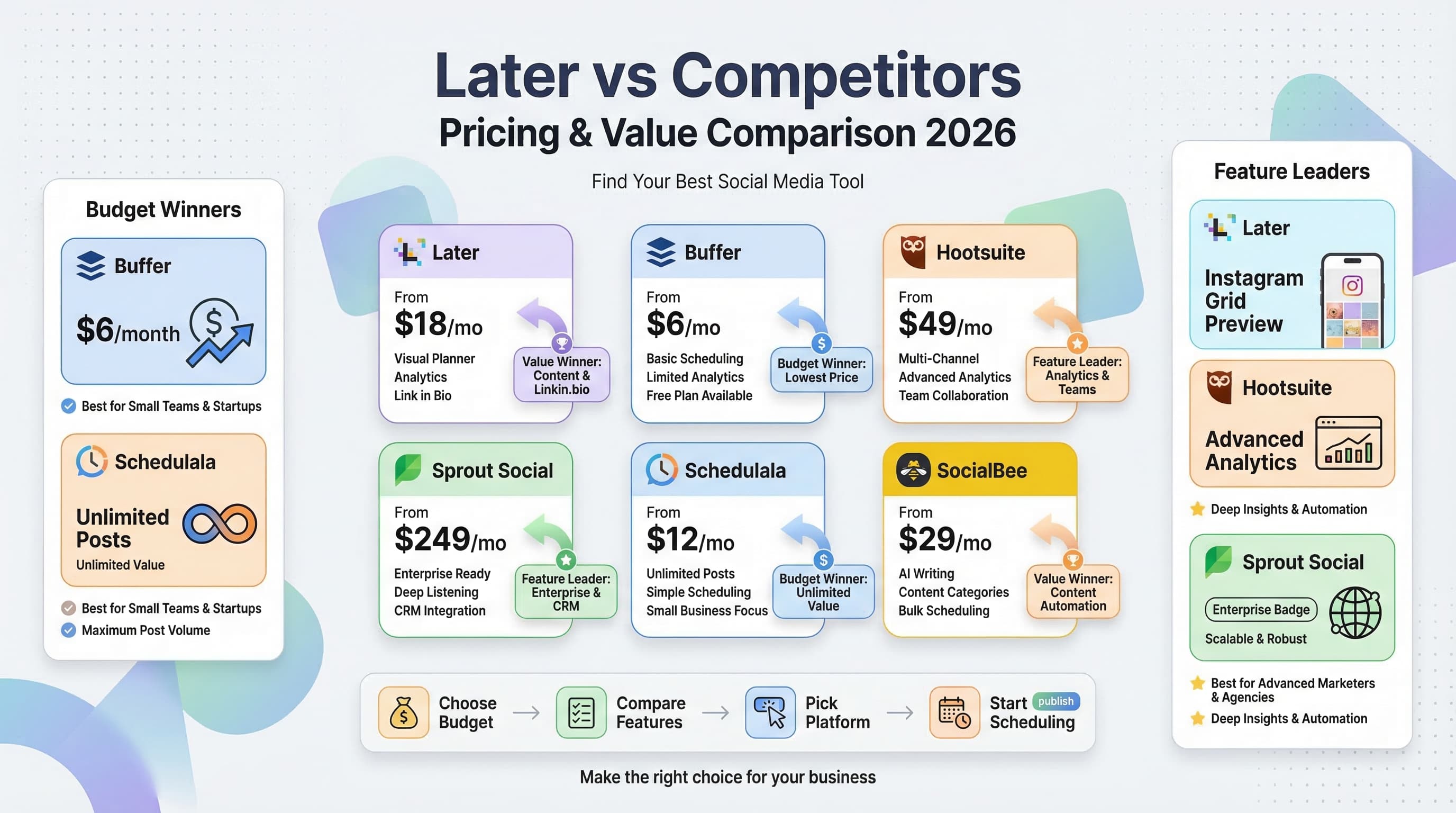
Before we dive deep, here's how Later's 2026 pricing compares to the major players in social media scheduling. See our buffer vs later which guide.
| Platform | Starting Price | Posts/Month | Social Accounts | Key Strength |
|---|---|---|---|---|
| Later | $25/month | 150 | 10 | Visual content planning |
| Buffer | $6/channel/month | 150 | 3 | Simple scheduling |
| Hootsuite | $99/month | Unlimited | 35 | Enterprise features |
| Sprout Social | $249/month | Unlimited | 5 | Advanced analytics |
| Schedulala | $9/month | Unlimited | 15 | Unlimited posting |
| SocialBee | $29/month | 1,000 | 5 | Content categories |
The pricing spread is massive. You're looking at anywhere from $6 to $249 per month for your first paid plan. Learn more about best time to post on instagram.
But price alone doesn't tell the whole story. A $6 Buffer plan that forces you to manually post half your content isn't actually cheaper than a $25 Later plan that handles everything automatically. Our instagram engagement calculator can help.
Later's 2026 Pricing Breakdown
Later Starter Plan - $25/month
Later's entry-level paid plan includes 150 posts per month across 10 social accounts. You get their visual content calendar, basic analytics, and auto-publishing to most platforms.
The plan covers Instagram, Facebook, Twitter, LinkedIn, Pinterest, and TikTok. You also get access to their media library with 1GB of storage.
What you don't get: advanced analytics, user-generated content tools, or their Link in Bio feature. Those require the $45/month Growth plan.
Later Growth Plan - $45/month
This is Later's sweet spot plan for most businesses. You get 300 posts per month, 25 social accounts, and all their premium features.
The big additions are advanced analytics, hashtag suggestions, user-generated content management, and their Link in Bio tool. Storage jumps to 10GB.
For Instagram-heavy businesses, the UGC tools alone might justify the extra $20/month. You can automatically collect and repost customer content with proper permissions.
Later Advanced Plan - $80/month
Later's top plan offers 600 posts monthly across 50 social accounts. You get everything from Growth plus social commerce features and advanced team collaboration.
The standout feature is social selling integration. If you're selling products directly through Instagram or Facebook, the Advanced plan connects your posts to your product catalog automatically.
Storage increases to 50GB, and you get priority customer support. Most small to medium businesses won't need this level of functionality.
How Later Stacks Against Budget Alternatives
Let's be honest: $25/month for 150 posts feels expensive when you compare it to budget-friendly alternatives.
Buffer vs Later: The Budget Champion
Buffer's Essentials plan costs $6/channel/month for 150 posts across 3 social accounts. That's roughly one-fourth of Later's starting price.
Buffer wins on pure affordability and simplicity. Their interface is cleaner, posting is more reliable, and they don't try to upsell you on features you don't need.
Where Later fights back is visual planning. Buffer's calendar view is functional but basic. Later's visual grid, especially for Instagram, makes content planning much more intuitive.
The account limit hurts Buffer here. Three social accounts means you're choosing between your main Instagram, Facebook business page, and LinkedIn. Most businesses need more than three accounts these days.
Schedulala vs Later: The Unlimited Underdog
Schedulala's Solo plan offers unlimited posts across one account on each of 12 platforms for $9/month, with no post limits at any tier.
For high-volume posters, that structure matters: whether you publish 20 posts a month or 200, the price stays the same because every Schedulala plan includes unlimited posts.
Later counters with more polished Instagram features and better visual planning tools. Schedulala focuses on reliable posting and comprehensive platform support without the bells and whistles.
The choice comes down to whether you value Later's Instagram-specific features over Schedulala's unlimited posting and flat account count you can spend in any combination.
SocialBee vs Later: The Content Organization Battle
SocialBee starts at $29/month for 1,000 posts across 5 social accounts. It's $4 more than Later but offers 6x more posts.
SocialBee's main advantage is content categorization. You can set up evergreen content that recycles automatically, mixed with fresh posts on a schedule you control.
Later's visual planning still wins for Instagram content, but SocialBee handles Twitter and LinkedIn content much better. Their content recycling saves hours of manual reposting.
If you publish a mix of evergreen and fresh content across multiple platforms, SocialBee's approach makes more sense than Later's Instagram-first philosophy.
Later vs Enterprise Competitors
When you're comparing Later to enterprise tools like Hootsuite and Sprout Social, the conversation shifts from affordability to capabilities.
Hootsuite vs Later: David vs Goliath
Hootsuite's Professional plan costs $99/month for unlimited posts across 35 social accounts. That's 4x Later's starting price, but you're getting enterprise-grade features.
Hootsuite's monitoring and listening tools blow Later out of the water. You can track brand mentions, competitor activity, and industry trends across the entire social web.
Later can't compete on analytics depth either. Hootsuite's reporting goes beyond post performance to audience insights, competitive analysis, and ROI tracking.
But Hootsuite's interface feels dated and overwhelming. Later's clean, visual approach makes daily social media management much more enjoyable.
For most small to medium businesses, Hootsuite's power comes with unnecessary complexity and cost. Later hits the sweet spot between functionality and usability.
Sprout Social vs Later: The Analytics Heavyweight
Sprout Social's Standard plan starts at $249/month for unlimited posts across 5 social accounts. Yes, that's 10x Later's starting price.
What you get for that premium is the most sophisticated social media analytics available. Sprout's reports can tie social media activity directly to business outcomes like leads and sales.
Sprout also excels at team collaboration and customer service integration. If you're using social media for customer support, Sprout's unified inbox and response tools are unmatched.
Later's visual planning and Instagram features feel almost quaint compared to Sprout's enterprise capabilities. But for most businesses, Sprout is massive overkill.
Unless you're managing social media for a large brand with dedicated team members and serious analytics needs, Sprout Social's price point doesn't make sense.
The Real Cost: Hidden Fees and Limitations
Comparing monthly subscription prices only tells part of the story. The real cost includes hidden limitations, upgrade pressure, and feature restrictions.
Later's Upgrade Pressure Points
Later's $25 starter plan looks reasonable until you hit the limitations. The 150 post limit sounds generous, but it includes every piece of content across all platforms.
Post a photo to Instagram, Facebook, and Twitter simultaneously? That counts as three posts against your limit. Heavy posters hit the ceiling fast and get pushed toward the $45 Growth plan.
The 10 account limit also creates pressure. Most businesses manage multiple Instagram accounts, Facebook pages, and profiles across LinkedIn, Twitter, and TikTok. Ten accounts disappears quickly.
Later's analytics on the starter plan are basically post-level metrics. No audience insights, no optimal timing suggestions, no competitive analysis. You need Growth or Advanced for actionable data.
Buffer's Hidden Limitations
Buffer's $6/channel/month price is attractive, but the three-account limit is brutal for most businesses. You'll likely need the $12/month Team plan for 8 accounts.
Buffer's analytics are thin even on paid plans. You get basic engagement metrics but no audience insights or optimal posting time recommendations until you hit their $120/month Analyze add-on.
The biggest hidden cost is time. Buffer's posting interface is functional but not inspiring. You'll spend more time on content planning and less time on strategic thinking.
Enterprise Tool Gotchas
Hootsuite and Sprout Social advertise unlimited posts, but they have soft limits. Push too hard and they'll throttle your account or suggest an enterprise upgrade.
Both platforms charge extra for advanced features through add-ons. Hootsuite's listening tools, Sprout's additional analytics, and premium support all cost extra.
Implementation and training costs add up too. These platforms require onboarding time and often consulting services to use effectively.
Platform-Specific Feature Comparison
Different social media scheduling tools excel on different platforms. Your platform priorities should heavily influence your choice.
Instagram: Later's Home Field Advantage
Later built its reputation on Instagram scheduling, and it shows. Their visual content calendar displays your Instagram grid exactly as followers see it.
The drag-and-drop interface makes rearranging posts intuitive. You can see how your feed aesthetic flows and adjust posting order to maintain visual consistency.
Later's auto-publishing to Instagram works reliably, including Stories and Reels. Their hashtag suggestions are Instagram-specific and actually useful.
Buffer and Schedulala handle Instagram posting fine, but their calendar views are generic. You lose the visual planning advantage that makes Instagram marketing effective.
If Instagram drives your social media strategy, Later's premium is justified. For businesses where Instagram is secondary, other tools offer better value.
LinkedIn: Buffer Takes the Lead
Buffer's LinkedIn integration is the most reliable among scheduling tools. Posts publish consistently without the formatting issues that plague other platforms.
Later's LinkedIn posting works but feels like an afterthought. The preview doesn't always match the final post, and link previews can break unexpectedly.
Hootsuite and Sprout Social both handle LinkedIn well, but their interfaces are overly complex for simple post scheduling.
Schedulala's LinkedIn integration is solid and includes LinkedIn company page support, which some competitors miss.
Twitter: Speed and Reliability Matter
Twitter's fast-moving timeline demands reliable, timely posting. Buffer and Schedulala both excel here with consistent publishing and minimal delays.
Later's Twitter posting is reliable but lacks advanced features like thread scheduling or Twitter-specific analytics.
SocialBee's content recycling shines on Twitter, where evergreen content can resurface months later without looking stale.
Hootsuite's Twitter monitoring and engagement tools are unmatched if you're doing serious Twitter marketing beyond just posting updates.
TikTok: The New Frontier
TikTok scheduling is still evolving, and platform support varies widely. Later offers TikTok scheduling but with limited features compared to Instagram.
Buffer recently added TikTok support with basic scheduling capabilities. The integration works but lacks the polish of their other platform integrations.
Most enterprise tools like Hootsuite and Sprout Social are still catching up on TikTok. If TikTok is crucial for your strategy, verify current capabilities before committing.
Who Should Choose What: Use Case Breakdown
The right social media scheduling tool depends heavily on your specific situation, team size, and platform priorities.
Choose Later If...
You're an Instagram-first brand that values visual planning and aesthetic consistency. Later's grid preview and drag-and-drop calendar justify the premium pricing.
Your team includes designers or visual content creators who need to see how posts flow together. Later's visual approach makes collaboration more intuitive.
You sell products through social commerce and need integration with Instagram Shopping or Facebook Shops. Later's Advanced plan connects posts to product catalogs automatically.
User-generated content is part of your strategy. Later's UGC tools help you collect, curate, and repost customer content with proper permissions and tracking.
Choose Buffer If...
You want simple, reliable scheduling without paying for features you won't use. Buffer's clean interface and straightforward pricing make social media management less overwhelming.
You're managing social media for a small business or personal brand with basic needs. Buffer handles the essentials well without unnecessary complexity.
LinkedIn is a primary platform for your business. Buffer's LinkedIn integration is consistently reliable and handles company pages well.
You prefer to pay only for what you need and scale up gradually. Buffer's pricing tiers are logical and transparent.
Choose Schedulala If...
You publish high volumes of content and need unlimited posting without breaking your budget. Schedulala removes post limits while keeping costs reasonable.
You manage multiple brands or clients and need many social accounts on a single plan. Fifteen accounts at the base price level beats most competitors.
You want comprehensive platform support without paying enterprise prices. Schedulala covers all major platforms competently without focusing exclusively on one.
Reliable posting matters more than advanced features. Schedulala focuses on doing the basics extremely well rather than adding bells and whistles.
Choose Hootsuite If...
You need social media monitoring and listening tools beyond just scheduling. Hootsuite's monitoring capabilities justify the higher price for brands that need to track mentions and sentiment.
Your team includes multiple people managing different aspects of social media. Hootsuite's collaboration tools and permission systems work well for larger teams.
Analytics and reporting are crucial for proving social media ROI. Hootsuite's reporting goes deeper than basic engagement metrics.
You're managing social media for multiple brands or divisions within a larger organization. Hootsuite's enterprise features scale well.
Choose Sprout Social If...
Social media is a significant revenue driver for your business and you need to prove direct ROI. Sprout's analytics can tie social activity to business outcomes.
You use social media for customer service and need unified inbox capabilities. Sprout's customer service integration is unmatched.
Your organization has dedicated social media team members who need advanced collaboration features. Sprout is built for professional social media management.
Budget isn't the primary concern and you want the most sophisticated social media management platform available.
Cost Per Value Analysis
Looking beyond monthly pricing to actual value delivered reveals some interesting insights about which platforms offer the best return on investment.
Cost Per Post Analysis
Later's starter plan costs $0.17 per post (150 posts at $25/month). Buffer's essentials plan costs $0.04 per post (150 posts at $6/channel/month).
Schedulala's unlimited posting makes cost-per-post calculation impossible, but even at 500 posts monthly, you're paying $0.038 per post.
SocialBee offers the best cost per post at $0.029 (1,000 posts at $29/month), but the content categorization features are what you're really paying for.
Enterprise tools like Hootsuite and Sprout Social make cost-per-post irrelevant since you're paying for analytics, monitoring, and team collaboration features.
Time Savings Value
Later's visual planning saves approximately 2-3 hours weekly for Instagram-heavy accounts. At $50/hour for social media management time, that's $100-150 in weekly savings.
SocialBee's content recycling can save 5-10 hours monthly on evergreen content reposting. For agencies or high-volume accounts, this time savings justifies the pricing.
Buffer's simplicity reduces the learning curve and daily management time. Less sophisticated features mean less time spent in the platform overall.
Enterprise tools often increase time investment initially but pay back through advanced automation and team collaboration features.
Feature Value Assessment
Later's Instagram grid preview is worth the premium if Instagram drives significant business results. Visual brands see measurable engagement improvements from better feed consistency.
Hootsuite's monitoring tools provide competitive intelligence that can inform content strategy and identify opportunities competitors miss.
Sprout Social's analytics can identify top-performing content types and optimal posting times, potentially improving engagement rates by 20-30%.
Budget tools like Buffer and Schedulala focus on execution over insights, which works fine if you already know what content performs best.
The Hidden Costs of Switching Platforms
Platform switching costs go beyond monthly subscription changes. Migration time, learning curves, and workflow disruption add up quickly.
Migration and Setup Costs
Moving scheduled content between platforms typically requires manual recreation. Most tools don't export scheduled posts in formats other platforms accept.
Team training on new interfaces can take 2-4 weeks depending on platform complexity. Hootsuite and Sprout Social require more extensive training than Buffer or Schedulala.
Custom workflow recreation includes rebuilding approval processes, content categorization systems, and reporting templates.
Account reconnection and permission setup can take several days, especially for businesses managing multiple brands or team members.
Opportunity Cost Considerations
Platform switching typically reduces posting consistency for 1-2 weeks while teams adjust to new workflows. This can impact engagement rates during the transition.
Learning new analytics interfaces means delayed reporting and potentially missed optimization opportunities.
Team productivity drops during platform transitions as members focus on learning new tools rather than creating content.
2026 Pricing Trends and Predictions
Social media scheduling tool pricing continues evolving as platforms add AI features, improve automation, and respond to competitive pressure.
AI Feature Integration
Later and competitors are integrating AI for content generation, optimal timing suggestions, and hashtag recommendations. These features will likely increase base pricing 10-20% across the industry.
AI-powered analytics that provide strategic recommendations rather than just data will become standard on mid-tier plans, pushing basic scheduling to lower price points.
Content generation AI will reduce the time investment for social media management but may commoditize simple scheduling services.
Platform Consolidation Pressure
As social platforms change APIs and posting requirements, smaller scheduling tools struggle to maintain consistent service across all platforms.
This benefits established players like Later, Buffer, and Hootsuite who have resources to adapt quickly to platform changes.
Expect continued pricing pressure on mid-market tools that can't differentiate beyond basic scheduling functionality.
Final Verdict: Who Actually Wins?
After comparing pricing, features, and real-world value across six major social media scheduling platforms, clear winners emerge for different use cases.
**Instagram-first brands**: Later justifies its premium pricing with superior visual planning and Instagram-specific features.
**Budget-conscious small businesses**: Buffer offers the best balance of simplicity and affordability for basic scheduling needs.
**High-volume content creators**: Schedulala's unlimited posting removes artificial constraints while keeping costs reasonable.
**Enterprise teams**: Hootsuite provides comprehensive monitoring and collaboration features that scale with larger organizations.
**Analytics-focused brands**: Sprout Social delivers the most sophisticated reporting and ROI tracking available.
Later's pricing isn't unreasonable for what it delivers, but it's not universally the best value. The platform excels when Instagram is central to your social media strategy and visual consistency matters.
For most small to medium businesses, Buffer or Schedulala provide better value propositions. Buffer wins on simplicity and reliability, while Schedulala wins on unlimited posting and comprehensive platform support.
Enterprise tools like Hootsuite and Sprout Social justify their pricing only when you need their advanced features. Don't pay enterprise prices for basic scheduling needs.
The best social media scheduling tool is the one you'll actually use consistently. Sometimes paying more for better user experience and platform-specific features is worth the investment.
Try Schedulala for free
Schedule posts to Bluesky, Twitter, and 8 other platforms from one dashboard.
Get started for free→