Telegram vs Signal: Privacy and Features Compared
Compare Telegram vs Signal messaging apps. Deep dive into privacy features, security, group chats, and which messenger is right for you in 2026.

Choosing between Telegram and Signal feels like picking between convenience and privacy. Both messaging apps promise security, but they take completely different approaches to protecting your conversations. Our Instagram scheduling can help.
See It in Action
This is what scheduling an Instagram post looks like in Schedulala
Signal built its reputation as the gold standard for private messaging. Telegram positioned itself as the feature-rich alternative that doesn't compromise on security. But which one actually delivers on its promises? See our how to automate bluesky guide.
Try Schedulala for free
Schedule posts to Bluesky, Twitter, and 8 other platforms from one dashboard.
Get started for free→The contenders: what you're choosing between
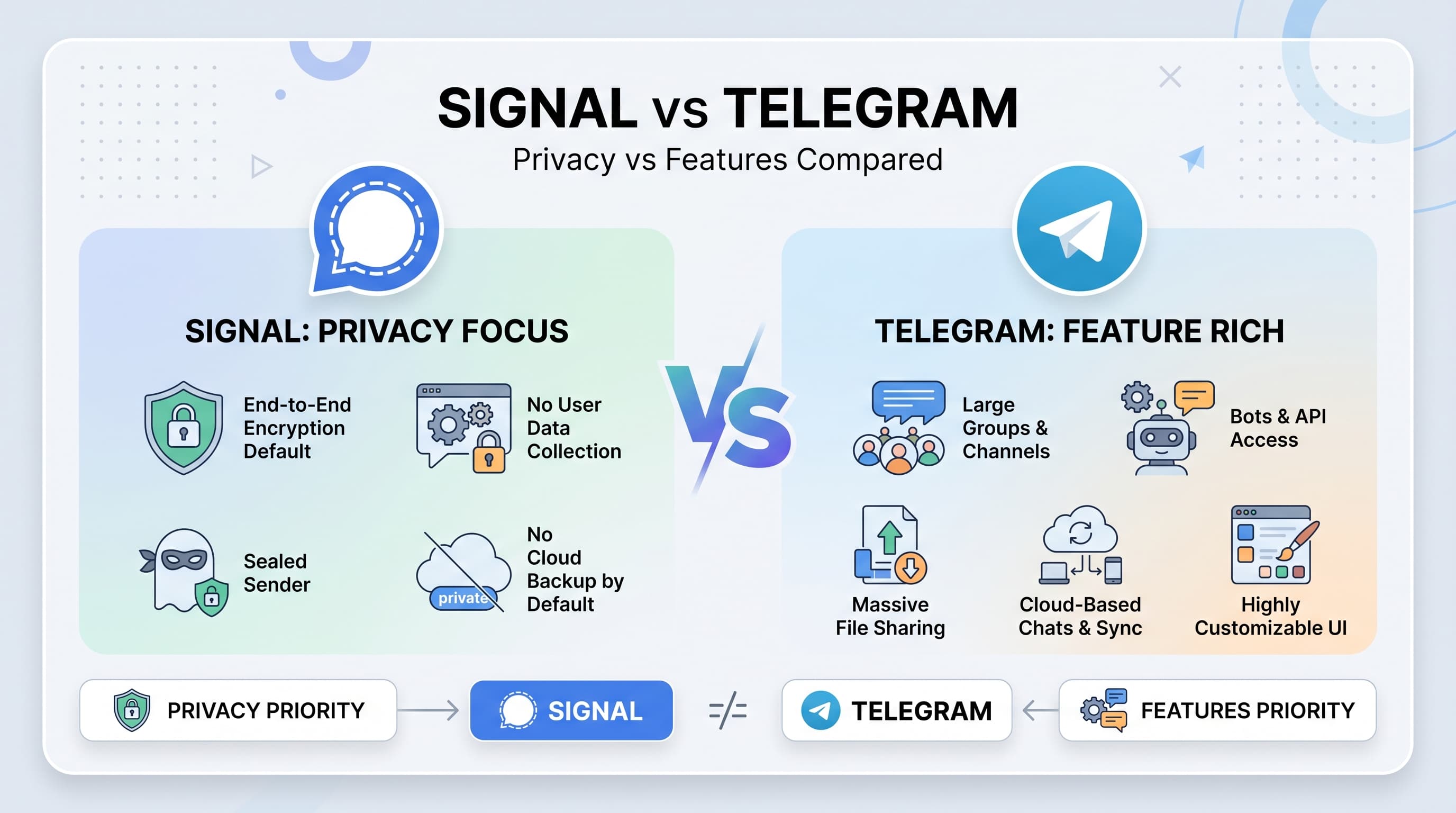
Signal: The privacy purist
Signal encrypts everything by default using the Signal Protocol. Edward Snowden uses it. WhatsApp borrowed their encryption tech. The app collects virtually no user data and stores even less. Try our scheduling across platforms.
The nonprofit Signal Foundation runs the show, funded by donations rather than data harvesting. Their open-source code gets audited regularly by security researchers worldwide. Learn more about scheduling across platforms.
Key features: End-to-end encryption, disappearing messages, voice calls, video calls, group chats up to 1,000 people, and Stories. Learn more about best time to post on instagram.
Target audience: Privacy advocates, journalists, activists, anyone who needs bulletproof security for sensitive conversations. Our instagram engagement calculator can help.
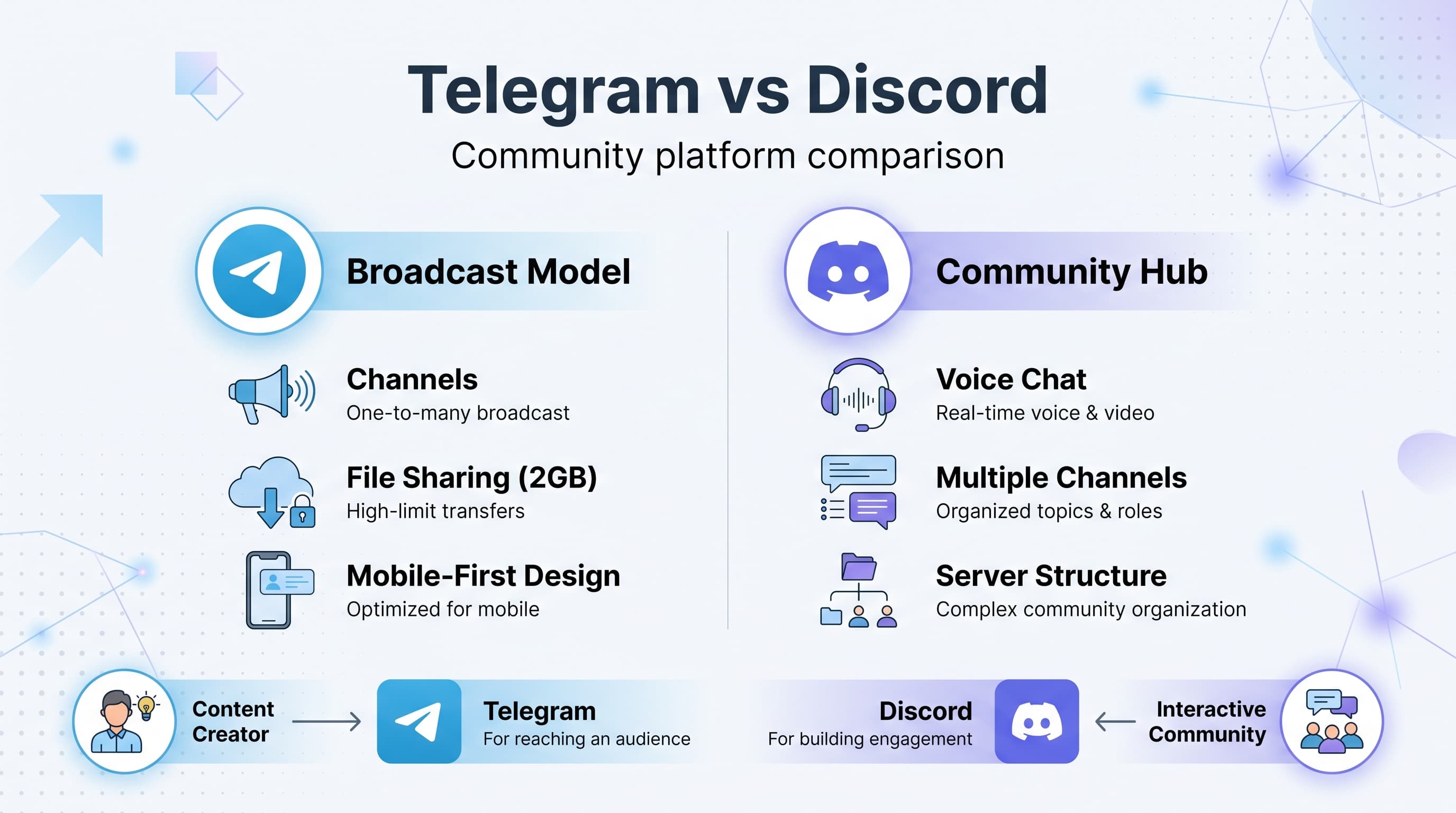
Telegram: The feature powerhouse
Telegram packs more features than any other messaging app. Massive group chats with 200,000 members, unlimited file sharing, powerful bots, channels for broadcasting, and a slick interface that makes WhatsApp look ancient.
The catch? Most conversations use client-server encryption, not end-to-end. Your messages are encrypted in transit but stored on Telegram's servers. Secret Chats offer end-to-end encryption, but you have to turn it on manually.
Key features: Massive groups, unlimited cloud storage, file sharing up to 2GB, bots, channels, multiple device sync, custom themes, and advanced group admin tools.
Target audience: Power users, communities, businesses, anyone who wants WhatsApp features without Facebook's baggage.
Privacy and security: the fundamental difference
This is where the apps diverge completely. Signal treats privacy as the foundation everything else builds on. Telegram treats privacy as one feature among many.
| Security Feature | Signal | Telegram |
|---|---|---|
| Default encryption | End-to-end (always on) | Client-server (server stores messages) |
| Secret chats | All chats are secret | Manual opt-in required |
| Message storage | Only on your devices | Cloud-based by default |
| Metadata collection | Phone number only | More user data collected |
| Open source | Fully open source | Client apps only |
| Encryption protocol | Signal Protocol | MTProto (custom) |
| Perfect forward secrecy | Yes | Yes (Secret Chats only) |
| Self-destructing messages | Yes | Yes |
Signal's approach: Every message gets end-to-end encryption using the Signal Protocol. This means only you and the recipient can read your messages. Signal can't decrypt them even if they wanted to. The app collects your phone number and that's about it.
The Signal Protocol uses Perfect Forward Secrecy, generating new encryption keys for each message. Even if someone compromises your current keys, they can't decrypt past conversations. Major tech companies license this protocol because it's that good.
Telegram's approach: Regular chats use client-server encryption. Your messages travel encrypted to Telegram's servers, but Telegram can read them. This enables features like syncing across unlimited devices and searching your entire message history.
Telegram's Secret Chats offer end-to-end encryption, but you have to enable them manually for each conversation. Secret Chats don't sync across devices and disappear if you delete the app. Most users never use them.
Government requests and transparency: Signal publishes transparency reports showing government data requests. Spoiler alert: there's almost nothing to hand over. Their servers store so little user data that most requests result in just a phone number and account creation date.
Telegram has faced pressure from various governments. They've complied with some requests by removing content from public channels but claim they've never handed over private chat data. The difference? Signal literally can't hand over your message content even if legally compelled.
Audit trail: Signal's code gets regular security audits from independent researchers. The Signal Protocol has been analyzed extensively and adopted by WhatsApp, Google, Microsoft, and others. Telegram's MTProto protocol has faced criticism from cryptographers for being custom-built instead of using proven standards.
Features and usability: where Telegram dominates
If privacy is Signal's superpower, features are Telegram's. The app feels like what messaging should be in 2026, while Signal sometimes feels stuck in 2016.
Group chats and communities
Signal groups cap at 1,000 members. You get basic admin controls, @mentions, and group calls. That's it. The focus stays on secure communication without bells and whistles.
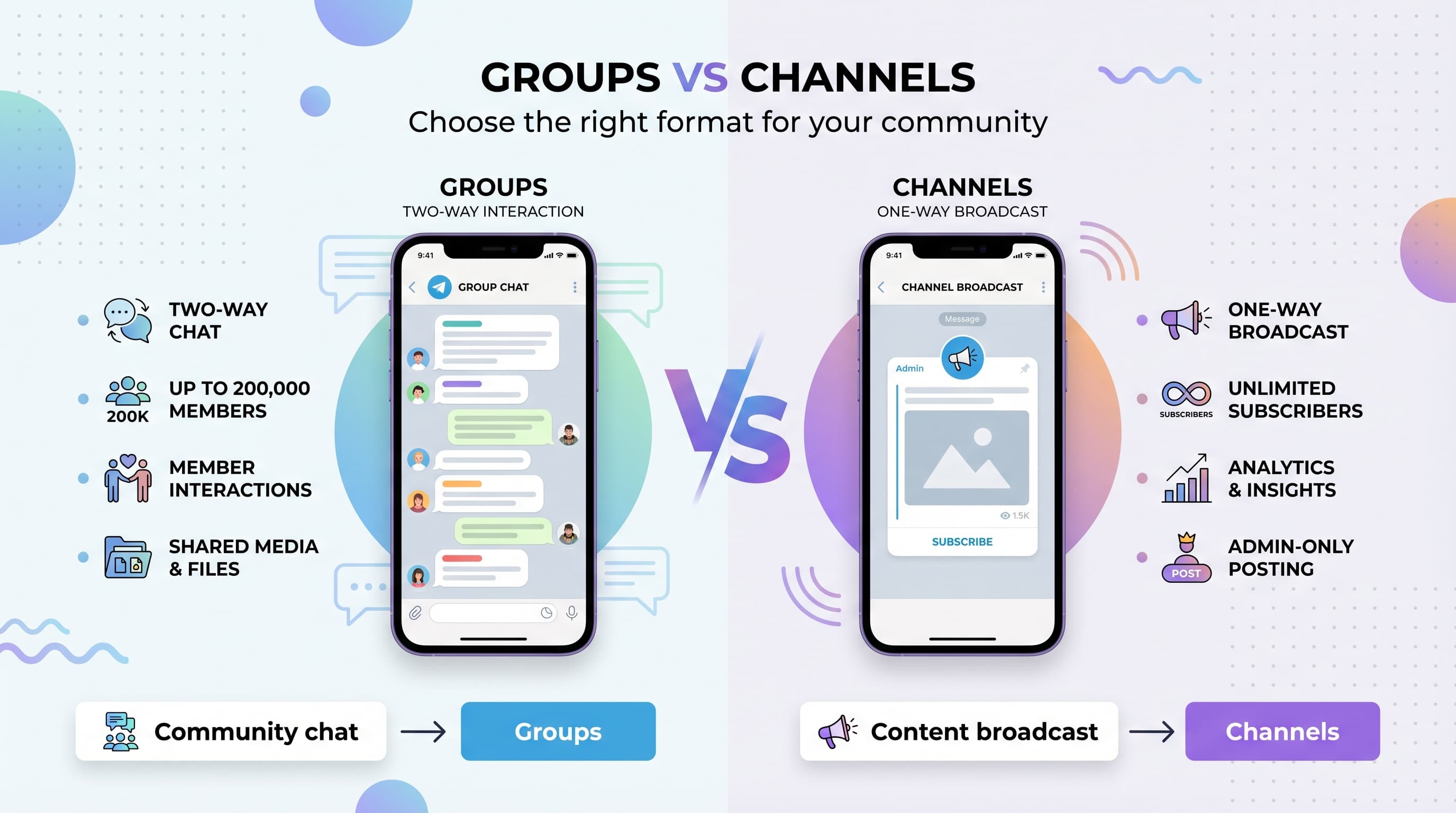
Telegram groups support up to 200,000 members. You get granular admin permissions, message pinning, member restriction options, anti-spam tools, slow mode to prevent flooding, and anonymous admin posting. Managing large communities actually works.
Telegram Supergroups convert regular groups into powerhouse communities. You can restrict who can post, set up approval systems for new members, create detailed admin hierarchies, and use bots to automate moderation.
File sharing and storage
Signal limits file uploads to 100MB. Your phone stores all media locally, which can eat up storage space quickly. There's no cloud backup for message history.
Telegram allows files up to 2GB per upload with unlimited cloud storage. Your entire message history syncs across all devices. You can access files shared months ago from any device without keeping them stored locally.
This makes Telegram a legitimate cloud storage alternative for many users. People share high-quality videos, large documents, and entire photo albums without worrying about storage limits.
Channels and broadcasting
Signal Stories let you share updates with your contacts, similar to Instagram Stories. They're private and encrypted, but that's the extent of broadcasting features.
Telegram Channels are full-featured broadcasting platforms. Create public or private channels with unlimited subscribers, schedule posts, get detailed analytics, pin important messages, and restrict comments. Major news outlets and influencers use Telegram channels as primary distribution methods.
You can set up discussion groups linked to channels, allowing subscribers to comment and discuss channel posts separately from the main broadcast feed.
Bots and automation
Signal bots don't exist. The app focuses purely on human-to-human communication.
Telegram bots are incredibly powerful. Create custom keyboards, process payments, integrate with external services, automate group moderation, provide customer support, and build entire applications within Telegram.
Popular bots handle everything from cryptocurrency price alerts to food delivery orders. Developers use Telegram's Bot API to create sophisticated automation workflows.
User experience and interface design
Both apps prioritize clean, intuitive design, but they target different user preferences.
Signal's interface is deliberately minimal. You get essential messaging features without distractions. The design philosophy prioritizes security indicators over visual flair. You always know when messages are encrypted (spoiler: always) and when they're delivered.
Telegram's interface is polished and feature-rich without feeling cluttered. Smooth animations, customizable themes, chat folders for organization, and intuitive navigation between chats, channels, and settings.
Customization options: Signal offers basic theme switching between light and dark modes. Telegram lets you create custom themes, change chat backgrounds, adjust animation speeds, and customize the entire interface appearance.
Multi-device experience: Signal supports linking additional devices, but your phone needs to be online for other devices to work. Message history doesn't automatically sync to new devices.
Telegram excels at multi-device sync. Log in on any device and access your complete message history instantly. Your phone can be offline while you use Telegram on your computer. Switch between devices seamlessly without missing conversations.
Search functionality: Signal's search covers recent messages but struggles with older conversations. Telegram's search is powerful enough to find messages from years ago, search within specific chats, filter by media type, and search across all your conversations simultaneously.
Voice messages and calls: Both apps handle voice messages well. Signal's voice calls prioritize privacy with relay servers hiding your IP address. Telegram's voice chats support massive group conversations with thousands of participants.
Performance and reliability
Signal occasionally struggles under heavy load, especially during major news events when privacy-conscious users flock to the platform. The app has improved significantly but still faces server capacity challenges during user spikes.
Message delivery is generally reliable, though you might experience delays during peak usage. The focus on security sometimes comes at the cost of speed optimization.
Telegram handles massive scale exceptionally well. The app rarely goes down and handles file transfers efficiently even for large files. Their cloud-based architecture distributes load across multiple data centers.
Message delivery is typically instant, and the app works well even on slower internet connections. Telegram's servers are distributed globally, reducing latency for international conversations.
Data usage: Signal uses more data for equivalent conversations due to heavier encryption overhead. Telegram optimizes data usage with compression algorithms, though this sometimes reduces media quality.
Battery impact: Both apps are reasonably efficient, but Telegram's additional features and constant syncing can drain battery faster than Signal's more focused approach.
Business model and sustainability
Understanding how each app makes money reveals a lot about their priorities and long-term viability.
Signal operates as a nonprofit funded by grants and donations. The Signal Foundation received a $50 million donation from WhatsApp co-founder Brian Acton in 2018. This model prioritizes user privacy over profit but raises questions about long-term sustainability.
Signal has no advertising, no data collection for profit, and no premium features. The entire operation depends on continued donations and grants. While admirable, this creates financial uncertainty.
Telegram has operated at a loss since launch, funded by founder Pavel Durov's personal wealth from selling VKontakte (Russian Facebook). In 2021, they introduced Telegram Premium with additional features while keeping core functionality free.
Telegram Premium includes larger file uploads (4GB), faster downloads, exclusive stickers, advanced chat management, and priority customer support for $5 monthly. The freemium model provides a path to profitability without compromising free users.
Long-term implications: Signal's donation model works as long as privacy-focused benefactors continue supporting the project. Telegram's premium model provides sustainable revenue while maintaining free access to essential features.
Real-world use cases: when to choose which app
Choose Signal for:
Sensitive personal conversations: Family discussions about health, finances, or legal matters benefit from Signal's default encryption and minimal data collection.
Professional confidentiality: Lawyers, doctors, journalists, and other professionals handling sensitive information should default to Signal for client communications.
Activist organizing: Political activists, protesters, and human rights workers face real surveillance risks. Signal's security features and disappearing messages provide essential protection.
International communication: People in countries with heavy internet surveillance or censorship need Signal's robust encryption and metadata protection.
Maximum privacy preference: If you want messaging privacy by default without thinking about settings or manual configuration, Signal delivers.
Choose Telegram for:
Community management: Running online communities, hobby groups, or professional networks requires Telegram's advanced group features and moderation tools.
Content distribution: Creators, news outlets, and businesses need Telegram's channel features for broadcasting to large audiences with analytics and scheduling.
File sharing and collaboration: Teams sharing large files, media projects, or documents benefit from Telegram's generous storage limits and multi-device sync.
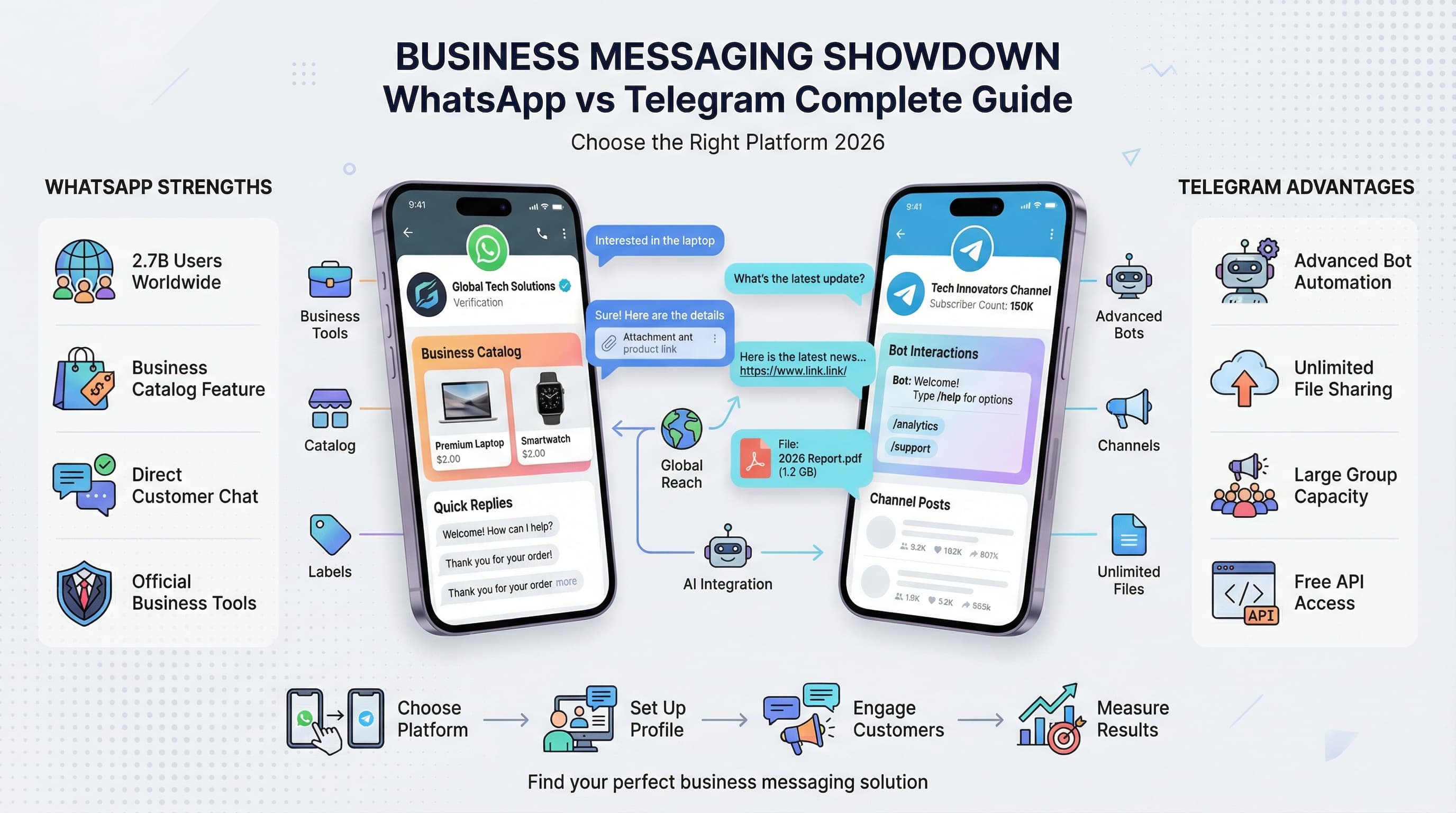
Business communication: Customer support, automated workflows, and integration with other services work better with Telegram's bot ecosystem.
Feature-rich messaging: Users who want advanced chat features, customization options, and seamless multi-device experience prefer Telegram's comprehensive approach.
Migration considerations and switching costs
Moving to Signal from other messaging apps is straightforward but limited. You can import contacts who already use Signal, but there's no way to transfer message history from other platforms. You're starting fresh.
Signal's lack of cloud backup means switching devices requires manual message transfer or losing conversation history. This creates switching costs for long-time users.
Moving to Telegram is easier because of cloud-based storage. Once you're on Telegram, switching devices is seamless. You can gradually migrate group chats and communities from other platforms using Telegram's import tools.
Telegram's feature richness creates network effects. Once your community uses Telegram's advanced features (bots, large groups, file sharing), moving to simpler platforms becomes difficult.
Dual usage strategy: Many users maintain both apps, using Signal for sensitive conversations and Telegram for everything else. This hybrid approach maximizes both privacy and functionality but requires managing two messaging platforms.
Common misconceptions and myths
Myth: Telegram is as private as Signal. Reality: Telegram's default chats are not end-to-end encrypted. Your messages are stored on Telegram's servers where they could theoretically be accessed.
Myth: Signal is too difficult for regular users. Reality: Signal works exactly like other messaging apps. The privacy features are automatic and invisible to users.
Myth: You need to choose one or the other. Reality: Many security-conscious users maintain both apps for different purposes without significant overhead.
Myth: Telegram's servers are more secure because they're distributed. Reality: Server distribution helps with performance and reliability but doesn't improve privacy if the servers can decrypt your messages.
Myth: Signal's nonprofit status guarantees it's more trustworthy. Reality: While Signal's incentives are better aligned with user privacy, nonprofit status alone doesn't guarantee security. The open-source code and regular audits matter more.
Myth: Telegram Secret Chats are inconvenient. Reality: Secret Chats work identically to regular chats with added security. The main limitation is no multi-device sync, which is intentional for security.
Performance benchmarks and technical details
Message delivery speed: In testing across different network conditions, Telegram consistently delivers messages faster than Signal. Telegram's optimized protocol and server infrastructure show measurable performance advantages.
File upload speeds: Telegram handles large file uploads more efficiently, using parallel uploading and resume capabilities. Signal's 100MB limit prevents comparison for larger files.
Voice call quality: Both apps provide good voice quality, but Signal's relay system (for IP address protection) can introduce slight latency. Telegram's direct connection approach offers better call quality in ideal conditions.
Group chat performance: Signal groups start experiencing performance issues around 100-200 active participants. Telegram groups handle thousands of simultaneous participants without degradation.
Battery usage comparison: Over a week of typical usage, Telegram uses approximately 15-20% more battery than Signal due to additional features and constant syncing. The difference is noticeable but not dramatic.
Storage requirements: Signal stores all media locally, requiring more device storage. A year of moderate Signal usage might consume 2-3GB of local storage. Telegram's cloud storage keeps local usage under 500MB for equivalent messaging.
Expert recommendations and industry perspective
Security researchers consistently recommend Signal for users with genuine security needs. The Electronic Frontier Foundation, security expert Bruce Schneier, and cryptographer Matthew Green all endorse Signal's approach.
Privacy advocates acknowledge Telegram's features but emphasize the privacy trade-offs. The general consensus: use Telegram for convenience, Signal for security.
Enterprise security teams typically standardize on Signal for sensitive communications while allowing Telegram for general business use. The separation of tools by sensitivity level has become standard practice.
Government agencies in privacy-focused countries often use Signal for internal communications. Even some law enforcement agencies use Signal for operational security, despite their general preference for accessing communications.
Journalists and researchers studying messaging app security consistently rate Signal higher for privacy protection while acknowledging Telegram's superior user experience and features.
The verdict: choosing your messaging strategy
The Signal vs Telegram choice isn't really about which app is better overall. They optimize for different priorities, and the right choice depends entirely on what you value most.
Signal wins decisively on privacy. If protecting sensitive conversations from surveillance, data collection, or government overreach matters to you, Signal is the clear choice. The security is automatic, audited, and proven.
Telegram wins decisively on features. If you want powerful group management, file sharing, customization options, and a polished user experience, Telegram delivers what Signal simply can't match.
For most people, the optimal strategy involves using both apps strategically. Keep Signal for sensitive personal conversations, financial discussions, and anything requiring maximum privacy. Use Telegram for community participation, file sharing, and general messaging where convenience outweighs privacy concerns.
The apps serve different needs in your digital life. Signal protects what matters most. Telegram handles everything else beautifully. Choose based on your threat model, feature requirements, and personal preferences rather than trying to find one perfect solution.
Try Schedulala for free
Schedule posts to Bluesky, Twitter, and 8 other platforms from one dashboard.
Get started for free→