Telegram Channel Monetization: Complete Guide to Making Money from Your Channel
Learn proven strategies for Telegram channel monetization. From ads to premium content, discover how to turn your channel into a profitable business.

Your Telegram channel has 50,000 subscribers and solid engagement. But your bank account? Still empty. Our Telegram scheduling can help.
See It in Action
This is what scheduling a Telegram post looks like in Schedulala
You're not alone. Thousands of channel owners sit on goldmines without knowing how to extract value. The good news? Telegram channel monetization is more accessible than ever, with multiple revenue streams that don't require millions of followers. Learn more about social media scheduling tools.
This guide covers every proven monetization method, from basic ad placements to advanced subscription models. You'll learn specific strategies, avoid common pitfalls, and discover tools that automate the money-making process. See our telegram content ideas what guide.
Try Schedulala for free
Schedule posts to Bluesky, Twitter, and 8 other platforms from one dashboard.
Get started for free→Why Telegram channel monetization works
Telegram's unique features make it a monetization powerhouse. Unlike other social platforms, Telegram doesn't take a cut of creator earnings. There's no algorithm suppressing your reach, and channels can grow to unlimited size without performance degradation. Try our scheduling across platforms.
Key advantages for monetization
Direct audience connection: No algorithm between you and your subscribers. When you post, everyone sees it immediately. Learn more about telegram line break generator.
High engagement rates: Telegram users are more active than typical social media users, with average engagement rates of 15-25%. Our telegram font generator can help.
Global reach: Telegram works everywhere, making it perfect for international monetization strategies.
Built-in payment system: Telegram Payments lets you sell directly through the app without external payment processors.
The platform's messaging-first approach creates stronger audience relationships than traditional social media. Your subscribers choose to receive your content, making them more likely to purchase products or services you recommend.
Sponsored posts and advertising
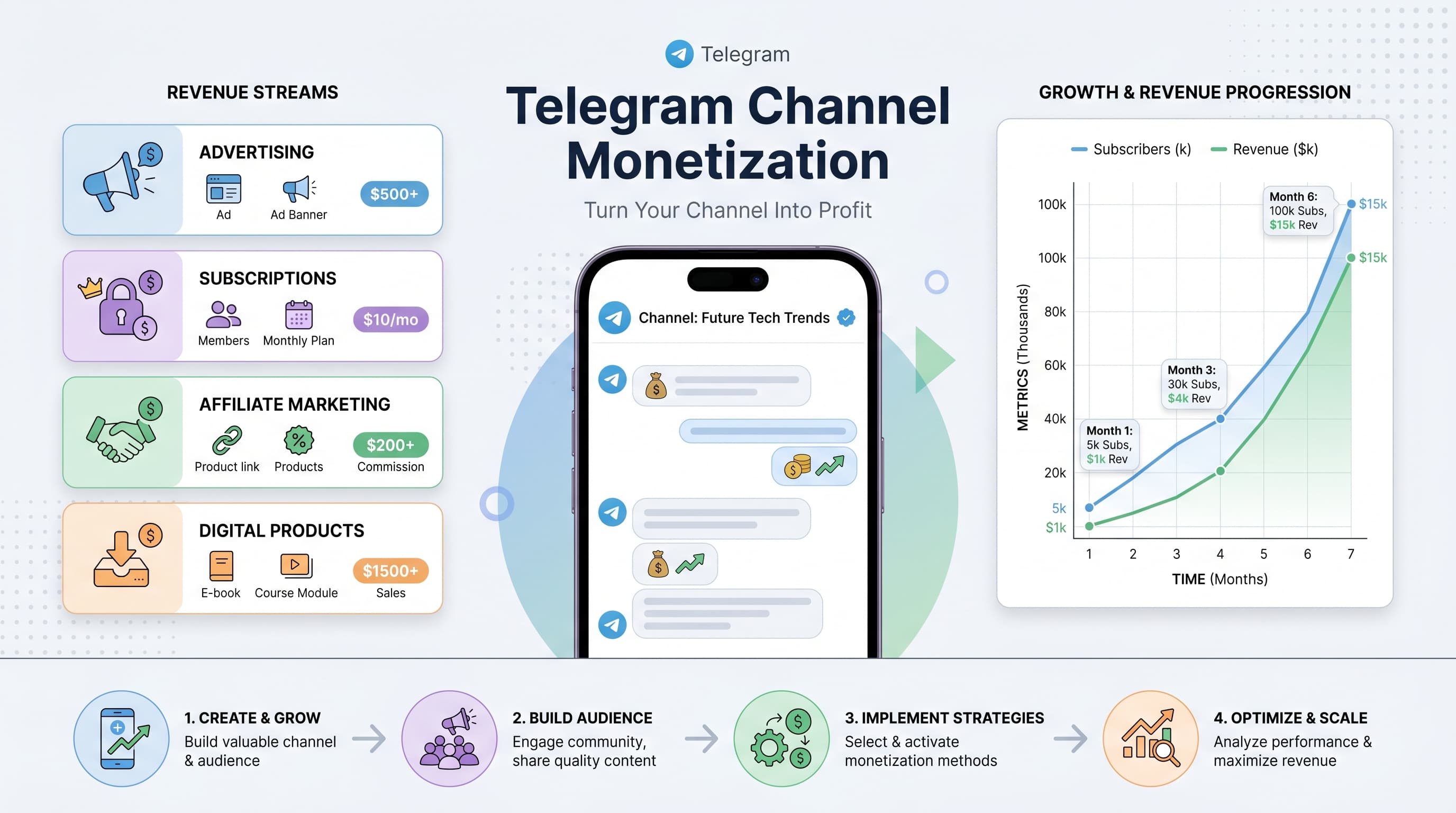
Sponsored content remains the most accessible monetization method for channels of any size. Brands pay for exposure to your audience, and rates vary based on niche, engagement, and subscriber count.
1. Direct brand partnerships
Reach out to companies in your niche directly. Tech channels can partner with software companies, fitness channels with supplement brands, and crypto channels with trading platforms.
Pricing formula: Charge $0.10-0.50 per subscriber for a single sponsored post, depending on your niche. Crypto and finance channels command premium rates ($0.30-0.50), while general entertainment channels typically earn $0.05-0.15 per subscriber.
Create a media kit with your channel stats, audience demographics, and sample sponsored posts. Include engagement rates, typical reach numbers, and testimonials from previous sponsors.
2. Ad networks and marketplaces
Telega.in: The largest Telegram advertising marketplace. Create a listing, set your rates, and brands contact you directly. They handle payment processing and dispute resolution.
Cross-promotion networks: Join networks where channel owners cross-promote each other's content. You pay to promote your channel and earn when others promote theirs on your channel.
CPM ad networks: Some networks pay per thousand views rather than per subscriber. Rates range from $0.50-3.00 CPM depending on your audience location and niche.
| Channel Size | Per-Post Rate (General) | Per-Post Rate (Crypto) | Monthly Potential |
|---|---|---|---|
| 1K-5K subs | $50-150 | $150-250 | $200-600 |
| 5K-20K subs | $250-800 | $600-1,200 | $1,000-3,200 |
| 20K-100K subs | $1,000-3,500 | $2,000-7,000 | $4,000-14,000 |
| 100K+ subs | $3,500+ | $7,000+ | $14,000+ |
The key to successful sponsored content is maintaining authenticity. Your audience follows you for your voice and opinions, not to see random ads. Only promote products you genuinely believe in, and always disclose sponsored content clearly.
Premium subscriptions and exclusive content
Creating premium tiers transforms casual followers into paying customers. This model works especially well for educational, trading, and professional development channels.
1. Setting up premium channels
Create a separate private channel for premium subscribers. Use your main channel to tease exclusive content and drive subscriptions to the premium tier.
Content differentiation strategies: Share basic tips on the free channel and detailed tutorials on premium. Post market updates publicly but detailed analysis privately. Offer live Q&A sessions exclusively to premium members.
Price premium subscriptions between $10-50 monthly, depending on value provided. Trading signals channels can charge $100+, while general lifestyle content typically maxes out at $20.
2. Content ideas for premium tiers
- Exclusive tutorials: Step-by-step guides not available anywhere else
- Early access: New content 24-48 hours before public release
- Trading signals: Real-time buy/sell recommendations for crypto or stocks
- Templates and resources: Downloadable files, spreadsheets, or design assets
- Direct access: Private chat with you for questions and advice
- Live sessions: Weekly webinars or voice chats with premium members
- Behind-the-scenes content: Your process, failures, and lessons learned
3. Managing premium subscribers
Use Telegram bots to automate subscription management. Bots can handle payments, add subscribers to premium channels, and remove them when subscriptions expire.
Popular subscription bots: @SubsBot handles monthly recurring payments and automatic access control. @PaymentBot integrates with Stripe for international payments. Both charge 5-7% transaction fees.
Set up payment reminders 3 days before expiration and grace periods for loyal subscribers experiencing temporary financial issues. Good customer service leads to higher retention rates.
Successful premium channels maintain a 60-80% retention rate after the first month. The key is delivering consistent value that subscribers can't find elsewhere. Document subscriber feedback to continuously improve your premium offering.
Affiliate marketing strategies
Affiliate marketing generates passive income by promoting other companies' products. Success requires choosing relevant products and building trust with your audience over time.
1. Choosing profitable affiliate programs
Focus on products your audience actually needs. Crypto channels should promote exchanges and trading tools, not random lifestyle products. Tech channels work well with software, courses, and digital tools.
High-paying affiliate categories: Online courses (30-50% commission), software subscriptions (recurring monthly commissions), financial services (CPA payments of $50-500), and digital marketing tools (25-40% commissions).
Research commission structures carefully. Some programs pay once, others provide recurring revenue. A $30 monthly software subscription with 30% commission generates $108 annually per referral.
2. Content strategies that convert
Product tutorials: Create comprehensive guides showing how to use affiliate products. Don't just list features; demonstrate real-world applications and results.
Comparison posts: Compare multiple tools in your niche, highlighting pros and cons. Include affiliate links for your top recommendations with clear reasoning for each choice.
Case studies: Share your own results using affiliate products. Screenshots, metrics, and specific outcomes build credibility and drive conversions.
Limited-time promotions: Partner with brands for exclusive discounts. Your audience gets value, and urgency increases conversion rates by 20-30%.
3. Tracking and optimization
Use UTM parameters or unique affiliate codes to track which posts generate sales. This data helps you focus on content types that actually convert.
Link management: Use link shorteners like Bit.ly or create branded short links. Track click-through rates and adjust posting strategies based on engagement data.
Test different call-to-action phrases. 'Get started here' often outperforms 'Click this link,' and 'Claim your discount' beats generic 'Learn more' buttons.
| Niche | Top Affiliate Categories | Average Commission | Conversion Rate |
|---|---|---|---|
| Crypto/Trading | Exchanges, Trading bots | $50-200 CPA | 3-7% |
| Tech/Programming | Courses, Software, Hosting | 30-50% | 2-5% |
| Business/Marketing | Tools, Courses, Templates | 25-40% | 4-8% |
| Fitness/Health | Supplements, Equipment | 15-30% | 2-4% |
| Lifestyle/Travel | Products, Services | 5-15% | 1-3% |
Selling digital products and services
Digital products offer the highest profit margins in Telegram monetization. Once created, they generate revenue with minimal ongoing effort while establishing you as an authority in your niche.
1. Course creation and delivery
Transform your expertise into structured courses. Break complex topics into digestible modules delivered over time through your Telegram channel.
Course formats that work: Video tutorials uploaded to Telegram (up to 2GB per file), PDF guides with step-by-step instructions, audio courses for busy professionals, and interactive challenges with daily tasks.
Price courses between $97-497 depending on depth and outcomes promised. Technical skills courses (programming, design) command higher prices than general knowledge courses.
Use Telegram's file sharing to deliver course materials directly to buyers. Create private channels for each course cohort to foster community and increase completion rates.
2. Templates, tools, and resources
Business templates: Marketing plans, social media calendars, email sequences, and sales funnels sell well to entrepreneurs and small business owners.
Design resources: Logos, social media templates, presentation themes, and graphics packages appeal to content creators and marketers.
Spreadsheets and calculators: Budget trackers, business dashboards, ROI calculators, and project management templates solve specific problems for busy professionals.
Bundle related resources together. A 'Complete Social Media Kit' with templates, calendars, and guides sells better than individual items and justifies higher prices.
3. Consulting and coaching services
Leverage your channel's authority to sell high-value services. Your content demonstrates expertise, making sales conversations easier and shorter.
Service pricing strategies: One-on-one coaching ($100-500 per session), group coaching programs ($297-997 monthly), strategy sessions ($200-1,000 per session), and done-for-you services ($1,000-5,000 per project).
Use Telegram for client communication and file sharing. Create dedicated channels for coaching clients where you share resources and conduct group sessions.
Offer consultation calls to high-value prospects who engage frequently with your content. Track which content types generate the most consultation requests to optimize your strategy.
The beauty of digital products is scalability. Once created, a course can sell thousands of copies without additional fulfillment costs. Focus on solving specific problems your audience faces, and price based on the value delivered, not time invested.
Donations and tip-based monetization
While not the most reliable income source, donations can supplement other monetization methods, especially for channels providing valuable free content.
1. Setting up donation systems
Crypto donations: Set up wallets for popular cryptocurrencies and share addresses in your channel bio. Bitcoin, Ethereum, and USDT are most commonly used for tips.
PayPal and traditional payments: Create PayPal.me links or use services like Ko-fi and Buy Me a Coffee for easy one-click donations.
Telegram Stars: Use Telegram's built-in tipping system where users can send paid reactions to your posts. Stars convert to real money, though rates vary by region.
2. Encouraging donations without being pushy
Frame donations as 'supporting the channel' rather than personal gain. Explain how donations help you create better content, invest in tools, or dedicate more time to the channel.
Value-first approach: Provide exceptional free content consistently, then mention donation options subtly. Users tip creators who consistently deliver value.
Share specific goals: 'Donations help me upgrade my recording equipment for better video quality' or 'Tips let me spend more time researching instead of freelancing.'
Donation-based monetization works best as a supplement, not a primary income source. Channels focused on education, news, or public service see higher donation rates than purely commercial content.
Automation tools for monetization
Managing multiple revenue streams manually becomes overwhelming as your channel grows. Automation tools handle repetitive tasks, letting you focus on content creation and strategy.
1. Content scheduling and management
Consistent posting keeps your audience engaged and maximizes monetization opportunities. Use scheduling tools to maintain presence even when you're not actively online.
Schedulala integration: Schedule sponsored posts, premium content releases, and promotional messages across multiple channels. Set up recurring posts for affiliate promotions and course launches.
Plan content calendars around monetization goals. Schedule product promotions between valuable free content to maintain audience trust while maximizing revenue opportunities.
2. Subscriber management bots
Payment processing bots: Automate premium subscription billing, trial periods, and access control. These bots add subscribers to premium channels automatically upon payment and remove them when subscriptions expire.
Welcome sequence automation: Set up automated message sequences for new subscribers, introducing your monetization offers gradually without overwhelming them.
Engagement tracking: Use bots to track which subscribers engage most with your content, helping identify potential customers for high-value products and services.
3. Analytics and optimization
Track key metrics to optimize monetization strategies. Monitor which content types generate the most clicks, conversions, and revenue to inform future content decisions.
Essential metrics: Click-through rates on affiliate links, conversion rates for different products, subscriber growth rates, and revenue per subscriber by channel segment.
Use UTM parameters and tracking pixels to measure campaign effectiveness. A/B test different promotional approaches to find what resonates with your specific audience.
Common monetization mistakes to avoid
Learning from others' mistakes saves time and protects your channel's reputation. These pitfalls can damage audience trust and reduce long-term earning potential.
1. Over-monetizing too quickly
The 80/20 rule: Provide value 80% of the time, promote products 20% of the time. New channels often flip this ratio, causing subscribers to leave before monetization takes hold.
Build audience trust before introducing monetization. Subscribers need to see consistent value before they're willing to pay for premium content or click affiliate links.
Introduce monetization gradually: start with subtle affiliate mentions, then sponsored posts, and finally premium offerings as your audience grows and engages.
2. Promoting irrelevant products
Relevance matters more than commission rates: A 5% commission on a relevant product often generates more income than 50% commission on something your audience doesn't need.
Survey your audience regularly to understand their pain points, goals, and purchasing behavior. Use this information to choose affiliate partners and create digital products that actually sell.
Test promotions with small segments before full channel rollouts. Track engagement rates and unsubscribe patterns to identify products that don't resonate with your audience.
3. Neglecting legal compliance
FTC disclosure requirements: United States law requires clear disclosure of paid partnerships and affiliate relationships. Other countries have similar regulations.
Keep records of all sponsored content, payments received, and products promoted. This documentation protects you if questions arise about compliance or tax obligations.
Research regulations in your country and key audience locations. European GDPR affects how you collect subscriber data, while US tax laws impact affiliate income reporting.
Scaling your Telegram monetization
Once basic monetization is working, focus on scaling successful strategies and diversifying revenue streams. Growth requires systematic approaches rather than random tactics.
1. Multiple channel strategy
Create specialized channels for different audience segments. A main general channel can spawn niche channels for specific topics, each with targeted monetization strategies.
Channel hierarchy: Use your main channel to drive traffic to specialized premium channels. Cross-promote between channels to maximize subscriber lifetime value across your network.
Different channels can have different monetization models: one focused on affiliate marketing, another on premium subscriptions, and a third on course sales.
2. Building sales funnels
Design subscriber journeys that naturally lead to higher-value purchases. Start with free valuable content, offer low-price products, then introduce premium services.
Funnel example: Free channel content → $10 template pack → $97 course → $297 group coaching → $997 one-on-one service. Each step builds trust and demonstrates value.
Use email capture alongside Telegram to build owned audiences. Email subscribers often convert at higher rates than social media followers for high-value products.
3. Partnership and collaboration opportunities
Partner with other channel owners in complementary niches for cross-promotion, joint products, and shared affiliate campaigns. Collaboration expands reach without additional ad spend.
Joint venture strategies: Co-create courses combining different expertise areas, share affiliate commissions for mutual promotions, and bundle products from multiple creators.
Build relationships with brands beyond one-off sponsored posts. Long-term partnerships often include higher rates, exclusive deals, and co-marketing opportunities.
| Growth Stage | Revenue Range | Primary Focus | Key Strategies |
|---|---|---|---|
| Startup (0-1K) | $0-100 | Audience building | Consistent content, basic monetization |
| Growth (1K-10K) | $100-1,000 | Monetization testing | Affiliate links, sponsored posts |
| Scale (10K-50K) | $1,000-5,000 | System optimization | Premium content, automation |
| Expansion (50K+) | $5,000+ | Diversification | Multiple channels, partnerships |
Measuring monetization success
Success metrics go beyond total revenue. Track efficiency, sustainability, and audience satisfaction to build long-term profitable channels.
Key performance indicators
- Revenue per subscriber: Divide monthly revenue by total subscribers to track monetization efficiency
- Customer lifetime value: Average revenue generated per subscriber over their entire relationship with your channel
- Conversion rates: Percentage of subscribers who purchase products or click affiliate links
- Retention rates: How many premium subscribers renew, and how long free subscribers stay engaged
- Engagement rates: Likes, shares, and comments on monetized vs. non-monetized content
- Unsubscribe patterns: Track when people leave to identify over-monetization issues
Set up monthly reporting to track these metrics consistently. Use spreadsheets or simple analytics tools to identify trends and optimize underperforming monetization strategies.
Try Schedulala for free
Schedule posts to Bluesky, Twitter, and 8 other platforms from one dashboard.
Get started for free→