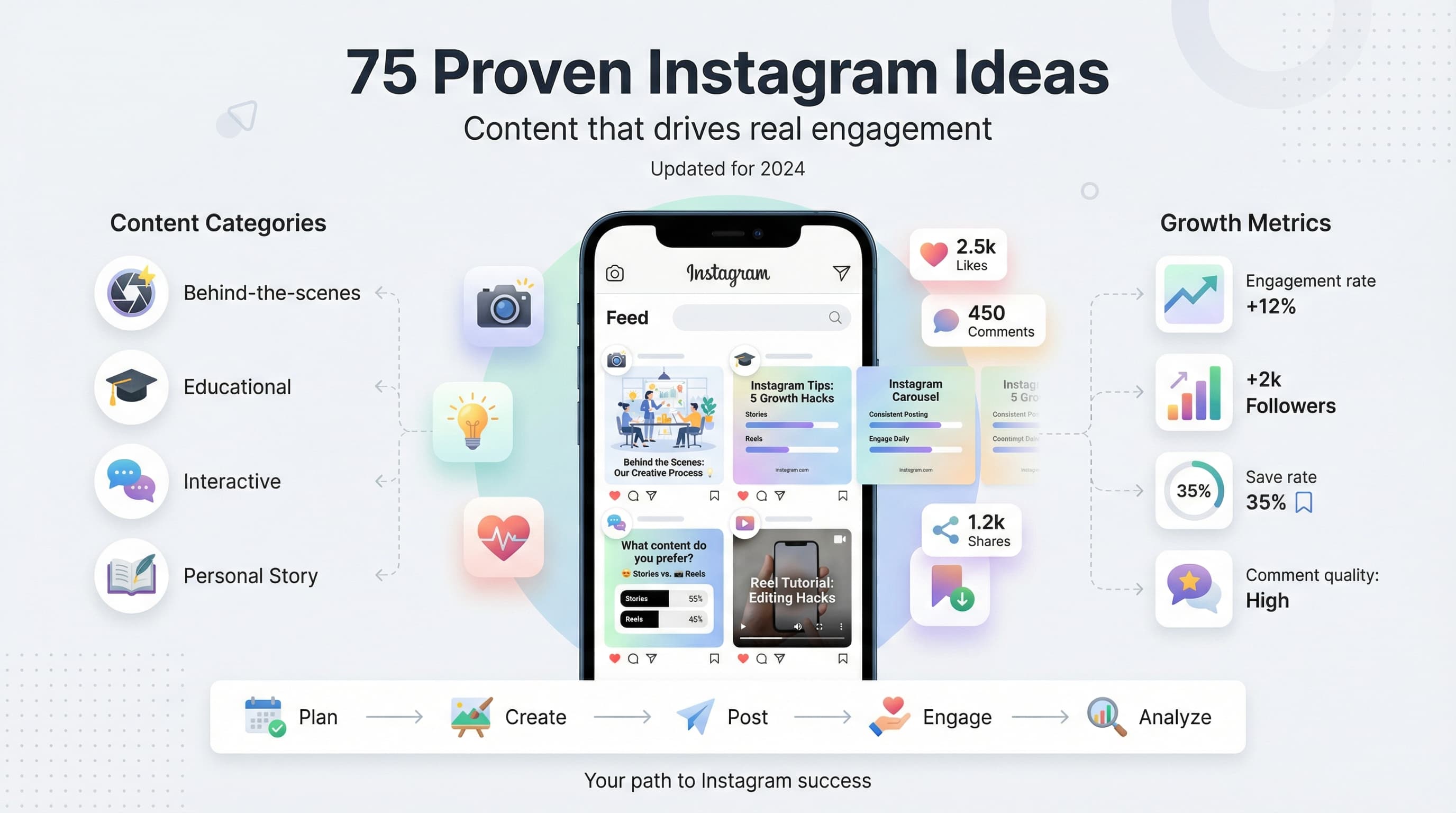
Instagram Content Ideas: 75 Posts That Work
75 proven Instagram content ideas to boost engagement. From behind-the-scenes posts to user-generated content, these creative ideas work for any brand.

Quick answer
Post a mix of behind-the-scenes content, user-generated content, Reels, carousels, and educational posts to keep your Instagram feed engaging.
- •Behind-the-scenes posts build trust and get 20-40% more engagement than polished content
- •User-generated content provides social proof and costs nothing to create
- •Educational carousel posts are the most saved content type on Instagram
- •Schedule 3-5 posts per week consistently with Schedulala for $9/month across 12 platforms
Running out of Instagram content ideas is every creator's nightmare. Our Instagram scheduling can help.
See It in Action
This is what scheduling an Instagram post looks like in Schedulala
You sit there staring at a blank post, wondering what your audience actually wants to see. The pressure to stay consistent while keeping things fresh can feel overwhelming. Learn more about social media scheduling tools.
What if you had a proven list of content ideas that actually drive engagement? Try our batch content creation.
Try Schedulala for free
Schedule posts to Bluesky, Twitter, and 8 other platforms from one dashboard.
Get started for free→Why These 75 Instagram Content Ideas Actually Work
These aren't random suggestions pulled from thin air. Each content type on this list has been tested by thousands of creators and brands. They work because they tap into fundamental human psychology: curiosity, social proof, entertainment, and education. Our the best time to can help.
The best part? You can adapt every single idea to fit your niche, whether you're a fitness coach, food blogger, tech startup, or fashion brand. The framework stays the same, but the execution becomes uniquely yours. Try our best time to post on instagram.
Behind-the-Scenes Content (Ideas 1-10)
1. Morning Routine Reveal
Show your actual morning routine, not the highlight reel version. Include the messy parts, the coffee spills, and the moments of doubt. Authenticity beats perfection every time. See our instagram engagement calculator guide.
Example: A business owner showing their 5am workout, followed by reviewing emails while eating breakfast, complete with their dog interrupting the shot.
2. Workspace Tour
Give followers a peek into where the magic happens. Show your desk setup, favorite tools, and maybe that pile of papers you've been avoiding.
Variation: Do a "then vs now" comparison of your workspace evolution.
3. Decision-Making Process
Walk through how you make tough business or creative decisions. Show the pros and cons lists, the research phase, and the final choice.
This builds trust because people see you as thoughtful rather than impulsive.
4. Failure Recovery
Share a recent mistake and how you're fixing it. Maybe a product launch that flopped or a campaign that missed the mark.
People connect with vulnerability more than they connect with constant success stories.
5. Team Dynamics
Show your team in action (with their permission). Highlight different personalities, inside jokes, and collaborative moments.
Even solopreneurs can show their "team" of freelancers, mentors, or advisors.
6. Creative Process Breakdown
Document how you go from initial idea to finished product. Show the sketches, iterations, and revisions.
This works for any industry: recipe development, logo design, workout programming, or content planning.
7. Day-in-the-Life Reality
Not the polished version, but the real one. Include the unexpected calls, the lunch eaten at your desk, and the 3pm energy crash.
Show time stamps and be honest about how long things actually take.
8. Tool and Resource Reveals
Show the apps, books, or physical tools you actually use daily. Give mini reviews of each one.
Go beyond the obvious choices and share some hidden gems your audience might not know about.
9. Learning Moments
Share something new you discovered recently. Maybe a technique, a mindset shift, or a resource that changed your approach.
Position yourself as a fellow learner, not just a teacher.
10. Prep Work Showcase
Show all the work that happens before the final result. The research, the prep, the setup that most people never see.
This helps people understand why your services or products are priced the way they are.
Educational and Tutorial Content (Ideas 11-25)
11. Quick Win Tutorials
Teach something your audience can implement in under 5 minutes. Focus on immediate, actionable results.
Example: "3-step email subject line formula that increased my open rates by 40%."
12. Mistake Prevention Guide
Share the top 3-5 mistakes beginners make in your field and how to avoid them. This positions you as the expert who can help them skip the learning curve.
Make it specific to your niche for maximum impact.
13. Tool Comparison Posts
Compare 2-3 popular tools in your industry. Give honest pros and cons for each, including pricing and use cases.
This type of content gets saved frequently because people reference it when making purchasing decisions.
14. Step-by-Step Process Breakdown
Take a complex process and break it into digestible steps. Use carousel posts to walk through each phase visually.
Include time estimates and difficulty levels for each step.
15. Industry Myths Debunked
Call out common misconceptions in your field. Explain why these beliefs persist and what the truth actually is.
This type of content often sparks healthy discussion in the comments.
16. Resource Roundup
Curate 5-10 valuable resources around a specific topic. Include why you recommend each one and who it's best for.
Mix free and paid resources to serve different budget levels.
17. Before and After Transformation
Show the transformation process, whether it's a room makeover, body transformation, or business growth. Include the timeline and key actions taken.
Be specific about what changed and what didn't work along the way.
18. Beginner vs Expert Approaches
Compare how beginners and experts approach the same challenge differently. Explain the mindset shifts that happen with experience.
This helps your audience understand their own journey and what to work toward.
19. Seasonal Strategy Shifts
Explain how your approach changes based on the season, market conditions, or trends. Share specific adjustments you make and why.
This shows your strategic thinking and adaptability.
20. Quick Reference Guides
Create cheat sheets or quick reference guides that people can save and use repeatedly. Think formulas, checklists, or decision trees.
These posts get bookmarked and shared frequently.
21. Problem-Solution Pairing
Identify a specific problem your audience faces and walk through your solution step by step. Include alternatives if your main solution doesn't work.
Focus on problems that cause real frustration or cost money when unsolved.
22. Trend Analysis and Predictions
Share your take on current trends in your industry. Explain which ones you think will stick around and which ones are just hype.
Include data or evidence to support your predictions when possible.
23. Cost Breakdown Transparency
Break down the real costs of something in your industry. This could be starting a business, running a campaign, or investing in equipment.
Include hidden costs people often overlook.
24. Time-Saving Hacks
Share specific ways to do common tasks faster or more efficiently. Focus on hacks that save at least 30 minutes per week.
Include the tools or systems that make these hacks possible.
25. Research Deep Dives
Take a recent study or piece of research relevant to your audience and break it down in simple terms. Explain what it means for them practically.
Always link back to the original source to build credibility.
Interactive and Community-Building Content (Ideas 26-40)
26. This or That Polls
Create visual polls that force your audience to choose between two options. Make the choices relevant to your industry or current trends.
Example: "Morning workouts or evening workouts?" with compelling visuals for each option.
27. Caption This Photo
Post an interesting or funny image and ask your audience to write the caption. Choose industry-relevant images that spark creativity.
Highlight the best responses in your stories to encourage more participation.
28. Ask Me Anything (AMA) Sessions
Dedicate posts to answering follower questions. You can collect questions in advance or answer them live in stories.
Focus on questions that provide value to your broader audience, not just the person asking.
29. Collaboration Spotlights
Feature other creators or businesses you've worked with. Share what you learned from the collaboration and how it benefited your audience.
This builds relationships and introduces your audience to valuable resources.
30. Challenge Announcements
Launch week-long or month-long challenges that get your community involved. Make the challenge specific and achievable.
Create a unique hashtag and encourage participants to share their progress.
31. Community Wins Celebration
Share success stories from your audience (with permission). Highlight specific results they achieved using your advice or products.
Include before/after details and what made the difference for them.
32. Debate Starters
Post controversial (but professional) takes on industry topics. Frame them in a way that encourages respectful discussion.
Monitor comments closely and engage thoughtfully with different viewpoints.
33. Fill in the Blank Posts
Create posts where followers complete a sentence or phrase related to your niche. Make the prompt specific enough to generate interesting responses.
Example: "The biggest game-changer for my morning routine was _____."
34. Rate My Setup
Ask followers to rate something you've created: a workspace, outfit, meal, or design. Be open to constructive feedback.
Use the feedback to improve and show your audience that you value their input.
35. Predict the Outcome
Before launching something new or trying an experiment, ask your audience to predict the results. Follow up with actual outcomes.
This creates anticipation and gives you content for multiple posts.
36. Weekly Check-ins
Create a consistent weekly post where followers can share updates, wins, or challenges. Respond to as many as possible to build connection.
Consider featuring standout responses in your stories.
37. Ranking Games
Ask your audience to rank items from best to worst: tools, strategies, trends, or preferences. Share your own ranking for comparison.
These posts generate lots of comments because everyone has opinions.
38. Story Prompts
Give your audience a prompt to share their own stories in the comments. Make it specific to your niche but relatable to most followers.
Example: "Tell me about a time when you almost gave up but pushed through instead."
39. Advice Request Posts
Ask your community for advice on a decision you're facing. This shows vulnerability and makes followers feel valued for their expertise.
Follow up later with what you decided and how their input influenced your choice.
40. Group Photo Recreations
Start a trend where followers recreate a photo or pose you share. Make it simple enough that anyone can participate.
Repost the best recreations to encourage more participation.
Personal Brand and Storytelling Content (Ideas 41-55)
41. Origin Story Breakdown
Tell the story of how you got started, but focus on one specific moment or decision that changed everything. Don't tell your whole life story in one post.
Include the emotions you felt and what you learned from that pivotal moment.
42. Values in Action
Share a recent situation where you had to choose between profit and principles. Explain your decision-making process and what it taught you.
This builds trust by showing your character under pressure.
43. Mentor Appreciation
Highlight someone who influenced your journey. Share specific advice they gave you and how you applied it.
Tag them if appropriate and explain why their guidance mattered.
44. Childhood Connections
Connect something from your childhood to your current work or interests. Maybe you were always organizing things, creating art, or solving problems.
This helps people understand your natural strengths and authentic interests.
45. Biggest Mindset Shifts
Share a belief you used to hold that you've completely changed your mind about. Explain what caused the shift and how it impacted your life or business.
This shows growth and intellectual honesty.
46. Daily Rituals and Why They Matter
Share a simple daily ritual that keeps you grounded or focused. Explain the science or psychology behind why it works.
Make it something your audience could easily adopt.
47. Fear Confession
Share something you're genuinely afraid of in business or life. Explain how you're working through it or what you've learned by facing it.
Vulnerability creates connection, but keep the focus on growth and learning.
48. Unexpected Inspiration Sources
Share where you find inspiration outside your industry. Maybe it's nature, other art forms, or completely unrelated fields.
Explain how these diverse inputs improve your work.
49. Personal Rules and Boundaries
Share 3-5 personal or professional rules you never break. Explain why each one matters and how it's served you.
This gives insight into your decision-making process and values.
50. Advice to Past Self
Write a letter to yourself from 5 years ago. What would you tell your past self to do differently or keep doing?
Make the advice specific and actionable rather than generic platitudes.
51. Unpopular Opinions
Share a professional opinion that goes against conventional wisdom in your industry. Support it with your experience or evidence.
Frame it respectfully but don't be afraid to take a stand.
52. Book or Podcast Impacts
Share a book or podcast that significantly changed your thinking. Explain the specific concept that resonated and how you applied it.
Give your audience enough detail that they can decide if it's worth their time too.
53. Identity Evolution
Share how you've changed as a person or professional over the past few years. What old identity did you shed and what new one did you embrace?
This helps followers who are going through their own transitions.
54. Life Lessons from Unexpected Places
Share a profound lesson you learned from an unlikely source: a child, a difficult client, a failed project, or a random conversation.
Focus on how it changed your perspective or approach.
55. Future Vision
Share your vision for where you want to be in 5 years, but make it specific and personal rather than just business goals.
Include what kind of person you want to become, not just what you want to achieve.
Trending and Seasonal Content (Ideas 56-65)
56. Holiday Industry Connections
Connect major holidays to your industry in unexpected ways. Don't just post generic holiday greetings; find meaningful connections.
Example: A productivity coach sharing "spring cleaning" tips for digital workflows during March.
57. Current Event Analysis
Analyze how current events might impact your industry or audience. Stay factual and focus on practical implications.
Avoid taking political sides unless that's specifically your brand's positioning.
58. Seasonal Strategy Updates
Explain how your approach changes with the seasons. This could be workout routines, business strategies, or creative processes.
Help your audience adapt their own approaches seasonally.
59. Trend Predictions
Share your predictions for upcoming trends in your industry. Explain your reasoning and what signals you're watching.
Follow up later to see how accurate your predictions were.
60. Anniversary Reflections
Mark significant anniversaries in your business or personal journey. Share specific metrics, lessons learned, or milestones reached.
Make it about the journey and growth, not just celebration.
61. New Year Goal Reality Check
In March or April, do a honest check-in on New Year goals. Share what's working, what isn't, and how you're adjusting.
This is more valuable than the typical January goal-setting content.
62. Back-to-School Professional Tips
Even if you're not in education, tap into the back-to-school energy in September. Share tips for learning new skills or starting fresh.
Focus on professional development and skill-building.
63. End-of-Year Wrap-ups
Share your biggest wins, failures, and lessons from the year. Include specific numbers and honest reflections.
Make it a mix of celebration and learning for maximum value.
64. Monthly Theme Announcements
Dedicate each month to focusing on a different aspect of your expertise. Announce the theme and explain why it matters now.
This gives your content strategy structure and helps followers know what to expect.
65. Cultural Moment Commentary
When something big happens in popular culture, share how it relates to your field. Look for unexpected connections and insights.
This shows you're culturally aware and can think creatively about connections.
Product and Service Showcase Content (Ideas 66-75)
66. Problem-First Product Introductions
Instead of leading with your product features, start with the problem it solves. Paint a picture of the frustration, then reveal your solution.
Include specific customer scenarios where this problem shows up.
67. Customer Success Transformations
Share detailed case studies of customer transformations. Include timeline, challenges faced, and specific results achieved.
Focus on the customer's journey rather than just promoting your service.
68. Behind Product Development
Show the messy middle of creating something new. Include failed prototypes, user feedback sessions, and iteration cycles.
This builds appreciation for the thought and work that goes into your offerings.
69. Honest Product Limitations
Share what your product or service isn't good for. Explain who shouldn't buy it and why.
This counterintuitive approach builds trust and attracts better-fit customers.
70. Price Justification Breakdowns
Break down exactly what goes into your pricing. Include time, expertise, materials, and overhead costs.
Help people understand the value they're getting for their investment.
71. Frequently Asked Objections
Address the most common concerns or objections people have about your offering. Be direct and honest in your responses.
This removes barriers for people who are on the fence about purchasing.
72. Alternative Solutions Comparison
Compare your solution to alternatives, including doing nothing or DIY approaches. Be fair and objective in your comparison.
Help people understand when each approach makes sense.
73. Customer Feedback Integration
Show how customer feedback has shaped your product or service improvements. Include specific changes you've made based on user input.
This demonstrates that you listen and continuously improve.
74. Service Process Walkthrough
Take followers through your entire service process from initial contact to final delivery. Include timelines and what they can expect at each stage.
This reduces anxiety and sets clear expectations for potential clients.
75. ROI and Results Documentation
Share specific, measurable results your customers have achieved. Include percentages, dollar amounts, and time frames when possible.
Use charts or graphics to make the data easily digestible and shareable.
Making These Ideas Work for Your Brand
Having 75 content ideas is great, but execution is everything. The key is adapting each concept to your unique voice, audience, and expertise.
Customization Strategy
Take each idea and ask yourself: "How does this apply specifically to my audience's biggest challenge?" Don't just copy the format; make the content unmistakably yours.
For example, if you're a fitness coach, the "morning routine reveal" becomes about how your routine supports your training goals. If you're a graphic designer, it becomes about how your morning routine sets up your creative flow.
Content Batching Approach
Don't try to use all 75 ideas next month. Pick 10-12 that excite you most and create multiple variations of each. One "behind-the-scenes" concept can become 5-6 different posts.
Batch similar content types together. Film all your tutorial content in one session, write all your educational posts in another block of time.
Audience-First Filtering
Not every idea will resonate with your specific audience. Test different types and pay attention to engagement patterns. Double down on what works and abandon what doesn't.
Your audience will tell you what they want more of through their likes, comments, saves, and shares.
| Content Type | Best For | Engagement Level | Time Investment |
|---|---|---|---|
| Behind-the-scenes | Building trust | High | Low |
| Educational | Establishing expertise | Medium-High | Medium |
| Interactive | Community building | Very High | Low-Medium |
| Personal stories | Brand connection | High | Medium |
| Product showcase | Driving sales | Medium | Medium-High |
Content Planning and Scheduling Success
Great content ideas mean nothing without a solid execution plan. The most successful Instagram accounts don't just create randomly; they plan strategically and post consistently.
The 80/20 Content Rule
Use 80% of your content to provide value (education, entertainment, inspiration) and only 20% for direct promotion. This builds trust and keeps followers engaged rather than feeling sold to constantly.
Within these 75 ideas, roughly 60 should be pure value-add content, while 15 can have promotional elements woven in naturally.
Timing and Frequency Strategy
Quality beats quantity every time, but consistency is non-negotiable. It's better to post 3 high-quality posts per week consistently than to post daily for two weeks and then disappear.
Use scheduling tools to maintain consistency even during busy periods. Batch your content creation and schedule posts in advance to take the daily pressure off.
Engagement Amplification
The real magic happens in the comments and DMs after you post. Plan to spend 15-20 minutes engaging with comments on each post within the first few hours of publishing.
Ask specific questions in your captions to encourage responses, then actually respond to those comments thoughtfully.
Measuring What Actually Matters
Vanity metrics like follower count feel good, but they don't grow your business. Focus on metrics that indicate real engagement and business impact.
Engagement Quality Over Quantity
A post with 50 meaningful comments from your ideal customers is infinitely more valuable than 500 likes from random accounts. Look for comments that show people are actually consuming and thinking about your content.
Save rates are particularly important because they indicate content people want to reference later. Educational and resource posts typically have the highest save rates.
Business Impact Tracking
Connect your Instagram content to actual business outcomes. Track how many leads, sales, or meaningful connections you can trace back to specific posts or content types.
Use unique tracking links or codes when appropriate to measure conversion from Instagram to your website or offers.
Content Performance Patterns
After 30-60 days of consistent posting, analyze which of these 75 content types perform best for your specific audience. Double down on your top 5 performers and experiment with variations.
Look for patterns in timing, format, and topics. Your audience might love behind-the-scenes videos but ignore educational carousels, or vice versa.
Advanced Content Strategies
Once you've mastered the basics of these content ideas, there are advanced strategies that can multiply your results without creating more content.
Content Repurposing Mastery
Each of these 75 ideas can be adapted across multiple formats. A tutorial post becomes a Reel, a carousel, a Story highlight, and an IGTV video. You're not creating four pieces of content; you're maximizing one great idea.
The key is understanding which format works best for each type of information and audience preference.
Cross-Pollination Strategy
Combine ideas from different categories for unique content angles. Mix a "behind-the-scenes" approach with "educational content" to show how you research and develop your tutorials.
These hybrid approaches often perform better than straightforward single-category content because they offer multiple value propositions in one post.
Seasonal Content Banking
Use trending and seasonal ideas as tentpole moments to amplify your evergreen content. Create special versions of your best-performing educational or behind-the-scenes content with seasonal angles.
This strategy helps you ride trending moments while staying true to your core expertise and brand voice.
Final Verdict: Your Instagram Content Game Plan
You now have 75 proven content ideas, but success comes from strategic implementation, not just having a big list. The accounts that win on Instagram are the ones that pick a focused set of content types and execute them consistently with their unique perspective.
Start with 3-5 categories that align best with your goals and audience needs. Master those before expanding to other types. Remember, your audience would rather see you do five content types exceptionally well than 25 types mediocrely.
Try Schedulala for free
Schedule posts to Bluesky, Twitter, and 8 other platforms from one dashboard.
Get started for free→