Instagram Marketing Strategy: 2026 Playbook - Everything You Need to Dominate
Master Instagram marketing strategy in 2026. Complete playbook with proven tactics, content frameworks, and growth hacks for businesses.

Instagram hit 2.4 billion monthly active users in 2026, but here's the thing: most businesses are still posting like it's 2022. While everyone else fights over yesterday's tactics, smart brands are adapting to Instagram's newest features and algorithm changes. Learn more about Instagram scheduling.
See It in Action
This is what scheduling an Instagram post looks like in Schedulala
This isn't another generic 'post pretty photos' guide. We're diving deep into the strategies that actually work in 2026, backed by data from brands generating millions in revenue through Instagram. Ready to build a marketing machine that converts? See our scheduling across platforms guide.
Try Schedulala for free
Schedule posts to Bluesky, Twitter, and 8 other platforms from one dashboard.
Get started for free→What changed in Instagram marketing for 2026
Instagram rolled out major updates in 2025 that completely shifted how content gets discovered and consumed. The algorithm now heavily favors authentic engagement over vanity metrics, and new features like AI-powered content suggestions and enhanced shopping experiences have changed the game. Try our social media scheduling tools.
1. Algorithm prioritizes conversation starters
Posts that generate meaningful comments within the first 30 minutes get massive reach boosts. Instagram's AI can now detect genuine conversations versus generic 'Nice post!' comments. This means your content strategy needs to focus on sparking real discussions, not just collecting likes. See our how to automate bluesky guide.
Brands seeing the biggest growth are posting conversation-starter content: controversial takes, thought-provoking questions, and behind-the-scenes moments that make followers want to share their own experiences. The days of beautiful but boring product shots are over. Learn more about best time to post on instagram.
2. Stories integration with Reels exploded
Instagram now seamlessly connects Stories and Reels through their new 'Story-to-Reel' feature. Content that performs well in Stories gets automatically suggested for Reel creation, and vice versa. This creates a content amplification loop that savvy marketers are exploiting. Our instagram engagement calculator can help.
Smart brands are creating Story series that convert to Reels. They'll post a compelling Story, let it gain traction, then expand it into a full Reel that reaches a broader audience. It's like having two shots at viral content from one idea.
3. Shopping features became invisible
The best part about Instagram Shopping in 2026? It doesn't feel like shopping anymore. Product tags are subtly integrated, checkout is frictionless, and Instagram's AI suggests products based on user behavior patterns. The hard sell is dead.
Successful brands are using contextual selling: showing products in real-life situations without obvious sales pitches. A coffee brand might show their morning routine, naturally featuring their beans, with product tags that feel like helpful suggestions rather than ads.
Building your Instagram marketing foundation
Before you start posting, you need a foundation that can scale. Too many businesses jump into content creation without understanding their audience or defining clear objectives. This scattered approach wastes time and money.
1. Define your Instagram business objectives
Skip the vague goals like 'increase brand awareness.' Instagram's 2026 analytics demand specific, measurable objectives that align with actual business outcomes. Here's what works:
- Lead generation: Capturing email addresses or phone numbers for your sales funnel
- Direct sales: Converting followers into customers through Instagram Shopping or swipe-ups
- Community building: Creating a engaged audience that becomes brand advocates
- Content distribution: Using Instagram to amplify your other marketing channels
- Customer retention: Keeping existing customers engaged and encouraging repeat purchases
Choose one primary objective and one secondary. Trying to achieve everything simultaneously leads to confused messaging and poor performance across all metrics.
2. Map your ideal customer's Instagram behavior
Instagram's audience insights got significantly more detailed in 2026. You can now see not just demographics, but behavioral patterns: when your audience is most likely to make purchasing decisions, what content formats they prefer, and how they typically discover new brands.
Create behavior profiles for your top customer segments. A B2B software company might discover their decision-makers browse Instagram during lunch breaks and prefer educational carousel posts over flashy Reels. A fashion brand might find their customers engage most with styling videos on weekend mornings.
Use Instagram's native analytics to identify these patterns. Look at your top-performing posts from the last 90 days and identify common elements: posting times, content formats, caption lengths, and engagement types. This data becomes your content strategy blueprint.
3. Develop your brand voice and visual identity
Instagram users can spot generic brand content from a mile away. Your visual identity and voice need to be distinctive enough that followers recognize your content before seeing your username. This doesn't mean you need a massive budget for professional photography.
Focus on consistent elements: color palettes, fonts, photography styles, and tone of voice. A local restaurant might use warm, natural lighting and casual, conversational captions. A tech startup might prefer clean, minimalist graphics with data-driven insights.
Create brand guidelines specifically for Instagram. Document your visual style, caption voice, hashtag strategy, and content pillars. This ensures consistency whether you're creating content in-house or working with creators and agencies.
Content strategy that converts in 2026
Content strategy has evolved beyond 'post regularly and hope for the best.' Instagram's algorithm now rewards accounts that consistently deliver value to specific audiences. This means your content needs to serve your followers' needs while advancing your business objectives.
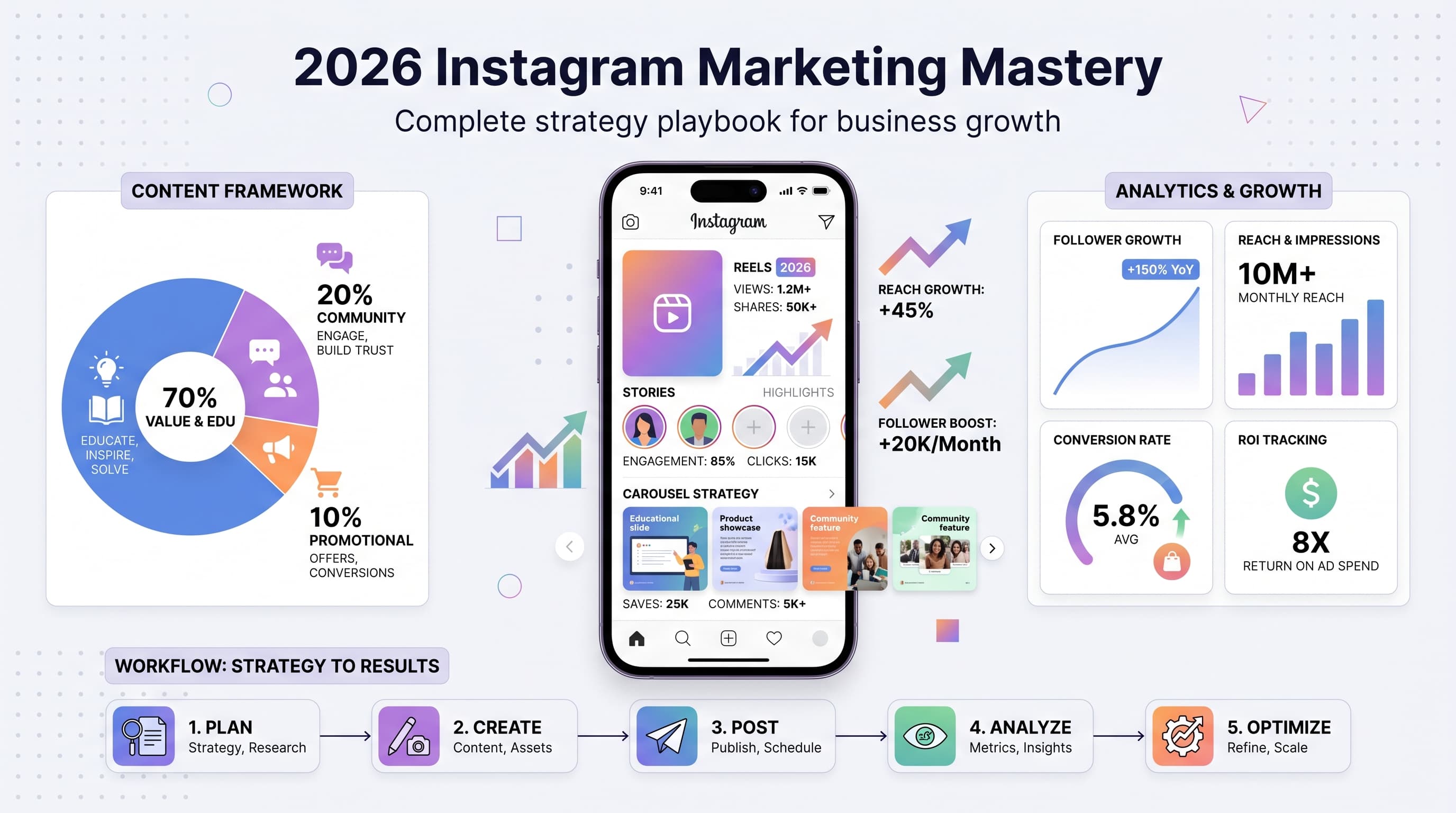
1. The 70-20-10 content framework
This framework replaced the outdated 80-20 rule and performs significantly better in 2026's algorithm environment. Here's the breakdown:
- 70% value-driven content: Educational, entertaining, or inspiring posts that serve your audience without direct selling
- 20% behind-the-scenes: Authentic glimpses into your brand, team, or process that build connection and trust
- 10% promotional: Direct sales content, product launches, or service promotions
A fitness coach might post workout tutorials and nutrition tips (70%), gym day vlogs and client success stories (20%), and program announcements (10%). The key is making your valuable content so good that followers welcome your occasional promotions.
Track engagement rates across these categories. If your promotional content gets significantly lower engagement, increase the value content ratio until you've earned the right to sell more directly.
2. Content pillar system for consistent value
Content pillars are themed categories that ensure you're consistently delivering diverse value. Most successful Instagram accounts in 2026 use 3-5 content pillars that align with their audience's interests and business goals.
For a marketing agency, effective pillars might include:
- Strategy breakdowns: Analyzing successful campaigns and explaining the tactics
- Tool reviews: Testing and reviewing marketing tools their audience uses
- Industry insights: Sharing trends, predictions, and data-driven observations
- Client spotlights: Showcasing results and case studies (with permission)
- Team expertise: Individual team members sharing their specialized knowledge
Rotate through your pillars to maintain variety while ensuring each post serves a strategic purpose. Use Instagram's content planning tools to visualize your pillar distribution over time.
3. Format-specific content optimization
Each Instagram format serves different purposes and requires unique optimization approaches. In 2026, successful brands master multiple formats rather than defaulting to one:
Reels for discovery: Short, engaging videos that can reach users beyond your followers. Focus on hooks in the first 3 seconds, trending audio when relevant, and clear value propositions. Reels perform best when they feel native to the platform rather than polished advertisements.
Carousel posts for education: Multi-slide posts that allow deeper dives into topics. These generate strong engagement because users spend more time with your content. Use consistent design templates and compelling headlines for each slide.
Stories for connection: Temporary content that feels more personal and immediate. Use Stories for behind-the-scenes content, quick tips, polls, and direct audience engagement. The ephemeral nature encourages more authentic sharing.
Single image posts for inspiration: High-quality visuals paired with thoughtful captions. These work well for quotes, lifestyle content, and brand moments. Focus on visual impact and caption depth.
| Content Format | Best For | Optimal Length | Key Metric |
|---|---|---|---|
| Reels | Discovery & viral reach | 15-30 seconds | Views & shares |
| Carousel | Education & engagement | 5-8 slides | Time spent & saves |
| Stories | Daily connection | 3-7 stories | Story completion rate |
| Single posts | Brand moments | 150-300 word captions | Comments & engagement rate |
Instagram Reels mastery for maximum reach
Reels remain Instagram's primary discovery engine in 2026, but the strategies that worked in 2024 feel outdated now. The platform's algorithm has become sophisticated enough to detect authentic value versus trend-chasing, and users have developed higher standards for the Reels they'll actually engage with.
1. Hook formulas that stop the scroll
You have less than 2 seconds to capture attention before users scroll past your Reel. The most successful accounts use proven hook formulas that immediately signal value:
- The contradiction: 'Everyone says X, but here's what actually works...'
- The mistake reveal: 'I wasted $10K on marketing until I learned this...'
- The number promise: '3 changes that doubled my engagement in 30 days'
- The behind-scenes: 'Here's what really happens when...'
- The transformation: 'Before I knew this vs. after I implemented it'
Avoid generic hooks like 'Let me share a tip' or 'Here's something interesting.' Instead, be specific about the value you're delivering and why it matters to your audience. Test different hook styles and track which ones generate the highest watch-through rates.
2. The 15-second value structure
Most successful Reels in 2026 follow a tight structure that delivers maximum value in minimum time:
- Seconds 1-3: Strong hook that promises specific value
- Seconds 4-12: Deliver the promised information clearly and concisely
- Seconds 13-15: Call-to-action or next step that drives engagement
This structure works because it respects users' short attention spans while providing enough value to encourage follows and saves. A business coach might hook with 'The productivity mistake costing you 2 hours daily,' explain the mistake in the middle section, and end with 'Try this tomorrow and tell me your results.'
Practice delivering your core message in 8 seconds or less. If you can't explain your main point quickly, your Reel topic might be too complex for the format.
3. Audio strategy that amplifies reach
Instagram's algorithm considers audio engagement when determining Reel distribution. However, blindly following trending sounds isn't enough anymore. The key is strategic audio selection that enhances your content's message.
Choose audio that:
- Matches your content's energy and tone
- Is currently trending but not oversaturated
- Allows your voice-over to be clearly heard
- Appeals to your target audience's preferences
- Complements rather than distracts from your message
Original audio can also perform exceptionally well if it provides unique value. Educational content with clear, well-produced voice-overs often outperforms trendy audio because users can easily consume the information.
Monitor audio performance through Instagram Insights. Pay attention to which sounds generate higher reach and engagement rates for your specific content style.
Stories strategy for daily engagement
Instagram Stories hit 1.2 billion daily active users in 2026, making them essential for maintaining consistent audience connection. While Reels focus on discovery, Stories excel at deepening relationships with existing followers and driving immediate actions.
1. The daily value stack approach
Instead of posting random behind-the-scenes content, successful brands use a value stack system that consistently delivers worth to Story viewers:
- Morning motivation: Inspirational quote or mindset tip related to your niche
- Midday mini-lesson: Quick educational content or industry insight
- Behind-the-scenes moment: Authentic glimpse into your work or process
- Evening engagement: Question, poll, or conversation starter
- Resource sharing: Tool recommendation, article link, or helpful tip
A marketing consultant might share a morning mindset quote, explain a marketing concept at lunch, show their workspace setup, ask followers about their biggest marketing challenge, and recommend a useful tool before ending the day.
This approach keeps your brand top-of-mind throughout the day while providing consistent value. Track Story completion rates to see which types of content keep viewers engaged through your entire daily sequence.
2. Interactive features that build community
Instagram's interactive Story features became more sophisticated in 2026, offering new ways to engage audiences and gather valuable insights. Use these strategically rather than randomly:
Polls for market research: Ask about preferences, challenges, or interests to inform your content strategy and product development. 'Should I create a course on email marketing or social media?' gives you direct audience feedback.
Questions for content ideas: Encourage followers to ask questions about your expertise area. This provides endless content inspiration while showing you're responsive to audience needs.
Quizzes for education: Test your audience's knowledge about your industry or niche. This works particularly well for educational brands and helps reinforce key concepts.
Sliders for feedback: Get nuanced feedback on ideas, designs, or concepts. More flexible than yes/no polls and provides richer data.
Always follow up on interactions. Respond to questions publicly in subsequent Stories (with permission) or privately via DM. This responsiveness encourages more engagement over time.
3. Story-to-feed content pipeline
Your best Stories should become feed content. This maximizes the value of your content creation efforts and ensures your best ideas reach beyond your Story viewers:
Test concepts in Stories first. If a Story gets high engagement, expanded replies, or lots of DMs, turn it into a full feed post or Reel. A quick Story tip that generates dozens of questions might become a detailed carousel post.
Use Story Highlights strategically to extend valuable content's lifespan. Organize Highlights by topic or content type so new followers can easily access your best information. Popular categories include FAQ, Tips, Behind-the-Scenes, and Reviews.
Create Story series that build anticipation for feed content. A 'Monday Motivation' Story series might preview the week's upcoming posts, while 'Friday Favorites' might recap the week's best content and encourage engagement.
Advanced Instagram marketing tactics
Once you've mastered the basics, these advanced tactics can significantly amplify your Instagram marketing results. These strategies require more effort but deliver disproportionate returns when executed correctly.
1. Micro-influencer partnership programs
Mega-influencer partnerships became less effective in 2026 as audiences grew skeptical of obvious sponsored content. Micro-influencers (1K-100K followers) now deliver better ROI because their audiences trust their recommendations more.
Build relationships with micro-influencers in your niche before you need them. Engage with their content genuinely, share their posts when relevant, and offer value without immediately asking for anything in return. This relationship-first approach leads to more authentic partnerships.
Structure partnerships for mutual benefit:
- Product exchanges: Provide your product or service in exchange for honest reviews
- Affiliate partnerships: Offer commission for sales generated through their content
- Content collaborations: Create content together that benefits both audiences
- Event partnerships: Invite them to exclusive events or experiences
- Long-term ambassadorships: Ongoing relationships with your biggest brand advocates
Track partnership ROI beyond immediate sales. Measure brand awareness, follower quality, engagement rate changes, and long-term customer value from influencer-driven audiences.
2. User-generated content systems
User-generated content (UGC) performs 5x better than brand-created content because it feels authentic and trustworthy. However, hoping customers will randomly post about you isn't a strategy. You need systematic UGC generation.
Create shareable experiences that naturally encourage social sharing. This might be unique product packaging, photogenic store displays, exclusive events, or limited-edition items that make customers feel special.
Develop branded hashtags that customers want to use:
- Make them memorable and easy to spell
- Connect them to a specific campaign or experience
- Promote them consistently across all touchpoints
- Show appreciation when customers use them
- Feature the best submissions on your own account
Incentivize UGC creation through contests, features, or rewards. A coffee shop might feature 'Customer Creation of the Week' where customers who post their coffee moment with the branded hashtag get featured and receive a free drink.
Always get permission before reposting customer content, and give proper credit. This builds trust and encourages more customers to create content knowing they might be featured.
3. Instagram Shopping optimization
Instagram Shopping became seamlessly integrated into the platform experience in 2026. The key isn't adding product tags to every post, but strategically using shopping features to enhance the customer journey.
Contextual product placement works better than obvious sales posts. Show products being used in real situations rather than isolated product shots. A skincare brand might show their morning routine, naturally tagging products as they appear.
Optimize your product catalog for Instagram's search and discovery features:
- Use descriptive, keyword-rich product titles
- Include detailed product descriptions with relevant hashtags
- Upload high-quality images that look good in Instagram's format
- Keep product information updated and accurate
- Use product collections to group related items
Create shopping-focused content formats:
- Product styling videos: Show different ways to use or style your products
- Comparison posts: Help customers choose between similar products
- Seasonal collections: Group products for specific occasions or seasons
- Customer spotlights: Feature real customers using your products
- Behind-the-scenes: Show product creation or sourcing processes
Monitor shopping insights to understand which products generate the most interest and optimize your content strategy accordingly.
Instagram advertising that actually converts
Organic reach is great, but Instagram ads accelerate results when done correctly. The platform's advertising options expanded significantly in 2026, offering more sophisticated targeting and creative formats. However, many businesses waste money on poorly optimized campaigns.
1. Campaign objective alignment
Instagram's campaign objectives got more specific in 2026, allowing better optimization for different business goals. Choose objectives that align with your actual desired outcomes, not what sounds most appealing:
Awareness campaigns work for new brands or product launches, but only if you have a clear plan for converting that awareness later. These campaigns should introduce your value proposition and encourage follows or website visits.
Traffic campaigns drive users to your website or landing page. Use these when you have a high-converting website and want to leverage Instagram's audience targeting to find potential customers.
Engagement campaigns boost post performance and can be useful for social proof, but they rarely drive direct business results. Use these sparingly and only for content that serves a strategic purpose.
Conversion campaigns optimize for specific actions like purchases, sign-ups, or downloads. These typically deliver the best ROI for businesses with clear conversion goals and proper tracking setup.
Retargeting campaigns target people who've already interacted with your brand. These often have the highest conversion rates because you're reaching warm audiences.
2. Audience targeting strategies
Instagram's audience targeting became incredibly sophisticated by 2026, but more options doesn't mean better results. Focus on strategic audience selection rather than trying every available targeting option:
Custom audiences from your data: Upload customer email lists, website visitors, or app users. These audiences typically convert better because they're already familiar with your brand.
Lookalike audiences based on best customers: Instagram analyzes your best customers' characteristics and finds similar users. Start with 1-2% lookalike audiences for highest similarity.
Interest-based targeting with depth: Instead of broad interests like 'fitness,' target specific sub-interests like 'high-intensity interval training' or 'yoga for beginners' to reach more qualified users.
Behavioral targeting combinations: Layer behaviors with demographics for precise targeting. A luxury watch brand might target high-income users who've purchased luxury goods online recently.
Test audience segments separately to identify your highest-performing groups, then allocate more budget to winners while eliminating underperformers.
3. Creative optimization for ad performance
Your ad creative determines whether users stop scrolling and take action. In 2026, successful Instagram ads feel native to the platform rather than obviously promotional:
Video ads with strong hooks: Start with a compelling statement, question, or visual that immediately communicates value. The first 3 seconds determine your ad's success.
Carousel ads for storytelling: Use multiple slides to guide users through a logical progression, from problem identification to solution presentation. Each slide should build on the previous one.
User-generated content style: Ads that look like organic posts from real customers tend to perform better than polished brand content. Use authentic-looking photos and casual language.
Clear value propositions: Immediately explain what users get and why it matters to them. Avoid industry jargon and focus on benefits over features.
Strong call-to-actions: Be specific about the next step. Instead of 'Learn More,' use 'Get Your Free Guide' or 'Start Your 7-Day Trial.'
Create multiple creative variations for each campaign and let Instagram's algorithm optimize delivery to the highest-performing versions. Refresh creative regularly to prevent ad fatigue.
| Campaign Type | Best For | Budget Range | Success Metric |
|---|---|---|---|
| Awareness | New brands | $20-50/day | CPM & reach |
| Traffic | Website visits | $30-75/day | CPC & CTR |
| Conversions | Direct sales | $50-200/day | ROAS & CPA |
| Retargeting | Warm audiences | $15-40/day | Conversion rate |
Analytics and optimization strategies
Instagram's analytics evolved dramatically in 2026, providing deeper insights into audience behavior and content performance. However, most brands still focus on vanity metrics instead of data that drives business decisions. Here's how to use analytics strategically.
1. Metrics that matter for business growth
Forget follower count and likes. In 2026, smart marketers track metrics that correlate with actual business outcomes:
Engagement quality over quantity: Look at comment sentiment, saves, and shares rather than just total engagement. A post with 50 thoughtful comments often outperforms one with 200 generic reactions.
Story completion rates: High completion rates indicate your content keeps audience attention throughout your entire message. This predicts how well your audience will consume longer-form content.
Profile visits to follower conversion: Tracks how compelling your profile is at converting interested users into followers. A high visit-to-follow ratio indicates strong brand positioning.
Website clicks and conversions: The ultimate business metric. Track not just clicks to your website, but what users do once they arrive. Instagram's conversion tracking shows the full customer journey.
Audience retention and growth quality: Monitor how many new followers remain active over 30, 60, and 90 days. Rapid follower growth means nothing if the audience doesn't engage long-term.
2. Content performance analysis framework
Analyze your content performance systematically to identify patterns and optimize future content:
Weekly performance reviews: Every week, review your top-performing and worst-performing posts. Look for common elements in successful content: topics, formats, posting times, caption styles, and visual elements.
Monthly trend analysis: Identify longer-term patterns in your content performance. Are certain content pillars consistently outperforming others? Has your audience's engagement behavior changed?
Competitive benchmarking: Compare your performance to similar accounts in your industry. Look for content gaps and opportunities where competitors are succeeding but you're not active.
Audience feedback integration: Combine quantitative analytics with qualitative feedback from comments, DMs, and customer conversations. Sometimes your most valuable insights come from direct audience feedback.
Document your findings and create content optimization guidelines based on your analysis. These guidelines should evolve as you gather more data and your audience grows.
3. A/B testing for continuous improvement
Systematic testing helps you optimize every element of your Instagram strategy. Focus on testing one variable at a time to get clear results:
Caption length and style: Test short, punchy captions versus longer, story-driven ones. Try different opening hooks, call-to-actions, and hashtag placements.
Posting times and frequency: Experiment with different posting times and content frequency. Your optimal schedule might differ from general best practices based on your specific audience.
Visual styles and formats: Test different photography styles, graphic designs, and content formats. Monitor which approaches generate higher engagement and reach.
Hashtag strategies: Compare different hashtag combinations, quantities, and placement strategies (caption vs. first comment). Track reach and discovery metrics for each approach.
Call-to-action variations: Test different ways of encouraging engagement. Compare direct asks ('What do you think?') with indirect prompts ('Share your experience below').
Run tests for at least 2-4 weeks to account for algorithm fluctuations and audience behavior variations. Document results and implement winning strategies consistently.
Common Instagram marketing mistakes to avoid
Even experienced marketers make costly Instagram mistakes that limit their results. Avoiding these common pitfalls will save you time, money, and frustration while accelerating your Instagram success.
1. Posting without strategy
The mistake: Random posting based on inspiration or convenience rather than strategic planning. This leads to inconsistent messaging, poor audience retention, and limited business results.
Why it hurts: Instagram's algorithm favors accounts that consistently deliver value to specific audiences. Random posting confuses both the algorithm and your followers about what to expect from your account.
The fix: Develop a content calendar based on your business objectives and audience needs. Plan themes, topics, and formats in advance, but leave room for timely, relevant content that responds to current events or trends.
Use tools to schedule content consistently, but don't rely on automation for engagement. Respond to comments and DMs personally to build real relationships with your audience.
2. Focusing on vanity metrics
The mistake: Obsessing over follower count, likes, and reach while ignoring metrics that drive business results. This leads to strategies that look good on the surface but don't generate revenue or meaningful growth.
Why it hurts: Vanity metrics don't correlate with business success. An account with 100,000 disengaged followers is less valuable than one with 10,000 engaged, qualified prospects.
The fix: Define business-relevant metrics based on your objectives. If you want leads, track email sign-ups from Instagram. If you want sales, track website conversions. If you want brand awareness, track brand mention increases and search volume.
Create monthly reports that connect Instagram metrics to business outcomes. This helps you optimize for results that matter and justify your Instagram marketing investment.
3. Ignoring audience engagement
The mistake: Treating Instagram like a broadcasting platform rather than a social network. Posting content without responding to comments, DMs, or engaging with your community.
Why it hurts: Instagram's algorithm considers engagement velocity and quality when determining content distribution. Accounts that don't engage back see declining reach and community growth.
The fix: Allocate dedicated time for community management. Respond to comments within 2-4 hours when possible, answer DMs personally, and proactively engage with your followers' content.
Create engagement rituals: Thank new followers personally, celebrate customer wins publicly (with permission), and remember personal details about your most active community members.
4. Over-promoting and under-delivering value
The mistake: Using Instagram primarily for sales promotion without providing sufficient value to your audience. This creates a negative user experience and damages your brand reputation.
Why it hurts: Modern consumers are skeptical of obvious marketing. Overly promotional accounts get unfollowed, muted, or reported as spam. Instagram's algorithm also reduces distribution for accounts with poor engagement rates.
The fix: Follow the 70-20-10 content rule religiously. Earn the right to promote by consistently delivering value. When you do promote, focus on how your product or service solves customer problems rather than listing features.
Make your promotional content feel valuable by including education, entertainment, or inspiration along with your sales message.
Tools and resources for Instagram marketing success
The right tools can significantly streamline your Instagram marketing efforts and improve your results. However, tools are only valuable if they solve real problems in your workflow or provide insights that drive better decisions.
1. Content creation and design tools
Canva Pro remains the most versatile design tool for Instagram content. The 2026 version includes AI-powered design suggestions, brand kit management, and video editing capabilities that make professional-quality content accessible to non-designers.
Adobe Creative Suite (Photoshop, Illustrator, Premiere Pro) offers maximum creative control for brands with design resources. The learning curve is steeper, but the possibilities are unlimited.
Unfold specializes in Instagram Story templates that look professional without obvious template markers. Their 2026 update includes motion graphics and interactive element templates.
InShot and CapCut provide mobile video editing capabilities for creating Reels on-the-go. Both apps include trending effects and easy-to-use editing tools.
Unsplash and Pexels offer high-quality stock photography, but use these sparingly. Original photography that reflects your brand personality typically performs better than stock images.
2. Analytics and optimization tools
Instagram's native analytics improved significantly in 2026 and should be your primary data source. The platform provides the most accurate and comprehensive data about your account performance.
Sprout Social offers advanced analytics, competitive analysis, and team collaboration features. Their listening tools help you track brand mentions and industry conversations beyond your own account.
Later's analytics focus specifically on Instagram performance with visual content calendars and optimal posting time recommendations based on your specific audience behavior.
Google Analytics with UTM parameters helps you track Instagram traffic and conversions on your website. Set up specific campaigns for different Instagram content types to measure their business impact.
Buzzsumo helps you identify trending topics and high-performing content in your industry, providing inspiration and competitive insights for your content strategy.
3. Automation and efficiency tools
Scheduling platforms like Buffer, Hootsuite, and Later help maintain consistent posting without being tied to your phone. However, avoid over-automation that makes your account feel robotic.
Zapier can automate repetitive tasks like adding email subscribers when someone follows you or creating calendar events when you receive collaboration inquiries through DMs.
ChatGPT and other AI writing tools can help brainstorm content ideas and draft captions, but always add your unique voice and perspective. AI-generated content without human editing often feels generic.
Linktree or similar bio link tools let you share multiple links from your Instagram bio. Customize these tools to match your brand aesthetic and track click-through rates for different links.
Customer service tools like Intercom or HubSpot can help manage Instagram DMs at scale while maintaining personal responses. However, direct personal responses still outperform automated ones for building relationships.
Try Schedulala for free
Schedule posts to Bluesky, Twitter, and 8 other platforms from one dashboard.
Get started for free→Your Instagram marketing action plan
Knowledge without action leads nowhere. Here's your step-by-step implementation plan to transform your Instagram marketing strategy and start seeing real business results.
Week 1: Foundation setup
Day 1-2: Audit your current Instagram presence. Analyze your top 20 posts from the last 90 days to identify patterns in successful content. Document what's working and what isn't.
Day 3-4: Define your Instagram business objectives using the SMART goals framework. Connect each objective to specific metrics you'll track monthly.
Day 5-7: Optimize your profile completely. Update your bio with a clear value proposition, choose a cohesive visual theme, and organize your Story Highlights with valuable evergreen content.
Week 2: Content strategy development
Day 1-2: Establish your 3-5 content pillars based on audience interests and business goals. Create a content distribution plan using the 70-20-10 framework.
Day 3-4: Develop templates for each content format you'll use regularly. This includes Reels structures, carousel post layouts, and Story series formats.
Day 5-7: Create your first month of content using your new strategy. Focus on quality over quantity and ensure each piece serves a specific purpose.
Week 3: Implementation and optimization
Day 1-2: Begin posting according to your content calendar. Focus on engaging authentically with your audience's comments and DMs.
Day 3-4: Start your first A/B tests on posting times, caption styles, or hashtag strategies. Document your testing hypotheses and success metrics.
Day 5-7: Identify potential collaboration partners and user-generated content opportunities. Begin building relationships with micro-influencers in your niche.
Week 4: Scaling and measurement
Day 1-2: Analyze your first month's performance using business-relevant metrics. Identify your highest and lowest performing content to refine your strategy.
Day 3-4: Set up Instagram ads if appropriate for your business stage and budget. Start with a small test budget focused on your most successful organic content.
Day 5-7: Plan your next month's content based on your performance insights. Scale successful content types and eliminate or improve underperforming approaches.