Social Media Goals Template: A SMART Framework You Can Copy This Week
Use this social media goals template built on the SMART framework to set goals you can actually measure and hit.

"Grow our social media presence." "Post more consistently." "Increase engagement." If any of these sound like your current social media goals, I have some bad news: they're not goals. They're wishes. And wishes don't show up in a quarterly report your boss actually respects. See our Instagram scheduling guide.
See It in Action
This is what scheduling an Instagram post looks like in Schedulala
The problem isn't that you lack ambition. It's that most social media goals are written without a structure behind them, so there's no way to know if you hit them, missed them, or just got lucky with an algorithm change. A social media goals template built on the SMART framework fixes this. It forces you to turn fuzzy intentions into numbers, deadlines, and owners, so three months from now you're not guessing whether the work paid off. Try our content calendar.
This guide gives you a copy-and-paste template, five fully worked examples across common goal types, and a breakdown of the mistakes that quietly sabotage most social media planning. Try our free social media tools.
Why vague goals waste your time (and budget)
Here's what usually happens without a real framework. A marketing team sets a goal like "grow Instagram engagement." Three months pass. Likes are up 4%, comments are flat, and one reel went semi-viral and skewed every average. Was the goal met? Nobody can say, because nobody defined what "met" looks like in the first place. Try our content calendar.
That ambiguity costs more than a confusing report. It makes it nearly impossible to justify budget for more scheduling tools, more ad spend, or more headcount, because you can't point to a clear before-and-after. A SMART goal gives you that before-and-after automatically, because the finish line is written down before you start running. Our best time to post on instagram can help.
This matters whether you're a solo creator trying to decide if TikTok is worth your time, a small business owner managing five platforms between client calls, or an agency reporting results to a dozen different clients. SMART goals are the one planning habit that scales down to a single freelancer and up to a 20-person social team without changing shape. See our instagram engagement calculator guide.
Try Schedulala for free
Schedule posts to Bluesky, Twitter, and 8 other platforms from one dashboard.
Get started for free→The SMART framework, applied to social media
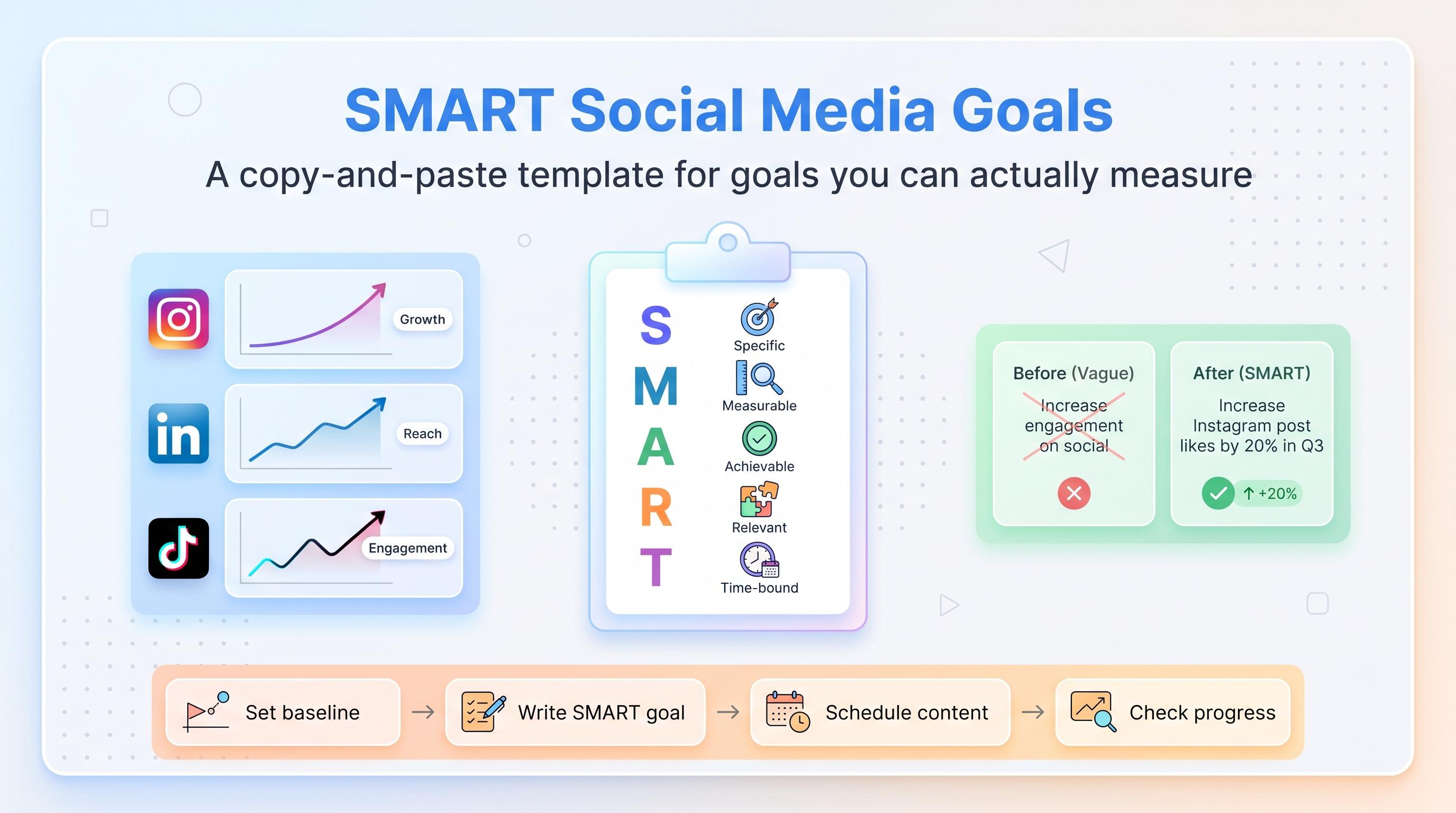
SMART stands for Specific, Measurable, Achievable, Relevant, and Time-bound. It's not new, you've probably seen it in a business textbook. But most examples of SMART goals are written for sales teams or project managers, not social media, which is why they feel generic when you try to apply them to a content calendar. Here's what each letter actually means when the goal lives on Instagram, LinkedIn, or TikTok.
S: Specific
A specific goal names the exact platform, the exact metric, and the exact audience. "Grow social media" is not specific. "Grow our LinkedIn follower count among mid-level marketing managers" is. If you can't picture the dashboard you'll check to confirm success, your goal isn't specific enough yet.
Ask yourself: which platform, which metric, which segment of your audience. If you can't answer all three in one sentence, rewrite the goal.
M: Measurable
This is where most social media goals fall apart, because teams pick vanity metrics that are easy to track but don't mean much, or pick meaningful metrics without a baseline to compare against. Measurable means you have a current number, a target number, and a way to check both using the same method.
Before you set the target, pull your last 90 days of data. If you don't have a baseline, your "20% increase" is a guess dressed up as a goal.
A: Achievable
Achievable doesn't mean easy, it means realistic given your resources, budget, and timeline. A brand with 800 Instagram followers setting a goal of 50,000 followers in 60 days isn't being ambitious, it's being unserious. A more achievable version, something like growing to 1,500 engaged followers in 90 days through consistent posting and three collaborations, is still a stretch, but it's one you can actually plan a path toward.
A useful gut check: can you describe, in one or two sentences, how you'd realistically hit this number? If not, scale it back.
R: Relevant
Relevant goals connect back to a business outcome, not just a platform metric. More followers only matters if it eventually supports sales, brand awareness, hiring, or customer retention. If a goal doesn't tie to something your business actually cares about, it's busywork with a nice chart attached.
This is also where you decide which platforms deserve the goal at all. If your customers live on LinkedIn and Google Business Profile, a TikTok growth goal might be irrelevant no matter how trendy it feels.
T: Time-bound
Every SMART goal needs a deadline, and "eventually" or "this year" doesn't count. Shorter windows (30, 60, 90 days) work better for social media than annual goals, because platforms and algorithms change fast enough that a 12-month goal often needs revisiting halfway through anyway.
I'd recommend 90-day cycles for most teams. Long enough to see real movement, short enough to course-correct if something isn't working.
The social media goals template (copy this)
Here's the actual template. Fill in each blank, and you've got a SMART goal that holds up to scrutiny.
That single sentence forces every SMART element into place. The date makes it time-bound. The metric and platform make it specific. The current and target numbers make it measurable. The actions make it achievable (you've already named how you'll get there). And the business outcome makes it relevant.
Run this template for each platform and goal type you're tracking, don't try to cram everything into one giant goal. Three or four focused SMART goals per quarter beat a single bloated one that tries to cover awareness, engagement, and sales at once.
5 SMART social media goal examples by objective
Different goal types need different metrics. Here are five fully filled-in examples you can adapt, covering the goal types most businesses are actually trying to hit.
1. Brand awareness
By March 1, we will increase Instagram reach from an average of 3,200 accounts per post to 6,000 accounts per post, by posting three Reels per week and using a consistent branded hook in the first three seconds, to support awareness ahead of our spring product launch.
Track this using reach and impressions, not follower count. Awareness goals often stall out because teams accidentally measure followers instead of exposure.
2. Engagement
By the end of Q2, we will raise our average LinkedIn post engagement rate from 1.8% to 3.5%, by publishing two original thought-leadership posts per week and responding to every comment within 4 hours, to strengthen our position as an authority in commercial insurance.
Engagement rate (not raw likes) is the right metric here, because it accounts for audience growth that happens alongside it.
3. Follower or community growth
By January 31, we will grow our TikTok following from 2,400 to 5,000, by posting daily short-form videos tied to trending audio in our niche and running two creator collaborations per month, to build a direct audience for our upcoming app launch.
Note the specific tactics named in the goal itself. Without them, a follower goal is just a wish with a number attached.
4. Lead generation
By the end of this quarter, we will generate 150 marketing qualified leads from LinkedIn through gated content offers and lead-gen forms, up from 60 last quarter, by posting three CTA-driven carousels per week and running one lead-gen ad campaign per month.
This is the goal type most likely to connect directly to revenue, which makes it the easiest to defend when budget conversations come up.
5. Customer service response
By June 1, we will reduce our average social media response time across Facebook, Instagram, and Twitter/X from 6 hours to under 1 hour, by assigning dedicated daily monitoring shifts and using saved replies for common questions, to improve customer satisfaction scores.
This one rarely gets treated as a social media goal, but slow response times quietly damage trust more than almost anything else on your profile.
Vague goal vs. SMART goal: side by side
Sometimes the easiest way to see the difference is a direct comparison. Here's how common vague goals translate into SMART versions.
| Vague goal | SMART version |
|---|---|
| Grow our Instagram | Increase Instagram followers from 4,000 to 6,500 by March 31 through 4 weekly Reels and 2 monthly creator collabs |
| Post more consistently | Publish 5 pieces of content per week across Instagram and LinkedIn for 90 straight days, tracked weekly in a shared calendar |
| Get more engagement | Raise average engagement rate from 2.1% to 4% in Q1 by replying to all comments within 4 hours and posting 2 polls per week |
| Build brand awareness | Increase video views from 15,000 to 40,000 monthly by June by shifting 70% of content to short-form video |
| Drive more traffic | Generate 500 monthly website clicks from social by February through link-in-bio optimization and 3 weekly CTA posts |
Common mistakes that wreck SMART social media goals
Writing a SMART goal is only half the battle. Here's where most teams lose the thread after week one.
- Setting the target before pulling a baseline. If you don't know your current engagement rate, follower count, or reach, you're guessing at the target. Pull 90 days of data before you write a single number.
- Chasing too many metrics at once. A goal that tries to boost followers, engagement, reach, and leads simultaneously isn't a goal, it's a hope. Pick one primary metric per goal.
- Copying a competitor's growth rate without context. A competitor with a 10-person content team and paid ad budget grows differently than a solo founder posting between client work. Benchmark against your own history first.
- Letting consistency slip mid-quarter. Most SMART social goals depend on a steady posting cadence to hit their numbers. A two-week gap in posting can quietly undo a month of progress, which is exactly the kind of thing a scheduling tool is built to prevent.
- Never revisiting the goal until the deadline. Check progress every two weeks, not just at the finish line. Catching a stalled metric at week 4 gives you time to adjust before week 12.
Tools that actually help you hit these goals
A SMART goal is only as good as your ability to execute the consistency it requires. Most of the goals above depend on a specific posting cadence, three Reels a week, two LinkedIn posts a week, daily TikToks, and that cadence falls apart the moment you're relying on remembering to post manually across multiple platforms.
This is where a scheduling tool earns its keep. With Schedulala, you can plan and schedule content across all 12 supported platforms (Instagram, TikTok, Twitter/X, LinkedIn, YouTube, Facebook, Threads, Bluesky, Pinterest, Telegram, Mastodon, and Google Business Profile) from one calendar, so the "post 4 Reels a week" portion of your SMART goal isn't resting on willpower.
Every Schedulala plan includes unlimited scheduled posts, even on the entry-level Personal plan at $29/month for 10 social accounts. Those 10 accounts aren't locked to specific platforms either, you can run them as 10 Instagram profiles, one account on each of 10 platforms, or any mix in between. The Team plan runs $49/month for 25 accounts, and Agency is $99/month for 100 accounts, which matters if you're managing SMART goals across multiple client brands at once. Pay annually on any plan and you get 2 months free.
You can try it through a 7-day free trial (a card is required to start, there's no permanent free tier) before committing a full quarter's content plan to it.
Beyond scheduling, check your platform's native analytics (Instagram Insights, LinkedIn Analytics, TikTok Analytics) every two weeks against the target number in your SMART goal. That rhythm catches a stalling goal while you still have time to fix it, instead of discovering the miss on reporting day.
Putting it all together
A social media goals template isn't a formality for a slide deck, it's the thing that turns "we should post more" into a plan you can actually execute, measure, and defend. Start with one SMART goal per platform per quarter. Pull your baseline first. Name the specific actions that will move the number. Set a real deadline. Check in every two weeks.
The teams that consistently hit their social media targets aren't the ones with the biggest budgets, they're the ones who wrote the goal down specifically enough to know, without debate, whether they hit it.
Try Schedulala for free
Schedule posts to Bluesky, Twitter, and 8 other platforms from one dashboard.
Get started for free→