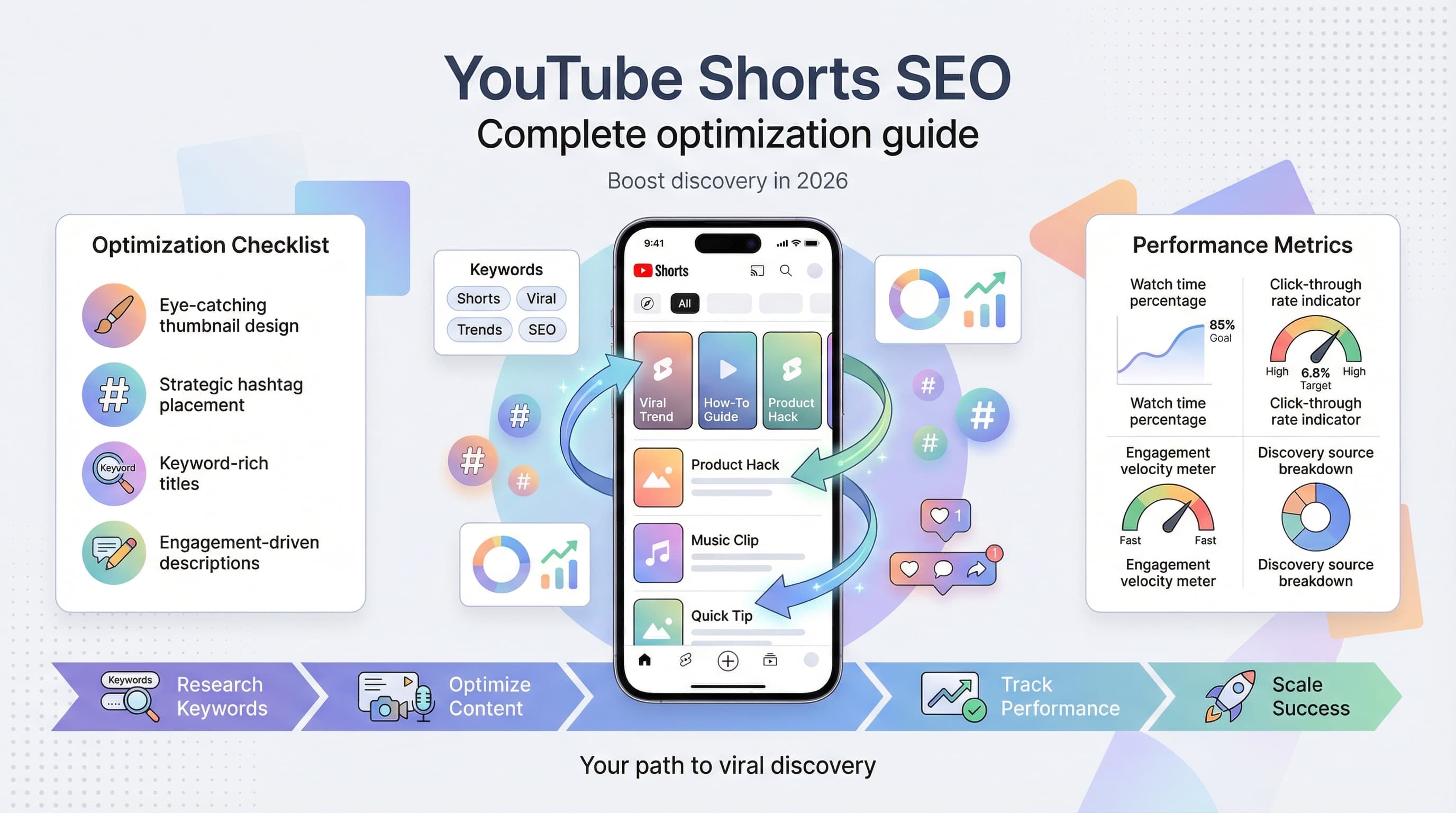
YouTube Shorts Monetization: Complete 2026 Guide to Earning Real Money
Master YouTube Shorts monetization in 2026. Learn eligibility requirements, revenue sharing rates, and proven strategies to maximize your earnings.

Quick answer
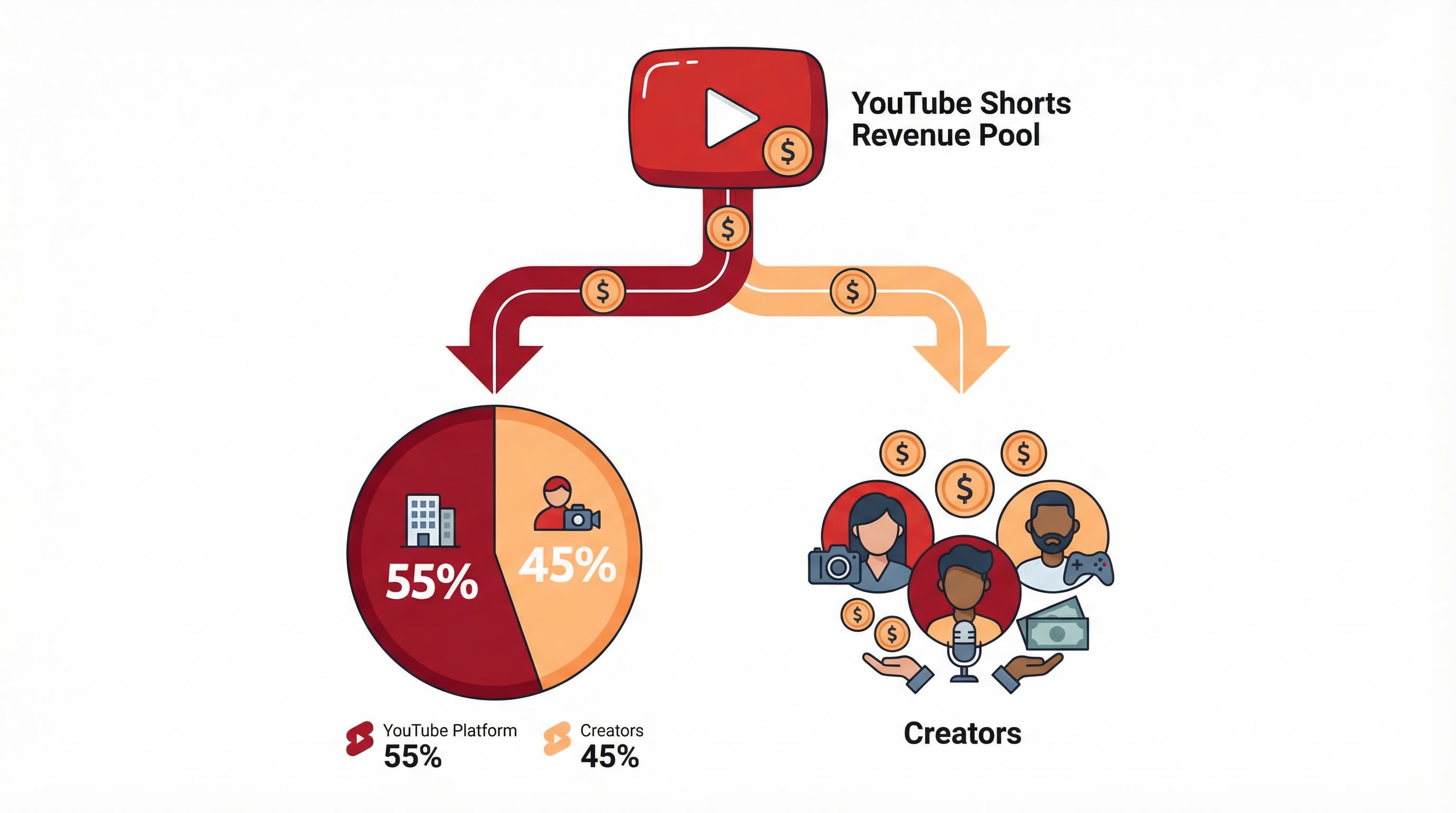
Monetize YouTube Shorts through the YouTube Partner Program, which pays creators 45% of ad revenue attributed to their Shorts.
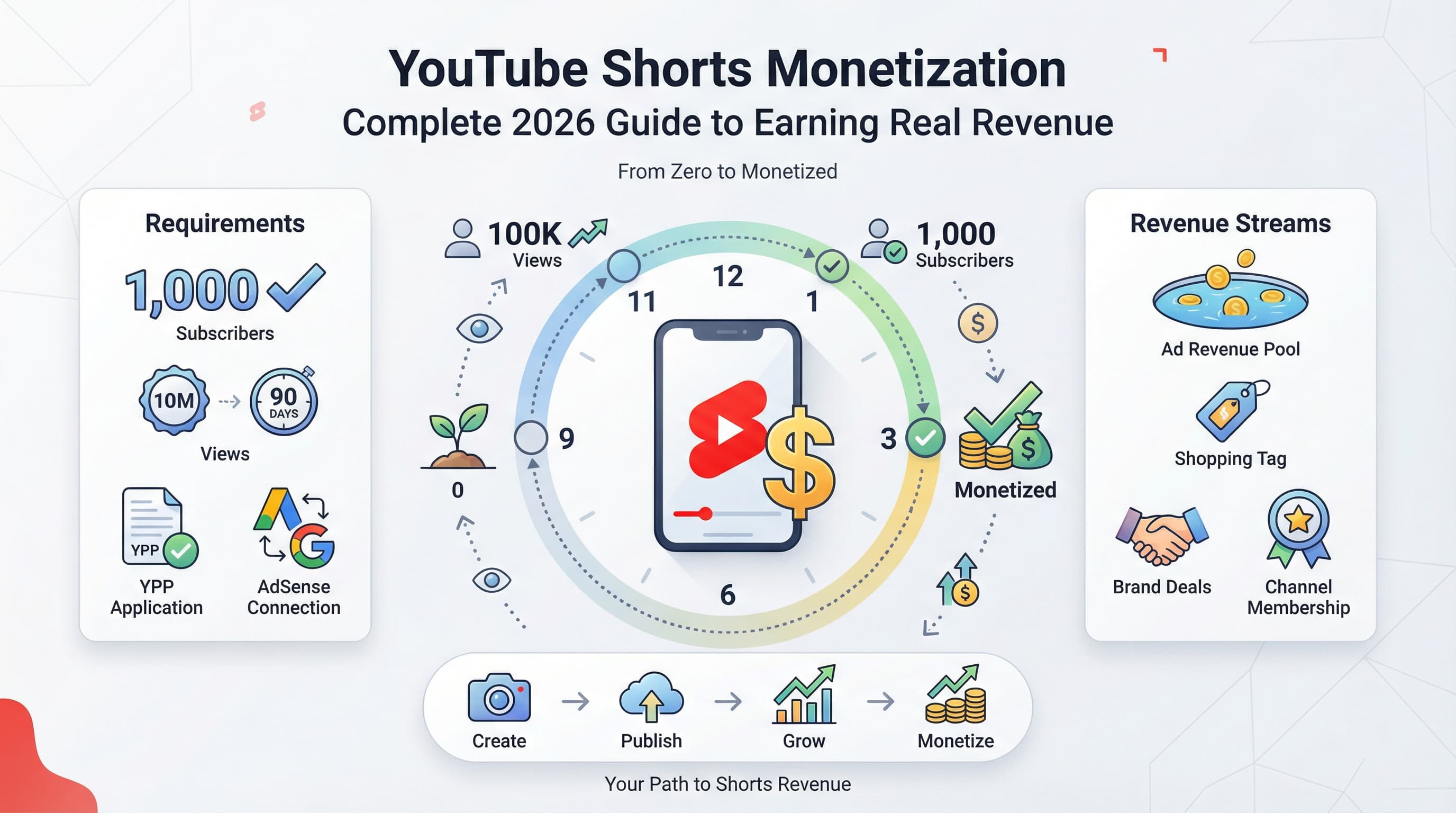
- •YPP eligibility: 1,000 subscribers plus either 4,000 watch hours or 10 million Shorts views in 90 days
- •Shorts ad revenue share: 45% to creators from the Shorts feed ad pool
- •Additional monetization: Super Thanks, channel memberships, and affiliate links in descriptions
- •Consistent posting boosts monetization; schedule Shorts with Schedulala for $9/month
You just hit 10 million views on a YouTube Short. The comments are blowing up. Your follower count jumped by 50,000 overnight. Then you check your revenue dashboard and see... $47. See our YouTube scheduling guide.
Sound familiar? You're not alone. YouTube Shorts monetization confuses most creators, and that confusion costs them real money. Our scheduling across platforms can help.
Here's the thing: Shorts monetization actually works now. But the system operates nothing like regular YouTube videos, and the creators making bank understand the mechanics most people ignore. What if you knew exactly how the money flows, what triggers higher payouts, and which strategies separate the top earners from everyone else? See our how to repurpose content guide.
This guide breaks down everything about YouTube Shorts monetization in 2026. No fluff, no vague promises. Just the actual numbers, requirements, and tactics that turn viral moments into sustainable income. Our scheduling across platforms can help.
Try Schedulala for free
Schedule posts to Bluesky, Twitter, and 8 other platforms from one dashboard.
Get started for free→See It in Action
This is what scheduling YouTube Shorts looks like in Schedulala
How YouTube Shorts monetization actually works
Let's clear up the biggest misconception first. Shorts don't pay per view like traditional YouTube videos. The revenue model is completely different, and understanding this difference is the foundation of making real money. See our best time to post on youtube guide.
The revenue pool system explained
YouTube pools all ad revenue generated from the Shorts feed into one big bucket. Every ad that runs between Shorts contributes to this pool. Then YouTube distributes that money to creators based on their share of total Shorts views. Learn more about youtube character counter.
Think of it like this: if the Shorts revenue pool for a given month is $100 million, and your Shorts account for 0.001% of all Shorts views, you get $1,000 from the pool. Simple math, but the implications matter.
This pooled approach means your individual video's "monetization rate" fluctuates based on total platform activity, not just your content's performance. A viral Short in December (high ad spending) pays more than the same viral Short in January (advertisers recovering from holiday budgets).
The music licensing cut
Here's where it gets tricky. If your Short uses licensed music, the revenue splits before you see a dime. YouTube takes their platform cut (around 55%), then the music rights holders take their share from what remains.
Use a song with one rights holder? They might take 50% of your creator share. Use a song with multiple rights holders? Each takes a cut. Some popular tracks have so many rights holders that creators keep less than 20% of their allocated revenue.
The math works like this for a Short with licensed music: YouTube takes 55% off the top. From the remaining 45% (your creator pool allocation), music rights holders take their percentage. What's left is yours.
This is why top Shorts creators obsess over original audio, royalty-free music, or tracks with minimal rights holder splits. The difference between using a trending song versus original audio can mean 3x to 5x more revenue for the same view count.
YouTube Shorts monetization requirements in 2026
Before you see a single dollar, you need to qualify for the YouTube Partner Program. YouTube offers two paths now, and the Shorts-specific path is more accessible than ever.
Path 1: Traditional YPP requirements
The classic route requires 1,000 subscribers and 4,000 watch hours on long-form content in the past 12 months. This path unlocks full monetization across all content types, including Shorts, long-form videos, and live streams.
Most Shorts-focused creators struggle with this path because, well, Shorts don't count toward watch hours. A 60-second video watched completely gives you one minute of watch time. You'd need 240,000 complete Short views just to hit the threshold, and that's assuming everyone watches until the end.
Path 2: Shorts-specific YPP requirements
YouTube introduced a Shorts-specific entry point that changed the game. You need 1,000 subscribers and 10 million Shorts views in the past 90 days. No watch hours required.
Ten million views sounds massive, but Shorts can rack up numbers fast. One viral video can hit that threshold alone. The catch? This path initially only unlocks Shorts monetization and fan funding features. Full monetization requires meeting the traditional requirements later.
For pure Shorts creators, this path makes sense. Get monetized, start earning, then work toward full YPP if you want to expand into long-form content.
| Requirement | Traditional Path | Shorts Path |
|---|---|---|
| Subscribers | 1,000 | 1,000 |
| Watch hours | 4,000 (12 months) | Not required |
| Shorts views | Not required | 10 million (90 days) |
| Unlocks | Full monetization | Shorts revenue + fan funding |
| Best for | Multi-format creators | Shorts-focused creators |
Additional eligibility requirements
Meeting the subscriber and view thresholds is just the start. YouTube also requires:
- You must be at least 18 years old (or have a legal guardian manage your account)
- You need to live in a country where the YouTube Partner Program is available
- Your channel must have no active Community Guidelines strikes
- You need to enable 2-step verification on your Google account
- You must have an AdSense account linked to your channel
- Your content must comply with YouTube's monetization policies
The content compliance piece trips up more creators than you'd expect. YouTube reviews your recent content before approving monetization. Borderline content, even if it doesn't violate Community Guidelines, can delay or deny your application.
How much do YouTube Shorts actually pay?
Let's talk real numbers. The "YouTube Shorts pays nothing" narrative is outdated, but let's also be honest: this isn't long-form YouTube money.
Current RPM ranges for Shorts
RPM (revenue per mille, or per 1,000 views) for Shorts typically ranges from $0.01 to $0.07 in 2026. The average sits around $0.03 to $0.05 for most niches. Compare that to long-form RPMs of $2-$10+, and you see why some creators dismiss Shorts monetization.
But here's what those creators miss: volume changes everything. A long-form video getting 100,000 views at $5 RPM earns $500. A Short getting 10 million views at $0.04 RPM earns $400. The Short took 1/10th the production time and reached 100x more people.
The math favors Shorts when you factor in production efficiency. Top Shorts creators publish daily, sometimes multiple times daily. A long-form creator might publish weekly. Over a month, consistent Shorts output often generates comparable total revenue with significantly less production effort per piece.
What affects your Shorts RPM
Your actual payout depends on several factors that vary significantly:
- Audience geography matters enormously. US, UK, Canadian, and Australian viewers generate higher ad rates than viewers from other regions. A channel with 80% US audience can earn 3-4x more than one with 80% Southeast Asian audience.
- Seasonal ad spending fluctuates dramatically. Q4 (October through December) typically pays 30-50% more than Q1 (January through March) due to holiday advertising budgets.
- Niche content can command premium rates. Finance, business, and technology Shorts often see higher RPMs than entertainment or comedy content because advertisers in those spaces pay more.
- Music usage affects your take. Original audio keeps 100% of your creator allocation. Licensed music can reduce it by 50-80%.
- Engagement rates influence algorithmic distribution. Higher engagement means more views, and more views in premium markets means higher total earnings.
| Niche | Typical RPM Range | Notes |
|---|---|---|
| Finance/Business | $0.05-$0.08 | High advertiser competition |
| Tech/Software | $0.04-$0.07 | Strong B2B ad demand |
| Health/Fitness | $0.03-$0.06 | Supplement and app advertisers |
| Entertainment | $0.02-$0.04 | High volume, lower rates |
| Gaming | $0.02-$0.05 | Varies by game popularity |
| Lifestyle/Vlogs | $0.02-$0.04 | Broad audience, average rates |

Beyond ad revenue: alternative monetization for Shorts
Smart Shorts creators treat ad revenue as a bonus, not the main income stream. The real money often comes from other channels that Shorts fuel.
YouTube Shopping and affiliate integration
YouTube's shopping features let you tag products directly in Shorts. Viewers tap to learn more or purchase without leaving the app. For product-focused content, this is huge.
The commission structure varies by program. YouTube Shopping affiliates typically earn 5-20% commission depending on the product category and brand deal. Some creators earn more from a single product sale than from 100,000 Short views.
The key is integration that doesn't feel forced. A cooking Short showing a technique naturally features the knife or pan you're using. A fitness Short demonstrates an exercise that works best with specific equipment. The product becomes part of the content, not an interruption.
Channel memberships and Super features
Once you hit YPP requirements, you unlock fan funding features. Channel memberships let viewers pay monthly for perks. Super Thanks lets viewers tip on individual videos, including Shorts.
Shorts work brilliantly for driving membership signups because you're constantly reaching new audiences. A viewer discovers you through a Short, binges your content, then joins your membership for exclusive access. The Short was the entry point, but the membership generates recurring revenue.
Super Thanks on Shorts might seem minor, but volume matters. If 0.01% of your Shorts viewers send a $2 Super Thanks, and you're getting 5 million monthly views, that's $1,000 extra monthly. Small percentages multiply with big audiences.
Brand sponsorships and deals
Here's where Shorts creators really cash in. Brands pay for sponsored Shorts at rates that dwarf ad revenue. A creator with 500,000 followers might earn $500-$2,000 per sponsored Short. Creators with millions of followers command $5,000-$20,000 or more.
The math is obvious. One sponsored Short per week at $1,000 generates $4,000 monthly. That's equivalent to roughly 100 million views at average Shorts RPM. Most creators would need months to hit that view count, but they can book that sponsorship this week.
Brands love Shorts because production costs are low, turnaround is fast, and the content reaches massive audiences. A 60-second integration feels less intrusive than a 10-minute long-form sponsorship segment. Everyone wins.
Driving traffic to other monetized platforms
Shorts excel at one thing: grabbing attention fast. Use that attention to funnel viewers toward higher-monetizing platforms and products.
Common funnel strategies include:
- Teasing long-form content in Shorts to boost watch hours and long-form ad revenue
- Promoting digital products like courses, ebooks, or templates
- Driving email list signups for future product launches
- Cross-promoting to other platforms where monetization is stronger
- Building awareness for services, coaching, or consulting offers
The Short itself might earn $50. But if it drives 100 people to purchase a $47 digital product, that's $4,700 from one video. The direct monetization becomes almost irrelevant compared to what it enables.
Step-by-step: getting monetized on YouTube Shorts
Theory is nice. Let's walk through the actual process of going from zero to monetized Shorts creator.
Step 1: Set up your channel correctly
Before chasing views, make sure your foundation is solid. Your channel needs to look legitimate and professional to both viewers and YouTube's review team.
Complete your channel art, write a clear channel description that explains what you post and who it's for, and organize any existing content into playlists. Enable 2-step verification on your Google account now. You'll need it for YPP anyway, and it protects your channel from hijacking.
Choose your niche and stick to it. YouTube's algorithm performs better when it understands what your channel is about. A focused channel ("quick cooking tips") grows faster than a scattered one ("random stuff I find interesting").
Step 2: Create content that reaches the algorithm
The Shorts algorithm prioritizes certain content characteristics. Understanding these gives you an edge.
Hook viewers in the first second. Literally the first second. If someone scrolls past before the first frame registers, that counts against your engagement rate. Start with movement, intrigue, or a compelling statement.
Optimize for completion rate. Shorts under 30 seconds typically see higher completion rates than those approaching 60 seconds. A 15-second Short watched twice beats a 60-second Short watched 40% through in YouTube's engagement calculations.
Post consistently. The algorithm favors active creators. Three Shorts daily outperforms three Shorts weekly for growth. Volume is your friend in the Shorts game.
Study what's working in your niche. Search for Shorts in your topic area, sort by views, and analyze the top performers. What hooks do they use? How long are they? What's the pacing like? Don't copy, but do learn.
Step 3: Hit the subscriber threshold
You need 1,000 subscribers for either YPP path. This is usually the easier threshold to hit, but it requires intentional strategy.
Every Short should include a call to action, whether verbal or visual. "Subscribe for daily tips" at the end of a video converts viewers into subscribers at 2-5x the rate of no CTA. Simple, but effective.
Create a subscriber-driving Short. This is content specifically designed to explain why someone should subscribe. What do you post? How often? What value do subscribers get? Pin this as a featured video on your channel.
Engage with comments. Reply to every comment in your first few months. Commenters who get replies are significantly more likely to subscribe. This also boosts your engagement signals, which helps algorithmic distribution.
Step 4: Accumulate 10 million Shorts views
This is the harder threshold. Ten million views in 90 days requires either a viral hit or consistent strong performance. Here's how to approach it.
Volume increases your viral lottery tickets. If one in 50 Shorts goes "viral" (however you define that), posting 100 Shorts gives you two potential hits. Posting 10 gives you... probably zero. Quantity creates opportunity.
Ride trends quickly. Trending sounds, topics, and formats get algorithmic boost. The creator who posts a trend video on day one gets more distribution than the one who posts on day five. Speed matters.
Cross-promote your best performers. When a Short starts gaining traction, share it everywhere. Other social platforms, your email list, relevant communities. External traffic signals value to YouTube's algorithm.
Repurpose and iterate. If a Short performs well, create variations. Same topic, different angle. Same format, different topic. Don't abandon a winning formula, expand on it.
Step 5: Apply for the YouTube Partner Program
Once you hit both thresholds, the application process begins. Navigate to YouTube Studio, click "Earn" in the left menu, and follow the prompts to apply for YPP.
You'll need to:
- Accept the YouTube Partner Program terms
- Sign up for Google AdSense (if you don't have an account already)
- Wait for YouTube to review your channel
During review, YouTube evaluates your content for policy compliance. Keep posting, but be careful about borderline content during this period. A strike during review can reset the entire process.
Most approvals happen within one to four weeks. If rejected, YouTube explains why. Fix the issues and reapply after 30 days.
Step 6: Optimize for revenue after approval
Getting monetized is step one. Maximizing earnings requires ongoing optimization.
Review your analytics regularly. Which Shorts earn the most revenue per view? What do they have in common? Double down on what's working.
Shift toward original audio when possible. Remember, licensed music splits your revenue. A Short with original sound keeps 100% of your creator allocation.
Target higher-value audiences. Content that appeals to US, UK, Canadian, and Australian viewers generates higher ad rates. This doesn't mean ignoring other audiences, but understanding where your revenue primarily comes from.
Maintain posting consistency. Stopping or significantly reducing output tanks your views, which tanks your revenue. The algorithm rewards active creators. Stay active.
Content strategies that maximize Shorts revenue
Not all views are created equal when it comes to monetization. Strategic content choices can significantly impact your earnings.
The original audio advantage
We've mentioned this, but it deserves its own section because the revenue impact is massive. Creators using primarily original audio earn 2-5x more per view than those relying on licensed music.
Original audio doesn't mean silent videos. It means voiceovers, original music, sound effects you create or license fully, and trending audio that's marked as royalty-free or has minimal rights holders.
Check the YouTube Audio Library for free tracks that don't split revenue. Some creators commission original music for their brand, which costs upfront but pays off through higher revenue retention on every future Short.
When you must use licensed music, choose tracks with single rights holders over those with multiple. The revenue split is usually less severe, though it still cuts into your earnings.
Niche selection for monetization
Your niche determines your ceiling. Some topics attract advertisers willing to pay premium rates. Others, despite high view counts, generate minimal revenue.
High-RPM niches typically include finance, investing, business, software, technology, health, and education. These topics attract advertisers with big budgets targeting valuable demographics.
Lower-RPM niches include entertainment, comedy, gaming (except certain games), and general lifestyle content. The audiences are massive but advertisers pay less to reach them.
This doesn't mean you should create content you hate because it pays well. But if you're choosing between two topics you enjoy equally, understanding the monetization landscape helps you make an informed decision.
Series content and viewer retention
Series content ("Part 1," "Day 3 of...", etc.) drives binge behavior. A viewer watches one Short, then seeks out the rest. This increases total watch time and often boosts subscriber conversion.
From a monetization perspective, series content tends to perform well because engaged viewers watch multiple pieces, inflating your total view count. The algorithm also seems to favor series content, suggesting subsequent parts to viewers who watched earlier episodes.
Structure series with standalone value in each part. Viewers should get something from watching one video, not feel frustrated that they need to watch 10 to understand anything. Each part should hook new viewers while rewarding existing followers.
Evergreen vs. trending content balance
Trending content gets quick views but dies fast. Evergreen content grows slowly but accumulates views over months or years. The optimal strategy includes both.
Trending content spikes your visibility, potentially going viral and bringing thousands of new subscribers. It's also risky. Miss the trend timing and you get minimal return on your effort.
Evergreen content builds your base. A Short about "how to tie a tie" or "easy dinner recipe" can accumulate views for years. It won't spike, but it compounds. And for monetization, consistent views over time often outperform one-time viral spikes.
A common split: 70% evergreen content that serves your niche long-term, 30% trending content that capitalizes on current moments. Adjust based on your niche and goals.

Common YouTube Shorts monetization mistakes
Knowing what to do matters. Knowing what NOT to do might matter more. These mistakes kill monetization potential for otherwise talented creators.
Mistake 1: Ignoring music licensing implications
We've covered this extensively because it's the most common revenue killer. Creators see a trending sound, use it without checking the licensing, then wonder why their millions of views generate pocket change.
Before using any music, check its licensing status. Hover over the track in YouTube's audio library to see revenue sharing details. If it shows multiple rights holders or high percentage splits, reconsider whether that track is worth the revenue hit.
Mistake 2: Chasing views over value
Views are vanity, revenue is sanity. A Short that gets 10 million views from an audience that never subscribes, never engages, and never converts to customers is worth less than a Short with 100,000 views from highly engaged potential subscribers.
Focus on attracting your ideal audience, not the maximum audience. Content that resonates deeply with a smaller group often outperforms content that mildly interests a larger group, both in monetization and long-term channel growth.
Mistake 3: Inconsistent posting
The Shorts algorithm rewards consistency. Posting five Shorts one day then nothing for two weeks confuses the algorithm and frustrates the audience you're trying to build.
Set a sustainable posting schedule. Daily is ideal for growth, but three times weekly can work if that's what you can maintain long-term. Consistency beats intensity. A creator posting three Shorts weekly for a year outperforms one posting daily for a month then burning out.
Mistake 4: Neglecting cross-promotion
Your Shorts should work for you across platforms. A Short created for YouTube can (and should) be repurposed for TikTok, Instagram Reels, and any other short-form platform relevant to your audience.
This isn't just about efficiency. Cross-platform presence builds overall brand awareness, and viewers from other platforms often become YouTube subscribers when they discover your content elsewhere.
The key is native optimization for each platform. Remove YouTube branding before posting to TikTok. Adjust aspect ratios if needed. Tweak captions for each platform's audience. The effort is minimal, but the reach multiplication is significant.
Mistake 5: Ignoring analytics
YouTube provides detailed analytics for Shorts. Creators who ignore this data leave money on the table.
Key metrics to track include:
- Average view duration: Are people watching your entire Short?
- Traffic sources: Where are your views coming from?
- Audience geography: What percentage of viewers are in high-RPM regions?
- Subscriber conversion: How many viewers become subscribers?
- Revenue per Short: Which content types generate the most earnings?
Review these metrics weekly. Identify patterns in your top performers. Replicate what works, abandon what doesn't. Data-driven creators consistently outperform those relying on instinct alone.
Mistake 6: Putting all eggs in the Shorts basket
Shorts are amazing for reach and growth. They're less amazing for building a sustainable income as a standalone strategy. Relying entirely on Shorts ad revenue is like building a house on sand.
Use Shorts as the top of your funnel. Drive viewers to long-form content (higher RPM), email lists (direct relationship), product pages (highest margin), or other monetized platforms. Shorts should be the start of the viewer's journey with you, not the entire journey.
Advanced tactics for maximizing Shorts earnings
Once you've nailed the basics, these advanced strategies can push your earnings further.
Strategic scheduling for global audiences
When you post matters. Shorts perform best when they catch the initial surge of viewers in high-value markets. For most creators targeting English-speaking audiences, this means posting during US East Coast morning hours (8-10 AM EST) or evening hours (6-8 PM EST).
But here's the twist: YouTube's global algorithm means different audiences are active at different times. If you're getting significant traction in other markets, consider scheduling posts to catch multiple time zone peaks.
Use scheduling tools to maintain consistent posting regardless of your personal schedule. Schedulala and similar platforms let you batch content and release it at optimal times automatically. This is especially valuable if your target audience is in a different time zone than you.
The playlist strategy for Shorts
Most creators don't realize you can add Shorts to playlists. And playlists can drive significant additional views.
Create themed playlists for your Shorts: "Quick cooking tips," "One-minute workouts," "Daily motivation." When someone watches one Short, the playlist encourages them to keep watching. This increases your total views and time spent on your content.
Playlists also improve channel organization, making it easier for new viewers to find content they're interested in. This boosts subscriber conversion and return viewership.
Collaborations and duets
Collaborating with other Shorts creators exposes your content to new audiences. YouTube's duet and stitch features make this easy, but direct collaborations work even better.
Find creators in complementary (not competing) niches with similar audience sizes. Propose a collaboration that benefits both channels. Cross-promotion introduces your content to pre-qualified audiences who already enjoy similar creators.
Even responding to or duetting with larger creators can get you exposure. If your response is genuinely valuable or entertaining, their audience may check out your channel.
Thumbnail and title optimization for Shorts
Wait, don't Shorts autoplay? Yes, but thumbnails and titles matter for search and browse appearances. When someone searches a topic or views your channel page, the thumbnail and title determine whether they click.
YouTube lets you select a custom thumbnail for Shorts. Choose a frame that's visually compelling and hints at the content without giving everything away. Faces with expressions, action shots, and text overlays all perform well.
Titles should include relevant keywords for search while being compelling enough to drive clicks. "How I made $1,000 from one YouTube Short" beats "My YouTube earnings video" for both search relevance and click-through rate.
Community engagement for algorithmic boost
The algorithm notices engagement signals. Comments, likes, and shares all factor into how widely YouTube distributes your content.
Boost engagement by ending Shorts with questions that invite comments. "What would you do?" "Did you know this?" "Which tip was most helpful?" Simple prompts increase comment rates significantly.
Reply to comments quickly, especially in the first hour after posting. Early engagement signals quality to the algorithm. A Short with 50 comments in the first hour often outperforms one with the same comments spread over a week.
YouTube Shorts monetization in 2026: what's changed and what's coming
The Shorts monetization landscape keeps evolving. Here's where things stand in 2026 and what to watch for.
Recent changes to Shorts monetization
YouTube has steadily improved Shorts monetization since the initial rollout. The revenue pool has grown as more advertisers embrace short-form inventory. Creator payouts have increased on average, though they remain lower per-view than long-form content.
Shopping integration has expanded significantly. Creators can now tag products more seamlessly, and the commission structures have become more competitive with dedicated affiliate platforms.
The YPP requirements have remained stable, but YouTube has streamlined the application process. Approvals are faster, and the criteria for content review are clearer than in previous years.
Emerging opportunities
Several trends suggest increased Shorts monetization potential in the coming months:
- Brand sponsored content deals for Shorts are becoming more common and more lucrative as advertisers recognize the format's effectiveness
- YouTube is testing enhanced fan funding features specifically for Shorts, potentially increasing direct-to-creator revenue
- Integration between Shorts and long-form content is improving, making it easier to use Shorts as a funnel to higher-monetizing formats
- AI-powered creation tools are reducing production time, allowing creators to increase output without proportional effort increase
What to prepare for
Stay adaptable. YouTube's algorithm and monetization policies change regularly. What works today might need adjustment tomorrow.
Build email lists and direct audience relationships now. Platform changes can affect reach overnight, but your email list remains yours regardless of algorithm shifts.
Diversify your platform presence. Shorts skills transfer to TikTok, Instagram Reels, and other short-form platforms. Cross-platform creators are more resilient to any single platform's changes.
Focus on building genuine audience connection over chasing viral moments. Audiences who care about you specifically will follow you through platform changes. Audiences who found you through one viral video will forget you exist.
Your Shorts monetization action plan
We've covered a lot of ground. Here's everything distilled into an actionable plan you can start today.
Week 1: Foundation
- Complete your channel setup (art, description, 2-step verification)
- Define your niche and content pillars
- Research top performers in your niche
- Set up a scheduling tool for consistent posting
- Create 5-10 Shorts to start building a content library
Week 2-4: Volume and experimentation
- Post at least one Short daily (two to three if possible)
- Test different hooks, lengths, and formats
- Engage with every comment
- Include subscriber CTAs in each video
- Track which content performs best
Month 2-3: Optimization and growth
- Double down on your best-performing content types
- Start creating series content
- Prioritize original audio over licensed music
- Cross-promote across other platforms
- Begin reaching out for potential collaborations
Month 3-6: Monetization push
- Apply for YPP once you hit requirements
- Set up AdSense properly
- Begin exploring sponsor relationships
- Implement shopping features if relevant to your niche
- Start building additional revenue streams (products, services, affiliates)
Ongoing: Sustainable growth
- Maintain consistent posting schedule
- Review analytics weekly and adjust strategy
- Diversify revenue streams
- Stay current on YouTube policy and feature changes
- Never stop experimenting with content
Final thoughts: is Shorts monetization worth it?
Here's my honest take after analyzing thousands of Shorts creators: yes, but not as a standalone strategy.
Shorts ad revenue alone won't make you rich. A creator getting 10 million monthly Shorts views might earn $300-$500 from ads. That's nice side money, but it's not quit-your-job money.
Where Shorts become genuinely lucrative is as a growth engine. The reach is unmatched. The subscriber acquisition cost (in terms of time and effort) is lower than almost any other format. And once you have an audience, monetization options multiply.
Use Shorts to build your audience. Use your audience to build real revenue through sponsorships, products, services, and diversified platforms. The Shorts ad revenue is the bonus, not the prize.
Now stop reading and go create something. Your first (or next) viral Short is waiting.
Try Schedulala for free
Schedule posts to Bluesky, Twitter, and 8 other platforms from one dashboard.
Get started for free→
![YouTube Shorts Script Templates [Free Download] - 15 Proven Templates That Drive Views](/_next/image?url=%2Fblog%2Fyoutube-shorts-script-templates%2Fheader.jpeg&w=3840&q=75&dpl=dpl_6RiKV7dz1EjMEbYgqheh1pc2YPwv)