AI Social Media Post Generator: Complete Guide to Automated Content Creation That Actually Works
Master AI social media post generators with our complete guide. Learn tools, prompts, and strategies to create engaging content that converts.

Staring at a blank screen, trying to come up with the perfect Instagram caption for the third time today? You're not alone. Learn more about LinkedIn scheduling.
See It in Action
This is what scheduling a LinkedIn post looks like in Schedulala
Content creators and social media managers are burning out faster than ever, spending hours crafting posts that might get a handful of likes. What if there was a smarter way to create engaging social media content without the creative burnout? Try our scheduling across platforms.
Try Schedulala for free
Schedule posts to Bluesky, Twitter, and 8 other platforms from one dashboard.
Get started for free→What is an AI social media post generator
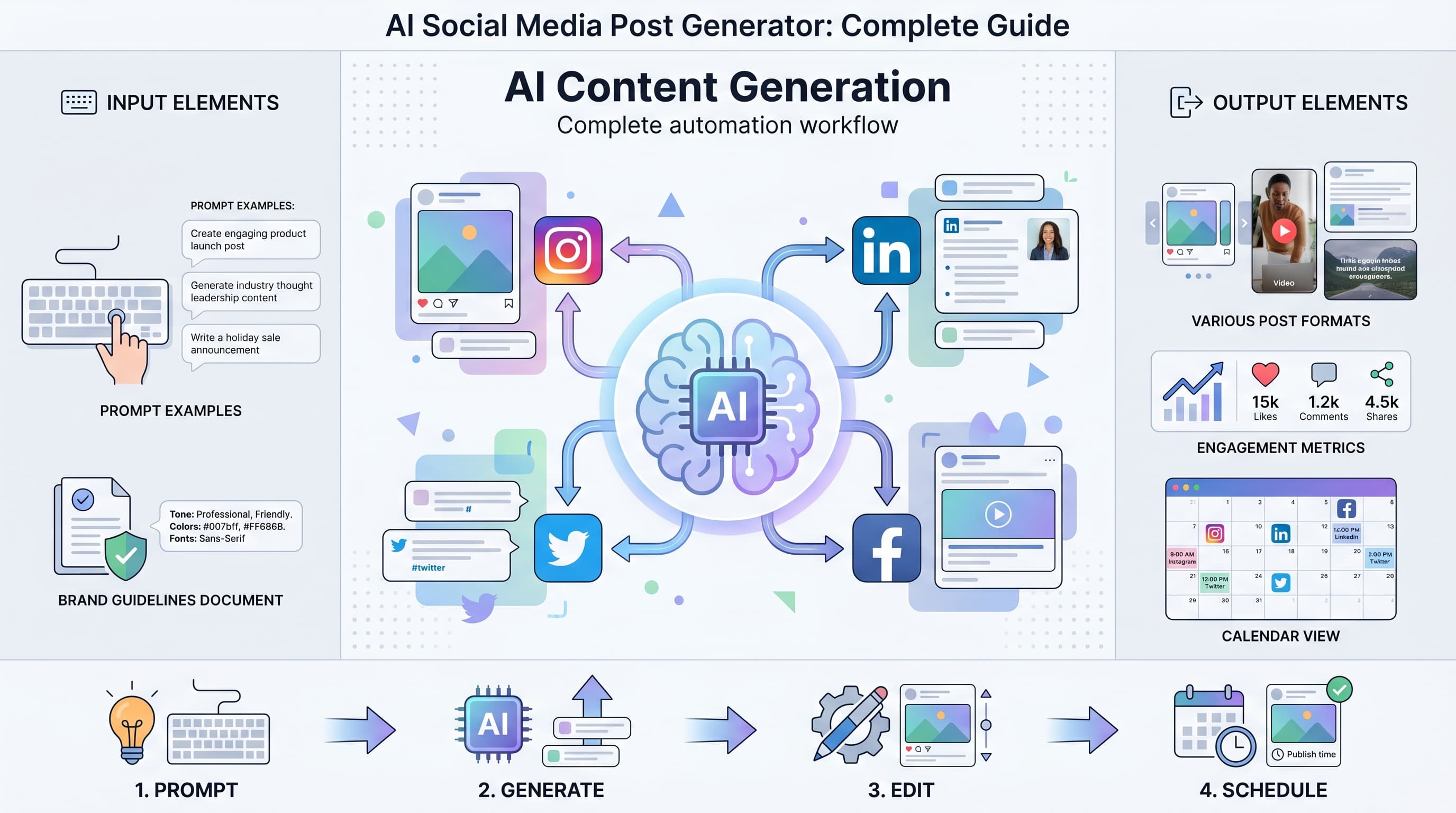
An AI social media post generator is a tool that uses artificial intelligence to create social media content automatically. These tools analyze patterns from millions of successful posts, understand platform-specific best practices, and generate captions, hashtags, and even content ideas based on your input. See our batch content creation guide.
Think of it as having a creative writing assistant who never gets tired, knows what works on every platform, and can adapt your brand voice instantly. The best AI generators don't just spit out generic content - they learn your style, understand your audience, and create posts that sound authentically human. Our the best time to can help.
How AI generators actually work
AI post generators use large language models trained on billions of text samples, including successful social media posts. When you input a topic or brief, the AI analyzes this against patterns it's learned about engagement, platform algorithms, and user behavior. See our best time to post on linkedin guide.
The process typically involves natural language processing, sentiment analysis, and platform-specific optimization. Advanced tools also consider factors like optimal posting times, trending hashtags, and audience demographics to maximize reach and engagement. Try our linkedin image size guide.
Why traditional content creation is failing
The social media landscape has changed dramatically. What worked five years ago - or even last year - might be completely ineffective today. Algorithm changes happen constantly, audience expectations keep rising, and the pressure to post consistently has never been higher.
The content creation bottleneck
Most businesses and creators are stuck in a cycle of reactive content creation. They scramble to post something, anything, just to maintain visibility. This leads to inconsistent messaging, burnout among team members, and content that fails to connect with audiences.
Research shows that 73% of marketers struggle with creating consistent, high-quality content. The manual approach simply doesn't scale when you need to post across multiple platforms, maintain brand voice consistency, and adapt content for different audiences.
The engagement crisis
Engagement rates across all major platforms have been declining steadily. Instagram engagement dropped to 0.67% in 2023, down from over 4% just a few years ago. The competition for attention is fierce, and only the most strategic, well-crafted content breaks through.
Generic, uninspired posts get buried in feeds. Audiences can instantly spot lazy content, and platform algorithms are designed to suppress posts that don't generate immediate engagement. This creates a vicious cycle where poor content performs badly, leading to even lower organic reach.
Top AI social media post generators in 2024
The AI content generation space has exploded with options, but not all tools are created equal. Some excel at creative copy, others focus on data-driven optimization, and a few manage to balance both creativity and performance.
1. ChatGPT and GPT-4
OpenAI's ChatGPT remains the gold standard for conversational AI content creation. GPT-4's improved reasoning makes it excellent for understanding complex brand guidelines and creating nuanced content that matches specific voices and tones.
Strengths: Exceptional at understanding context, great for long-form captions, excellent at adapting tone and style. Can handle complex prompts and maintain consistency across multiple posts.
Weaknesses: Requires detailed prompting for best results, doesn't understand platform-specific optimization, no built-in scheduling or analytics features.
Best for: Brands with dedicated social media teams who can craft detailed prompts and want maximum creative control.
2. Copy.ai
Copy.ai specializes in marketing copy and has robust social media templates. Their platform includes pre-built prompts for different industries and post types, making it accessible for beginners while still powerful for experienced users.
Strengths: User-friendly interface, industry-specific templates, good at generating multiple variations quickly, includes basic hashtag suggestions.
Weaknesses: Can feel formulaic after extended use, limited customization for brand voice, no direct platform integration.
Best for: Small businesses and solo creators who need quick, professional-sounding content without extensive customization.
3. Jasper AI
Jasper focuses heavily on brand voice consistency and long-form content. Their social media features are part of a broader content marketing suite, making it ideal for businesses with comprehensive content strategies.
Strengths: Excellent brand voice training, integrates with broader content strategy, good at maintaining consistency across campaigns, strong analytics integration.
Weaknesses: Higher price point, steeper learning curve, sometimes over-optimizes for brand guidelines at the expense of creativity.
Best for: Medium to large businesses with established brand guidelines and dedicated content teams.
4. Writesonic
Writesonic offers a good balance of features and affordability. Their social media tools include platform-specific optimization and trend integration, making posts more likely to perform well algorithmically.
Strengths: Platform-specific optimization, trend integration, affordable pricing, good variety of post types and formats.
Weaknesses: Quality can be inconsistent, limited advanced customization, sometimes produces generic-sounding content.
Best for: Growing businesses that need consistent content output without breaking the budget.
5. Schedulala's AI features
Schedulala combines AI content generation with comprehensive scheduling and analytics. The AI understands optimal posting times, audience preferences, and platform-specific best practices to create content that's designed to perform.
Strengths: Integrated scheduling and analytics, performance-optimized content, learns from your account's historical data, multi-platform optimization built-in.
Weaknesses: Newer to the market compared to standalone AI tools, AI features are part of a broader platform rather than the sole focus.
Best for: Businesses that want AI generation, scheduling, and analytics in one unified platform.
| Tool | Best Feature | Price Range | Learning Curve |
|---|---|---|---|
| ChatGPT | Flexibility | $20/month | Medium |
| Copy.ai | Templates | $36/month | Easy |
| Jasper | Brand Voice | $99/month | Hard |
| Writesonic | Value | $19/month | Easy |
| Schedulala | Integration | $29/month | Medium |
Try Schedulala for free
Schedule posts to Bluesky, Twitter, and 8 other platforms from one dashboard.
Get started for free→Step-by-step guide to using AI post generators effectively
Getting good results from AI post generators isn't about finding the perfect tool - it's about using any tool strategically. The difference between amateur and professional results comes down to preparation, prompting technique, and post-generation optimization.
1. Define your brand voice and content strategy
Before generating a single post, document your brand voice in detail. This isn't just 'friendly and professional' - you need specific examples, tone preferences, vocabulary choices, and topics you avoid.
Create a brand voice document that includes sample posts you love, key messaging points, preferred hashtags, and content themes. The more specific you are, the better AI tools can match your style.
Example brand voice guide: 'We write like a knowledgeable friend giving advice over coffee. Use contractions, ask rhetorical questions, avoid corporate jargon. Include actionable tips in every post. Never use emojis in captions, but use them in comments.'
2. Research your audience and platform preferences
AI generators work best when they understand who you're writing for. Analyze your top-performing posts to identify patterns in language, topics, and format that resonate with your audience.
Document audience preferences by platform. Your LinkedIn audience might prefer industry insights and professional development content, while your Instagram followers want behind-the-scenes content and quick tips.
Use your platform analytics to identify peak engagement times, popular hashtags, and content formats that perform best. This data will inform both your AI prompts and your posting strategy.
3. Master the art of AI prompting
Effective AI prompting is a skill that dramatically impacts output quality. Vague prompts produce generic content, while detailed, specific prompts generate posts that sound authentically human and on-brand.
Structure your prompts with context, specific requirements, examples, and constraints. Instead of 'write a post about productivity,' try 'Write an Instagram caption for busy entrepreneurs about the 2-minute rule for productivity. Include a personal anecdote, end with a question, keep it under 150 words, and suggest 5 relevant hashtags.'
Always include format specifications, tone requirements, and any platform-specific considerations. The more constraints you provide, the more focused and useful the output will be.
4. Generate multiple variations and test
Never use the first AI-generated post without exploring alternatives. Generate 3-5 variations of each post, then combine the best elements or choose the version that best matches your goals.
Test different approaches systematically. Try varying the hook, call-to-action, or content format while keeping other elements consistent. This helps you identify what works best for your specific audience.
Keep a swipe file of your best AI-generated content. Note what prompts produced the best results and refine your prompting strategy based on performance data.
5. Edit and optimize for human connection
AI-generated content should be a starting point, not a finished product. Always edit for authenticity, add personal touches, and ensure the content feels genuinely connected to your brand and audience.
Add specific examples, personal anecdotes, or current references that an AI wouldn't know about. This human touch is what separates good AI-assisted content from obvious AI-generated content.
Read everything out loud before posting. If it doesn't sound like something you'd actually say, keep editing until it does. Authenticity matters more than perfection.
6. Schedule strategically and monitor performance
Use your AI-generated content as part of a strategic posting schedule. Don't just generate and post immediately - plan your content calendar to ensure variety, consistency, and optimal timing.
Monitor performance metrics closely and adjust your AI prompting strategy based on what works. If posts with specific elements consistently outperform others, incorporate those elements into your prompt templates.
Track engagement patterns, click-through rates, and conversion metrics to understand which AI-generated content types deliver the best business results, not just vanity metrics.
Advanced AI prompting techniques for social media
Basic prompting gets you basic results. Advanced techniques unlock AI's full potential for creating content that genuinely engages audiences and drives business results. These strategies separate professionals from amateurs in the AI content game.
The PASTOR framework for persuasive posts
PASTOR stands for Problem, Amplify, Story, Transformation, Offer, Response. This framework works exceptionally well for AI-generated social media content because it provides clear structure while encouraging emotional connection.
Problem: Identify a specific pain point your audience faces. Don't be generic - get specific about the frustration, inconvenience, or challenge.
Amplify: Emphasize why this problem matters and what happens if it's not solved. Create urgency without being manipulative.
Story: Share a brief narrative that illustrates the problem and solution. Stories are where AI often struggles, so you might need to add personal details afterward.
Transformation: Show the positive outcome after the problem is solved. Paint a picture of the better future.
Offer: Present your solution, product, or advice. Keep it valuable and relevant to the problem discussed.
Response: Include a clear call-to-action that tells people exactly what to do next.
Emotional triggering for engagement
High-performing social media content triggers specific emotions: curiosity, surprise, validation, inspiration, or mild controversy. When prompting AI, specify the emotional response you want to create.
Instead of asking for 'engaging content,' request 'content that makes small business owners feel validated about their struggles with time management.' This emotional specificity produces much more compelling results.
Create prompts that include emotional context: 'Write this as if you're reassuring someone who's feeling overwhelmed' or 'Create excitement about this opportunity without sounding salesy.'
Platform-specific optimization prompts
Each platform has unique characteristics that affect content performance. Your AI prompts should reflect these differences to maximize effectiveness on each platform.
LinkedIn prompts: 'Write a professional but conversational post that positions expertise without being boastful. Include industry insights and end with a thoughtful question that encourages meaningful discussion.'
Instagram prompts: 'Create a caption that works both as a standalone post and complements a visual. Use line breaks for readability, include relevant hashtags naturally, and end with a call-to-action that encourages saves or shares.'
Twitter prompts: 'Write a thread-worthy hook in under 280 characters that makes people want to read more. Use conversational language and include a clear value proposition in the first tweet.'
Constraint-based creativity
Counterintuitively, adding constraints to your AI prompts often produces more creative and effective content. Limitations force the AI to find unique solutions within specific parameters.
Try prompts like: 'Write a productivity tip using only questions,' or 'Explain this concept without using industry jargon,' or 'Create a motivational post that doesn't mention success, achievement, or goals.'
Constraints also help ensure content fits your brand voice and audience expectations. If your brand is known for humor, add 'include subtle humor but keep it professional' to every prompt.
Data-driven prompt refinement
Track which types of AI-generated posts perform best, then reverse-engineer successful prompts. If posts that include statistics consistently outperform others, add 'include a relevant statistic or data point' to your standard prompts.
Create a feedback loop between your AI prompting and performance data. If questions generate more engagement than statements, adjust your prompts to favor interrogative structures.
Document successful prompt formulas and create templates. This systematic approach turns AI content generation from random experimentation into a predictable, scalable process.
Common AI content generation mistakes to avoid
Even with powerful AI tools, most people make predictable mistakes that sabotage their results. These errors are easy to spot once you know what to look for, and avoiding them immediately improves your content quality.
The generic prompt trap
Asking AI to 'write a social media post about productivity' produces the same boring content everyone else gets. Generic prompts create generic content that audiences ignore.
Instead, provide specific context, target audience details, and desired outcomes. Replace 'write about productivity' with 'write a LinkedIn post for overwhelmed marketing managers about the productivity technique that helped you reclaim 2 hours daily.'
Always include who you're writing for, what specific benefit you're providing, and what action you want readers to take. Specificity is the difference between content that converts and content that gets scrolled past.
Ignoring platform-specific best practices
Using the same content across all platforms is a rookie mistake. What works on LinkedIn fails miserably on TikTok, and Instagram content rarely translates well to Twitter.
Each platform has different audience expectations, optimal post lengths, and engagement patterns. Your AI prompts should reflect these differences rather than creating one-size-fits-all content.
Study top performers on each platform you use. Notice how successful creators adapt their voice, format, and content style to match platform conventions while maintaining their brand identity.
Publishing without human editing
AI-generated content always needs human editing, even from the best tools. Publishing raw AI output makes your content feel robotic and disconnected from your audience.
At minimum, add personal touches, current references, or specific examples that ground the content in reality. Better yet, restructure sentences, adjust tone, and ensure the content genuinely sounds like your brand voice.
Read everything aloud before posting. If it doesn't sound like something you'd say in conversation, keep editing. Authenticity matters more than efficiency.
Overusing AI-generated content
AI should enhance your content creation, not replace human creativity entirely. Audiences can sense when everything is AI-generated, even when individual posts are well-crafted.
Mix AI-assisted content with original thoughts, personal experiences, and spontaneous posts. The goal is to use AI to handle routine content while preserving space for authentic human connection.
A good rule of thumb: use AI for 60-70% of your content, but ensure that 30-40% comes from genuine human insight and experience. This balance maintains efficiency while preserving authenticity.
Neglecting performance analysis
Generating content without tracking performance is like shooting arrows in the dark. You need data to understand what works and refine your approach accordingly.
Track not just engagement metrics, but business outcomes. Which AI-generated posts drive website traffic, generate leads, or result in sales? Focus on optimizing for results that matter to your business.
Create a feedback loop where performance data informs your AI prompting strategy. If certain prompt structures consistently produce better results, incorporate those elements into your standard templates.
Creating content calendars with AI assistance
Individual posts are just the beginning. The real power of AI content generation emerges when you use it to create comprehensive, strategic content calendars that maintain consistency while reducing planning overhead.
Strategic content planning with AI
AI excels at generating content ideas based on themes, seasons, industry events, and audience interests. Instead of brainstorming individual posts, use AI to create month-long content themes with supporting post ideas.
Start with broad themes relevant to your business goals. For example, if you're launching a product in Q2, ask AI to generate content themes that build toward that launch: awareness, education, social proof, and conversion-focused content.
Prompt example: 'Create a 4-week content calendar for a productivity software company launching a new feature. Week 1 should focus on the problem this feature solves, Week 2 on how it works, Week 3 on customer success stories, Week 4 on conversion. Include 5 post ideas per week across LinkedIn and Twitter.'
Batch content creation workflows
Generate content in batches rather than one post at a time. This approach maintains thematic consistency, reduces context switching, and allows for better strategic planning.
Create weekly or monthly batches focused on specific themes. Generate all content for a campaign at once, then schedule it strategically rather than creating content reactively.
Use AI to create content series: '5 tips for...', 'Behind the scenes of...', or 'Common mistakes in...' These series provide structure while ensuring variety in your content mix.
Seasonal and trending content integration
AI can help you capitalize on trends, seasons, and current events by generating relevant content quickly. However, speed shouldn't come at the expense of thoughtfulness or brand alignment.
Create prompts that tie trending topics to your expertise area. Instead of jumping on every trend, focus on those that naturally connect to your business and provide genuine value to your audience.
Example: 'Write a LinkedIn post connecting the new year resolution trend to productivity software adoption. Focus on sustainable habit formation rather than quick fixes. Include actionable advice.'
Multi-platform content adaptation
Use AI to adapt core content ideas across multiple platforms rather than creating entirely new content for each channel. This maximizes your content investment while respecting platform-specific conventions.
Start with one comprehensive piece of content, then use AI to adapt it for different platforms. A detailed LinkedIn post can become a Twitter thread, an Instagram carousel, and a Facebook discussion starter.
Maintain consistent messaging while adjusting format, tone, and length for each platform. Your core value proposition stays the same, but the presentation adapts to platform norms and audience expectations.
Try Schedulala for free
Schedule posts to Bluesky, Twitter, and 8 other platforms from one dashboard.
Get started for free→Measuring and optimizing AI-generated content performance
Creating content is only half the equation. Without proper measurement and optimization, you're essentially creating content in a vacuum, missing opportunities to improve performance and achieve better business results.
Key metrics that actually matter
Vanity metrics like likes and followers feel good but don't necessarily drive business results. Focus on metrics that correlate with your actual business goals: website traffic, lead generation, sales inquiries, or email signups.
Track engagement quality, not just quantity. Comments that spark meaningful discussions are more valuable than passive likes. Saves and shares indicate content that provides lasting value.
Measure content efficiency by tracking time investment versus results. AI-generated content should improve your content ROI by reducing creation time while maintaining or improving performance.
A/B testing AI-generated variations
Use AI's ability to generate multiple variations for systematic A/B testing. Test different hooks, call-to-actions, content formats, and posting times to optimize performance.
Create controlled tests where you vary one element while keeping others constant. Test emotional versus logical appeals, question-based versus statement-based hooks, or long-form versus short-form content.
Document your findings and incorporate successful elements into future AI prompts. This creates a continuous improvement cycle where your AI-generated content gets better over time.
Platform algorithm optimization
Each social media platform's algorithm rewards different behaviors. LinkedIn favors professional discussion, Instagram rewards visual appeal and engagement speed, Twitter amplifies timely and conversational content.
Use AI to create content optimized for specific algorithmic preferences. Include elements that each platform's algorithm favors: questions for discussion, trending hashtags, or content that encourages quick engagement.
Monitor how algorithm changes affect your AI-generated content performance. Adjust your prompting strategy when you notice shifts in what types of content perform best.
| Metric Type | Primary KPI | Secondary KPI | Business Impact |
|---|---|---|---|
| Engagement | Comments | Saves/Shares | Brand Awareness |
| Traffic | Click-through Rate | Time on Site | Lead Generation |
| Conversion | Email Signups | Demo Requests | Revenue |
| Efficiency | Content Cost | Time Saved | Team Productivity |
Advanced strategies for different business types
AI content generation isn't one-size-fits-all. Different business types, industries, and audience segments require adapted approaches to maximize effectiveness and authenticity.
B2B companies and professional services
B2B audiences expect authority, expertise, and professional insight. Your AI prompts should emphasize thought leadership, industry knowledge, and practical business advice.
Focus on content that demonstrates expertise without being overly promotional. Share insights about industry trends, explain complex concepts simply, and provide frameworks or methodologies your audience can apply.
Prompt example: 'Write a LinkedIn post for B2B marketing directors about the ROI of content marketing automation. Include specific metrics or statistics, address common objections, and end with a strategic question that encourages professional discussion.'
B2B content performs best when it provides immediate value while subtly positioning your expertise. Avoid hard sales pitches in favor of educational content that builds trust and demonstrates competence.
E-commerce and retail brands
E-commerce brands need content that showcases products while building lifestyle aspiration. AI can help create product-focused content that doesn't feel overly commercial.
Generate content that shows products in context, addresses common customer questions, and creates emotional connections with purchase decisions. Focus on benefits and transformation rather than features.
Use AI to create seasonal content, gift guides, styling tips, and user-generated content campaigns. E-commerce audiences respond well to visual storytelling and social proof.
Prompt example: 'Create an Instagram caption for a sustainable clothing brand showcasing a new jacket. Focus on the versatility and environmental benefits. Include styling tips and end with a soft call-to-action about making conscious fashion choices.'
Personal brands and creators
Personal brands require authentic voice and personality to succeed. AI should enhance your natural communication style rather than replace it with generic corporate speak.
Use AI to structure your thoughts and insights, but always add personal anecdotes, opinions, and experiences. Your audience follows you for your unique perspective, not polished corporate messaging.
Generate content ideas and frameworks, then personalize heavily. AI can help with structure and clarity, but the stories, examples, and personality must come from you.
Focus on content that builds relationships: behind-the-scenes insights, lessons learned, personal challenges, and authentic reactions to industry events or trends.
Local businesses and service providers
Local businesses need content that builds community connection and demonstrates local expertise. AI can help create content that feels neighborhood-focused rather than generic.
Generate content about local events, community involvement, customer spotlights, and behind-the-scenes glimpses of your business operations. Local audiences want to feel connected to the people behind the business.
Use AI to create educational content specific to your local market: 'home maintenance tips for [city] weather conditions' or 'best practices for [local industry] in [region].'
Always add local references, community connections, and personal touches that AI can't provide. Your local knowledge and community involvement are your competitive advantages.
Future trends in AI social media content
The AI content generation landscape evolves rapidly. Understanding emerging trends helps you stay ahead of the competition and adapt your strategies before changes become mandatory.
Hyper-personalization and audience segmentation
Future AI tools will create highly personalized content for different audience segments automatically. Instead of one-size-fits-all posts, you'll generate variations optimized for specific customer personas, demographics, or engagement histories.
This trend requires better audience data and more sophisticated prompting strategies. Start collecting detailed audience insights now and experiment with creating persona-specific content variations.
The businesses that win will be those that use AI to create more personal, relevant content rather than more generic content at scale.
Multi-modal content generation
AI is expanding beyond text to generate images, videos, and audio content. Soon, you'll prompt AI to create complete social media campaigns with coordinated visual and textual elements.
Tools are emerging that can generate Instagram posts with custom graphics, TikTok videos with AI-generated scripts and visuals, and podcast content with synthetic voices that sound authentically human.
Start experimenting with AI image generation and video tools now. Understanding how to coordinate AI-generated visual and textual content will become a crucial competitive advantage.
Real-time trend integration
Advanced AI systems will monitor trending topics, breaking news, and viral content in real-time, automatically suggesting timely content opportunities that align with your brand voice and business goals.
This capability will compress the time between trend emergence and brand response from hours or days to minutes. Speed and relevance will become even more important competitive factors.
Prepare by developing clear brand guidelines about which trends you'll engage with and which you'll avoid. Quick response times won't matter if the content damages your brand reputation.
Performance prediction and optimization
Future AI systems will predict content performance before publication, suggesting optimizations for timing, format, or messaging based on historical data and current platform dynamics.
These predictive capabilities will help you invest creation time in content most likely to succeed while avoiding content formats or topics that typically underperform for your audience.
Start building comprehensive performance databases now. The more historical data you have, the better AI tools will be able to optimize your future content.
Building sustainable AI content workflows
Random experimentation with AI tools leads to inconsistent results and wasted effort. Sustainable success requires systematic workflows that balance efficiency with quality and authenticity.
Creating content production systems
Develop repeatable processes for different types of content. Create templates for product announcements, thought leadership pieces, customer spotlights, and seasonal campaigns.
Document your most successful prompts and create a prompt library organized by content type, platform, and business goal. This systematic approach ensures consistent quality while reducing the mental overhead of content creation.
Build quality control checkpoints into your workflow. Never publish AI-generated content without human review, brand voice verification, and factual accuracy checking.
Team collaboration and training
If multiple team members use AI for content creation, establish shared standards, prompt libraries, and quality guidelines. Inconsistent AI usage across team members creates inconsistent brand voice.
Train your team on effective prompting techniques, brand voice guidelines, and platform-specific best practices. AI tools are only as good as the humans using them.
Create feedback loops where team members share successful prompts, techniques, and performance insights. Collective learning accelerates everyone's AI content skills.
Balancing automation with authenticity
The goal isn't to automate everything, but to automate routine tasks while preserving space for authentic human connection and creativity.
Use AI for content structure, initial drafts, and routine announcements. Reserve human creativity for storytelling, personal insights, and content that requires genuine emotional connection.
Monitor audience feedback and engagement patterns to ensure your AI-assisted content maintains the authentic feel that builds genuine relationships with followers.
Getting started: your first 30 days with AI content generation
Transforming your social media strategy with AI doesn't happen overnight. Here's a practical 30-day plan to implement AI content generation systematically while maintaining quality and authenticity.
Week 1: Foundation and setup
Day 1-2: Audit your current content performance. Identify your top-performing posts and analyze what made them successful. This analysis will inform your AI prompting strategy.
Day 3-4: Choose your AI tool based on your budget, technical comfort level, and specific needs. Start with a free or low-cost option to experiment before committing to expensive enterprise solutions.
Day 5-7: Create your brand voice document and develop 5-10 template prompts for your most common content types. Test these prompts and refine based on output quality.
Week 2: Content creation and testing
Day 8-10: Generate your first batch of AI-assisted content. Create 2 weeks worth of posts, editing each one to match your brand voice and add personal touches.
Day 11-14: Begin publishing AI-assisted content while continuing to create some content manually. This hybrid approach helps you compare performance and maintain authenticity.
Week 3: Optimization and scaling
Day 15-17: Analyze performance data from your first AI-generated posts. Identify patterns in what works and what doesn't, then adjust your prompting strategy accordingly.
Day 18-21: Experiment with different content formats, posting times, and engagement strategies. Use AI to generate A/B test variations of your best-performing content.
Week 4: Workflow refinement
Day 22-25: Develop your sustainable content creation workflow. Determine how much AI assistance to use versus human creativity, and establish quality control processes.
Day 26-30: Create your first AI-assisted content calendar for the following month. Plan themes, campaigns, and specific post types that align with your business goals.
Try Schedulala for free
Schedule posts to Bluesky, Twitter, and 8 other platforms from one dashboard.
Get started for free→