Claude for Social Media: Complete Guide to AI-Powered Content Creation
Learn how to use Claude AI for social media content creation, scheduling, and strategy. Complete guide with prompts, tips, and best practices.

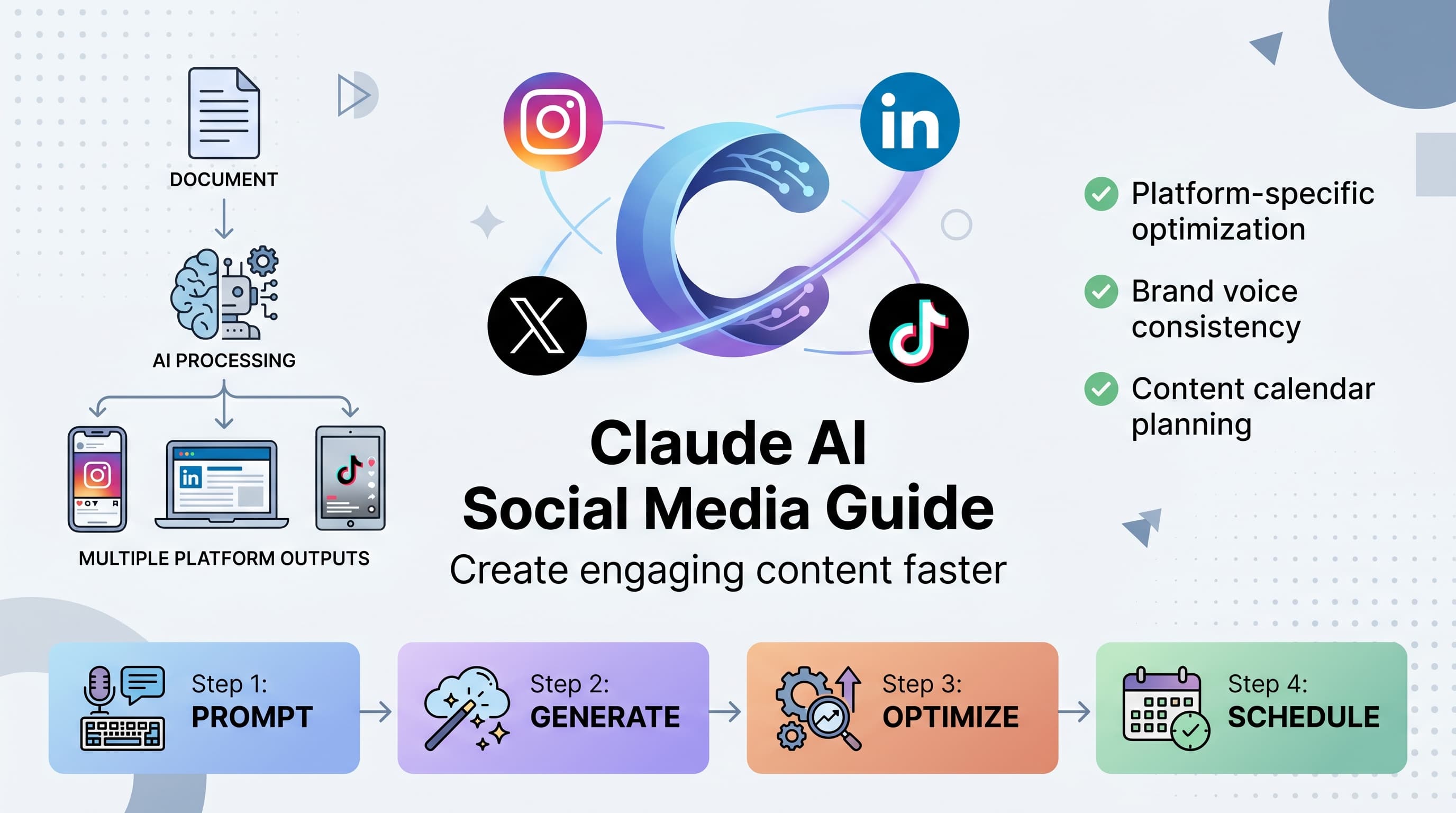
Claude AI is changing how content creators approach social media. Instead of spending hours brainstorming posts, writing captions, and planning content calendars, you can use this powerful AI assistant to streamline your entire social media workflow. See our LinkedIn scheduling guide.
See It in Action
This is what scheduling a LinkedIn post looks like in Schedulala
Whether you're managing multiple brand accounts or trying to maintain a consistent personal presence, Claude can help you create engaging content faster than ever. But here's the thing: most people are using it wrong. Our cross-platform analytics track 9 can help.
Try Schedulala for free
Schedule posts to Bluesky, Twitter, and 8 other platforms from one dashboard.
Get started for free→What makes Claude different for social media
Claude isn't just another AI writing tool. It understands context, tone, and audience in ways that make it particularly suited for social media content. Unlike other AI models that tend to sound robotic or overly formal, Claude can adapt its voice to match your brand personality. Try our scheduling across platforms.
1. Conversational tone mastery
Claude excels at creating content that sounds natural and conversational. It can write Instagram captions that feel authentic, LinkedIn posts that strike the right professional tone, and Twitter threads that flow seamlessly from one tweet to the next. Try our the best story scheduler:.
The key is in how you prompt it. Instead of asking for generic social media content, give Claude specific context about your audience, brand voice, and the platform you're targeting. Our best time to post on linkedin can help.
2. Platform-specific optimization
Each social media platform has its own culture, format requirements, and audience expectations. Claude understands these nuances and can tailor content accordingly. A LinkedIn post needs a different approach than a TikTok script, and Claude gets this. See our linkedin line break generator guide.
When you specify the platform in your prompts, Claude automatically adjusts its writing style, length, and formatting to match what works best on that particular channel.
Essential Claude prompts for social media content
The quality of your Claude outputs depends entirely on how well you craft your prompts. Generic requests produce generic content. Specific, detailed prompts generate content that actually connects with your audience.
1. Content creation prompts
Start with this template: 'Write a [platform] post for [target audience] about [topic]. The tone should be [adjective] and the goal is to [specific objective]. Include [specific elements like hashtags, CTAs, etc.]'
For example: 'Write an Instagram post for small business owners about email marketing. The tone should be encouraging and practical. The goal is to get them to try email automation. Include 3-5 relevant hashtags and a clear call-to-action.'
- LinkedIn thought leadership: 'Write a LinkedIn post sharing a contrarian opinion about [industry trend]. Make it thought-provoking but professional.'
- Twitter engagement: 'Create a Twitter thread explaining [complex topic] in simple terms. Use analogies and examples. Aim for 5-7 tweets.'
- Instagram storytelling: 'Write an Instagram caption telling a story about [experience/lesson]. Include a personal anecdote and connect it to a broader lesson.'
2. Content repurposing prompts
One of Claude's strongest abilities is transforming existing content into fresh formats. This saves massive amounts of time and helps you get more mileage from your best content.
- Blog to social: 'Turn this blog post into 5 different social media posts for LinkedIn, Instagram, Twitter, Facebook, and TikTok.'
- Long-form to threads: 'Convert this article into a 10-tweet Twitter thread. Each tweet should be self-contained but flow logically.'
- Video to text: 'I have a video transcript about [topic]. Create 3 LinkedIn posts, 5 Instagram story frames, and 10 tweet ideas from this content.'
3. Engagement and community building prompts
Creating content that sparks conversation requires intentional design. Claude can help you craft posts that naturally encourage engagement and build community around your brand.
- Question posts: 'Create a thought-provoking question for [platform] about [topic] that will generate discussion in the comments.'
- Poll ideas: 'Generate 5 poll ideas for Instagram Stories about [industry/topic] that will help me understand my audience better.'
- Conversation starters: 'Write a controversial but defensible opinion about [topic] formatted as a LinkedIn post that will spark healthy debate.'
Platform-specific strategies with Claude
Each social media platform has its own best practices, audience expectations, and content formats. Here's how to leverage Claude effectively for each major platform.
Instagram optimization
Instagram is visual-first, but captions matter more than most people think. Claude can help you write captions that complement your visuals and drive engagement. The key is balancing personality with purpose.
For Instagram, prompt Claude with: 'Write an Instagram caption for [describe the image/video]. The caption should be [tone] and include a hook in the first line, a story or valuable insight in the middle, and end with a question to encourage comments. Add 5-8 relevant hashtags.'
- Hook formulas that work: personal anecdotes, controversial opinions, or surprising statistics
- Story structure: problem, solution, result or before, during, after
- Questions that drive comments: ask for experiences, opinions, or advice
- Hashtag strategy: mix popular and niche tags, avoid overly competitive ones
LinkedIn professional content
LinkedIn rewards content that provides professional value. Claude excels at creating thought leadership content, industry insights, and career advice that resonates with professional audiences.
Effective LinkedIn prompts for Claude: 'Write a LinkedIn post about [professional topic] that provides actionable advice. Start with a compelling hook, share 3-5 specific tips, and end with a question that encourages professional discussion. Keep it under 1,300 characters for maximum reach.'
- Industry commentary: Share opinions on trends, changes, or best practices in your field
- Career advice: Offer specific, actionable tips based on your experience
- Behind-the-scenes: Share lessons learned, mistakes made, or processes that work
- Data-driven insights: Present research, survey results, or case study findings
Twitter engagement tactics
Twitter's fast-paced environment rewards concise, timely, and often witty content. Claude can help you craft tweets that cut through the noise and start conversations.
Try this approach: 'Write a Twitter thread about [topic]. Start with a hook tweet that makes people want to read more. Break down [main concept] into 5-7 digestible tweets. Each tweet should provide value on its own but contribute to the overall narrative. End with a call-to-action.'
- Thread starters: 'Here's what nobody tells you about...', 'I analyzed 100 [things] and found...'
- Engagement tweets: Polls, questions, unpopular opinions, or hot takes
- Value bombs: Quick tips, resources, or insights that can be consumed quickly
- Story threads: Personal experiences with broader lessons or takeaways
TikTok and video content scripting
Even though TikTok is video-first, the script makes or breaks your content. Claude can help you structure videos that hook viewers immediately and keep them watching until the end.
For TikTok scripts, use: 'Write a 60-second TikTok script about [topic]. Start with a hook in the first 3 seconds that creates curiosity. Structure it as [format like tutorial, story, or list]. Include natural transition phrases and end with a strong call-to-action. Mark where visual elements should appear.'
- Hook formulas: 'POV:', 'Things I wish I knew...', 'Red flags that...'
- Structure options: Tutorials, transformations, day-in-the-life, or myth-busting
- Retention tactics: Tease what's coming, use countdown formats, or build suspense
- CTA options: Follow for more, share with someone who needs this, try this and report back
Content calendar planning with Claude
Creating a consistent content calendar is one of the biggest challenges in social media management. Claude can help you plan weeks or months of content in advance, ensuring you never run out of ideas and maintain a consistent posting schedule.
1. Monthly theme planning
Start by asking Claude to help you develop monthly themes: 'I run a [type of business] and post on [platforms]. Create a 12-month content theme calendar. Each month should focus on a different aspect of [your industry/expertise]. Include seasonal relevance and key dates.'
This approach ensures your content has direction and purpose rather than feeling random or disconnected. Each month builds on the previous one while addressing different aspects of your audience's needs and interests.
2. Weekly content batching
Once you have monthly themes, use Claude to batch content creation: 'Based on this month's theme of [theme], create 20 post ideas for [platforms]. Include a mix of educational, entertaining, and promotional content. Format as: Platform, Post Type, Caption/Copy, Visual Description.'
This batching approach lets you create multiple posts in one focused session, then schedule them throughout the week. You'll maintain consistency without the daily pressure of coming up with fresh ideas.
3. Seasonal and trending content
Claude can help you prepare seasonal content in advance and jump on trends quickly. Use prompts like: 'Create 15 holiday-themed posts for [upcoming holiday] that relate to [your business/niche]. Include both obvious and creative connections to the holiday.'
For trending topics, try: 'How can I connect [current trend/news] to [my business/expertise] in a way that provides value to my audience? Give me 5 different angles and suggest the best platform for each.'
Advanced Claude techniques for social media
Once you master basic content creation, these advanced techniques will help you create more sophisticated, engaging, and effective social media content with Claude.
1. Audience persona development
Before creating content, use Claude to develop detailed audience personas: 'Based on my business [description], create 3 detailed customer personas. Include demographics, pain points, goals, preferred content types, and social media behavior. Make them specific enough that I can visualize real people.'
Then reference these personas in your content prompts: 'Write an Instagram post for [specific persona] about [topic]. Address their main pain point of [specific issue] and speak to their goal of [specific outcome].'
This persona-driven approach makes your content more targeted and relevant, leading to higher engagement and better results across all platforms.
2. Brand voice consistency
Develop a brand voice guide with Claude's help: 'Analyze these 10 posts from my brand [provide examples]. Identify the consistent voice characteristics, tone patterns, and messaging style. Create a brand voice guide I can reference for future content creation.'
Use this guide in all future prompts: 'Write a LinkedIn post about [topic] using my brand voice: [paste brand voice characteristics]. Ensure the tone matches my established personality while addressing [specific audience need].'
Consistency across platforms and over time builds brand recognition and trust. Your audience should be able to recognize your content even without seeing your logo or name.
3. Engagement optimization
Use Claude to analyze and improve your engagement patterns: 'Here are my top 5 performing posts [provide examples] and my 5 lowest performing posts. Analyze what makes the difference and give me a framework for creating more engaging content.'
Then apply these insights: 'Using the engagement framework you identified, write 5 Instagram posts about [topic]. Each should incorporate the high-performing elements while avoiding the patterns that led to low engagement.'
This data-driven approach helps you replicate success and avoid repeating mistakes, continuously improving your social media performance over time.
Integrating Claude with social media scheduling tools
Creating great content is only half the battle. Scheduling and managing your posts efficiently is crucial for maintaining consistency and maximizing reach. Here's how Claude fits into your scheduling workflow.
1. Batch content creation workflow
The most efficient approach combines Claude's content creation power with scheduling tools like Schedulala. Start by creating all your content for the week in one Claude session, then upload everything to your scheduling platform.
Use this workflow: Create 20-30 posts with Claude, export them to a spreadsheet with columns for platform, copy, hashtags, and posting time, then bulk upload to your scheduler. This approach saves hours compared to creating content daily.
When batching with Claude, ask for variety: 'Create 25 posts for this week: 10 educational, 8 entertaining, 4 promotional, and 3 behind-the-scenes. Vary the formats between single posts, carousels, and video scripts. Include optimal posting times for each.'
2. Cross-platform adaptation
Instead of creating separate content for each platform, use Claude to adapt one core message across multiple channels: 'Take this main message [provide core content] and adapt it for Instagram, LinkedIn, Twitter, and Facebook. Maintain the core value while optimizing format, length, and tone for each platform.'
This approach ensures consistent messaging while respecting each platform's unique culture and requirements. Your scheduling tool can then distribute these adapted versions at optimal times for each platform.
Pro tip: Start with your most important platform (usually where you get the best engagement), then ask Claude to adapt that winning content for other channels rather than creating from scratch.
3. Performance-based content iteration
Use your scheduling tool's analytics combined with Claude's analysis capabilities: 'Here's the performance data from my last 20 posts [provide metrics]. Help me understand what content types, topics, and formats perform best. Then create 10 new posts optimized based on these insights.'
This creates a feedback loop where your best-performing content informs future creation, continuously improving your results over time. Your scheduling platform provides the data, Claude provides the analysis and optimization.
Common mistakes to avoid with Claude
Even with Claude's advanced capabilities, many users make predictable mistakes that limit their results. Avoiding these pitfalls will dramatically improve your social media content quality and engagement.
1. Generic prompting
The biggest mistake is using vague prompts like 'Write a social media post about marketing.' This produces generic, forgettable content that sounds like every other AI-generated post.
Instead, be specific: 'Write an Instagram post for small business owners who struggle with email marketing. Address their fear of seeming pushy. Share a gentle email strategy they can implement this week. Use a encouraging, mentor-like tone and end with a question about their biggest email challenge.'
The more context and specificity you provide, the better Claude's output will be. Think of prompting as briefing a talented writer rather than issuing a command to a machine.
2. Ignoring platform differences
Using the same approach for all platforms is a recipe for mediocre results. What works on LinkedIn often fails on TikTok, and Instagram content rarely performs well on Twitter.
Always specify the platform and consider its unique characteristics: audience demographics, content formats, engagement patterns, and cultural norms. Claude can adapt accordingly, but only if you give it this direction.
Before creating content for any platform, ask yourself: How do people behave here? What do they expect? What format works best? Then include these considerations in your Claude prompts.
3. Over-relying on AI without human insight
Claude is incredibly powerful, but it works best when combined with human creativity and insight. Don't just accept its first output – iterate, refine, and add your personal perspective.
Use Claude as a collaborator, not a replacement: 'Here's a draft you created [paste content]. Help me make it more personal by incorporating this story [add your experience]. Also, adjust the tone to be more [specific adjustment].'
The best social media content combines AI efficiency with human authenticity. Use Claude for structure, ideas, and optimization, but inject your personality, experiences, and unique perspective.
4. Neglecting audience feedback
Creating content in a vacuum leads to declining engagement over time. Pay attention to comments, shares, and overall performance to understand what resonates with your actual audience.
Regularly feed audience feedback back to Claude: 'My audience responded well to this post about [topic] but didn't engage with this one about [topic]. Based on the difference, help me understand what content angles work best for my followers.'
Your audience's behavior provides valuable data that Claude can analyze and incorporate into future content creation, creating a continuous improvement cycle.
Measuring success and optimizing results
Creating content with Claude is just the beginning. To truly succeed on social media, you need to measure what works and continuously optimize your approach based on real performance data.
1. Key metrics to track
Focus on metrics that actually matter for your goals. Vanity metrics like total followers look good but don't necessarily translate to business results. Instead, track engagement rate, click-through rate, conversions, and audience growth rate.
Use Claude to help analyze your metrics: 'Here's my social media performance data for the last month [provide key metrics]. Help me identify patterns in what content performs best and suggest improvements for underperforming areas.'
- Engagement rate: Likes, comments, and shares relative to your follower count
- Click-through rate: How often people click links in your posts
- Conversion rate: Actions taken after clicking through from social media
- Audience growth rate: Quality followers gained over time, not just quantity
2. A/B testing content approaches
Use Claude to create variations for testing: 'Create two different versions of this post concept [provide idea]. Version A should focus on the emotional benefits, Version B should focus on practical benefits. Keep everything else similar so I can test which approach resonates better.'
Test one variable at a time: post format, caption length, call-to-action style, or visual approach. This helps you understand exactly what drives better performance rather than guessing.
After collecting results, ask Claude to help interpret: 'Version A got 30% more engagement than Version B. Based on the differences between them, what does this tell me about my audience preferences? How should I apply this insight to future content?'
3. Continuous improvement strategies
Set up monthly reviews where you analyze your best and worst performing content with Claude's help. This creates a systematic approach to improvement rather than random trial and error.
Use this monthly review prompt: 'Analyze my top 10 and bottom 10 posts from this month [provide data]. What patterns emerge in topics, formats, timing, and messaging? Create an action plan for next month based on these insights.'
Document your learnings and create guidelines for future content creation. Over time, you'll develop a playbook of what works specifically for your audience and niche.
Try Schedulala for free
Schedule posts to Bluesky, Twitter, and 8 other platforms from one dashboard.
Get started for free→Future of AI in social media management
As AI technology continues evolving rapidly, understanding what's coming next helps you stay ahead of the curve and make better decisions about your social media strategy.
Claude and similar AI tools are becoming more sophisticated at understanding context, maintaining brand voice consistency, and creating content that genuinely connects with audiences. This trend will only accelerate, making AI literacy increasingly important for social media success.
The businesses and creators who learn to effectively combine AI efficiency with human creativity will have a significant advantage. Those who resist or poorly implement AI tools risk falling behind as the pace of content creation and optimization accelerates.

![Social Media Proposal Template [Free Download] - Win More Clients](/_next/image?url=%2Fblog%2Fsocial-media-proposal-template%2Fheader.jpeg&w=3840&q=75&dpl=dpl_6RiKV7dz1EjMEbYgqheh1pc2YPwv)