Instagram Hashtags Strategy: Complete 2026 Guide to Boost Your Reach & Engagement
Master Instagram hashtags strategy in 2026. Complete guide with proven tactics, best practices, and tools to maximize reach and engagement.

Quick answer
Use 5-10 highly relevant hashtags per post, mixing popular, medium, and niche tags to maximize Instagram reach in 2026.
- •Instagram allows up to 30 hashtags per post, but 5-10 targeted ones perform better
- •Place hashtags in the first comment instead of the caption for a cleaner look
- •Create a branded hashtag for user-generated content campaigns
- •Schedulala includes AI hashtag suggestions to optimize reach across Instagram and 9 other platforms
Your Instagram post gets 50 likes instead of 5,000. The difference? A smart hashtags strategy that most creators completely mess up. See our Instagram scheduling guide.
See It in Action
This is what scheduling an Instagram post looks like in Schedulala
Instagram's algorithm has evolved dramatically in 2026, but hashtags remain one of the most powerful ways to expand your reach. The problem is everyone's using outdated tactics from 2020 that actually hurt your performance now. Our how to repurpose content can help.
Try Schedulala for free
Schedule posts to Bluesky, Twitter, and 8 other platforms from one dashboard.
Get started for free→Why your current hashtag strategy isn't working
Most Instagram creators are stuck in 2020. They're still using massive hashtag lists, copying competitors blindly, and wondering why their reach keeps dropping. Learn more about content calendar.
Here's what changed in 2026 that makes old hashtag advice dangerous:. See our the best time to guide.
1. Algorithm prioritizes relevance over volume
Instagram now penalizes accounts that use irrelevant hashtags. The platform can detect when you're hashtag stuffing or using tags that don't match your content. Learn more about best time to post on instagram.
Using 30 random hashtags will hurt your reach more than using 5 highly relevant ones. The algorithm looks for semantic connections between your content, captions, and hashtags. Our instagram engagement calculator can help.
2. Hashtag saturation levels have shifted
Popular hashtags like #instagood (over 1.9 billion posts) are essentially useless now. Your content gets buried within seconds.
The sweet spot has moved to hashtags with 100K to 2M posts. These have enough activity to be discovered but aren't oversaturated.
3. Community hashtags outperform generic ones
Instagram's recommendation system now heavily weights community engagement. Hashtags that connect you with specific communities (like #solopreneur or #plantparenthood) perform better than broad categories.
These community hashtags have more engaged users who actually interact with content, which signals quality to the algorithm.
The 2026 Instagram hashtags strategy framework
Forget everything you know about hashtag research. The new approach focuses on hashtag ecosystems rather than individual tags.
Think of hashtags as neighborhoods. You want to find the right neighborhoods where your ideal audience already hangs out. Here's how to build your hashtag ecosystem:
1. Map your content pillars to hashtag categories
Start by identifying your 3-5 main content themes. For a fitness creator, this might be workouts, nutrition, motivation, equipment reviews, and transformation stories.
Each content pillar needs its own hashtag family. Don't use the same hashtag mix for a workout video and a meal prep post. The algorithm notices this lack of relevance.
Create separate hashtag sets for each pillar. A workout post might use #homeworkout #bodyweighttraining #fitnessjourney, while a nutrition post uses #mealprep #healthyeating #nutritiontips.
2. Use the 40-30-20-10 hashtag distribution
40% niche-specific hashtags (10K-500K posts): These are your bread and butter. Tags like #sustainablefashion or #plantbasedrecipes that describe exactly what you do.
30% community hashtags (50K-2M posts): Tags that connect you with specific communities. Examples: #millennialentrepreneur #workingmom #digitalnomadlife.
20% location or trending hashtags (varies): Use your city name, trending topics in your niche, or seasonal hashtags. These change frequently.
10% branded or unique hashtags (under 50K posts): Your brand hashtag plus any unique tags you create for campaigns or series.
3. Research hashtags like a detective
Stop using hashtag generator tools. Start researching like your audience does. Go to Instagram's search bar and type keywords related to your content. Look at the suggested hashtags that appear.
More importantly, check what hashtags your engaged followers are using. Look at accounts that regularly like and comment on your posts. What hashtags do they use? This reveals the communities you should be targeting.
Use Instagram's hashtag pages to understand the vibe. Click on potential hashtags and scroll through recent posts. Do they match your content style and quality? Are people actively engaging?
Step-by-step hashtag research process
Here's the exact process I use to build hashtag sets that consistently deliver 3x more reach than random hashtag selection:
Step 1: Define your target audience's hashtag behavior
Open Instagram and search for accounts that represent your ideal follower. Not competitors, but potential customers or fans. Look for accounts that have 1K-10K followers in your niche.
Study their recent posts. What hashtags do they use? Write down every hashtag that appears more than once across different accounts. These are hashtags your audience already follows.
Pay special attention to hashtags with strong engagement relative to their size. A hashtag with 100K posts where recent content gets 50+ likes is better than a 1M hashtag where posts get 10 likes.
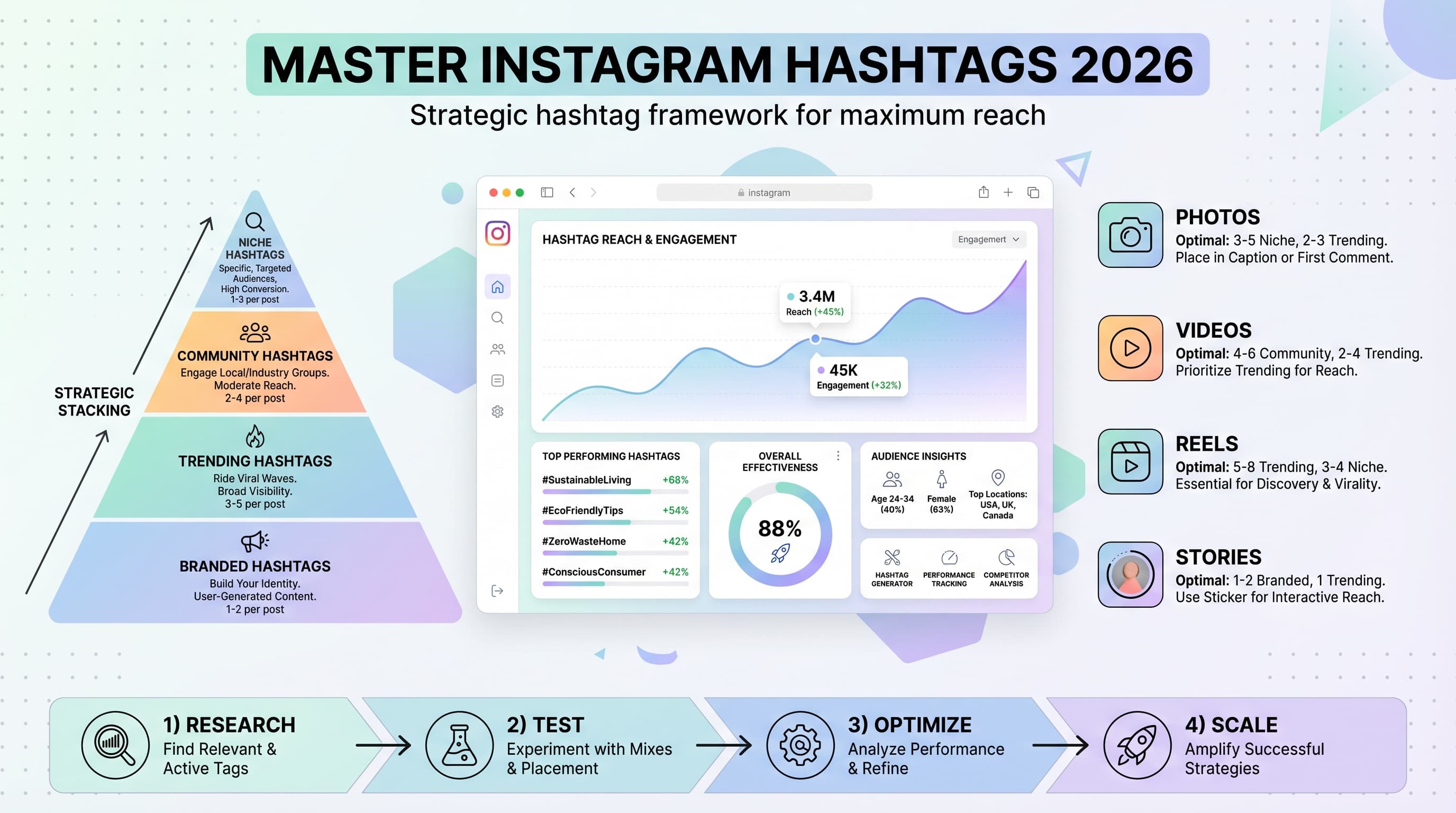
Step 2: Build your hashtag pyramid
Create four tiers of hashtags based on competition and specificity. Tier 1 (Top): Highly specific, low competition (under 50K posts). Examples: #veganmealprepsunday #beginneryogapose.
Tier 2: Niche but growing (50K-200K posts). Examples: #plantbasedathlete #workfromhomemom. Tier 3: Established community hashtags (200K-1M posts). Examples: #entrepreneurlife #homeworkout.
Tier 4 (Base): Broad category hashtags (1M+ posts). Use sparingly. Examples: #fitness #food #motivation. Your mix should be 40% Tier 1-2, 40% Tier 3, 20% Tier 4.
Step 3: Test and validate your hashtag sets
Create 5 different hashtag combinations for your next content type. Post identical content using different hashtag sets (space them out over time) and track reach, impressions, and engagement.
Use Instagram Insights to see which hashtags drove the most impressions. Go to your post insights and check 'From Hashtags' under Discovery. This tells you exactly which hashtags are working.
Double down on hashtag combinations that deliver 20%+ of your total reach from hashtags. These are your golden combinations to reuse and refine.
Step 4: Create your hashtag rotation system
Never use the exact same hashtag combination twice in a row. Instagram's algorithm flags repetitive hashtag usage as spam behavior. Create 3-5 variations for each content type.
Keep 60% of your hashtags consistent (your core niche and community hashtags) and rotate 40% based on trends, locations, or specific post details.
Update your hashtag sets monthly. Hashtags lose effectiveness over time as they become oversaturated or as Instagram's algorithm evolves.
Advanced hashtag tactics that work in 2026
Basic hashtag strategy gets you basic results. Here are advanced techniques that separate high-performing accounts from the pack:
1. Hashtag threading for series content
When creating content series (like 'Monday Motivation' or 'Tutorial Tuesday'), use consistent hashtag threading. Include 2-3 series-specific hashtags in every post of that series.
This creates a discoverable archive of your series content. Users who find one post in your series can easily find all related content by clicking your series hashtag.
Example: A cooking creator might use #sarahskitchensecrets and #15minutemeals for all their quick recipe videos. This builds hashtag authority over time.
2. Seasonal hashtag layering
Layer seasonal, monthly, and event-based hashtags on top of your core hashtag strategy. In January, fitness creators should include #newyearfitness #januarygoals alongside their regular fitness hashtags.
Track seasonal hashtag performance year over year. Some seasonal hashtags peak earlier or later than expected. #summerworkout might peak in April when people start preparing, not in July.
Create a seasonal hashtag calendar. Plan hashtag additions for holidays, industry events, and seasonal trends 2-3 months in advance.
3. Micro-influencer hashtag infiltration
Find hashtags that micro-influencers in your niche use but aren't widely known. These are often the most engaged communities because they're exclusive and authentic.
Look for influencers with 10K-100K followers who consistently get high engagement. They often create or popularize hashtags that larger accounts haven't discovered yet.
Engage genuinely with content under these hashtags before using them. Community hashtags work best when you're actually part of the community, not just using the hashtag.
Hashtag placement and timing strategies
Where and when you place hashtags affects their performance more than most creators realize. Here's what works in 2026:
1. Caption vs. first comment placement
Instagram's algorithm treats hashtags the same whether they're in captions or first comments. The choice depends on your aesthetic preferences and audience behavior.
Use caption hashtags when: Your hashtags add context to the post, you want to encourage hashtag discovery, or you're posting time-sensitive content where every second matters.
Use first comment hashtags when: You want clean captions, your hashtags are purely for discovery, or you're A/B testing different hashtag combinations.
2. The optimal hashtag count debate
Instagram allows up to 30 hashtags, but data from 2026 shows diminishing returns after 15-20 hashtags. More importantly, relevance matters more than quantity.
For new accounts (under 10K followers): Use 20-25 highly relevant hashtags to maximize discovery. You need the exposure more than established accounts.
For established accounts (over 10K followers): Focus on 10-15 highly strategic hashtags. Quality over quantity becomes more important as your audience grows.
3. Timing your hashtag strategy with posting schedules
Post when your hashtag communities are most active, not just when your followers are online. Check the recent activity on your target hashtags at different times.
Business hashtags like #entrepreneurtips perform better during weekday mornings. Lifestyle hashtags like #weekendvibes peak on Friday evenings and weekends.
Use scheduling tools to optimize both your posting time and hashtag selection. Different content types with different hashtag strategies should post at different optimal times.
Measuring and optimizing hashtag performance
Most creators set up hashtag strategies and never measure results. Here's how to track and optimize your hashtag performance systematically:
| Metric | What It Means | Optimization Action |
|---|---|---|
| Hashtag impressions | How many people saw your post through hashtags | Replace low-performing hashtags |
| Hashtag reach rate | Percentage of total reach from hashtags | Aim for 15-30% of total reach |
| Engagement from hashtags | Comments/likes from hashtag discovery | Focus on hashtags that drive engagement, not just views |
| Follower conversion | New followers from hashtag discovery | Double down on hashtags that bring quality followers |
| Hashtag ranking | Position in hashtag feed | Track if you're ranking in top posts vs. recent |
1. Weekly hashtag performance audit
Every week, review your top 3 posts' hashtag performance. Check Instagram Insights for 'Impressions from Hashtags' and identify which specific hashtags drove the most visibility.
Create a simple spreadsheet tracking hashtag performance over time. Note which hashtags consistently appear in your top performers and which ones never deliver results.
Look for patterns in your best-performing hashtag combinations. Are there certain hashtag types or sizes that work better for your content and audience?
2. Competitive hashtag gap analysis
Monthly, analyze your competitors' hashtag strategies to identify opportunities you're missing. Look for hashtags where they're getting strong engagement that you haven't tried.
Pay attention to newer hashtags that competitors start using. Early adoption of trending hashtags can give you a significant advantage before they become oversaturated.
Find hashtags where you could realistically outrank competitors. Look for hashtags they use where their content gets lower engagement than their average.
3. Hashtag ROI calculation
Calculate the actual value of your hashtag strategy by tracking follower growth, engagement increases, and business results attributed to hashtag discovery.
Use UTM parameters or ask new followers how they found you to attribute growth to specific hashtag strategies. This helps justify time spent on hashtag research.
Set specific KPIs for your hashtag strategy: aim for 20% of total impressions from hashtags, or 5% follower growth monthly from hashtag discovery.
Common Instagram hashtag mistakes to avoid
These hashtag mistakes can tank your reach and hurt your account's algorithmic performance. I see even experienced creators making these errors:
1. Using banned or flagged hashtags
Instagram regularly shadowbans hashtags for various reasons. Using shadowbanned hashtags can limit your content's visibility across the platform, not just for that specific hashtag.
Check hashtag status by searching for the hashtag and looking at recent posts. If you don't see a 'Recent' tab or if recent posts are very limited, the hashtag might be shadowbanned.
Avoid hashtags with controversial content, spam, or those frequently used for inappropriate content. When in doubt, skip questionable hashtags.
2. Hashtag stuffing without strategy
Using all 30 hashtags just because you can is a rookie mistake. Instagram's algorithm can detect when hashtags are irrelevant to your content and may reduce your reach accordingly.
Every hashtag should serve a purpose. Ask yourself: 'Would someone searching this hashtag want to see my content?' If the answer is no, don't use it.
Mixing completely unrelated hashtags (like using #fashion on a fitness post) signals low content quality to Instagram's algorithm.
3. Ignoring hashtag community etiquette
Each hashtag represents a community with its own vibe and expectations. Using hashtags without understanding the community can lead to negative reactions and poor performance.
Before using community-specific hashtags like #blackownedbusiness or #mompreneur, make sure you're actually part of that community. Authentic community members can spot outsiders immediately.
Engage with content under hashtags before using them. Like, comment, and build relationships within hashtag communities rather than just extracting value.
4. Never updating or refreshing hashtag sets
Using the same hashtags for months signals automated or low-effort content to Instagram's algorithm. Hashtag performance also naturally declines over time as they become more competitive.
Refresh 20-30% of your hashtags monthly. Remove underperforming hashtags and test new ones. Keep successful hashtags but rotate supporting hashtags regularly.
Stay current with trending hashtags in your niche. New hashtags often have less competition and higher engagement rates in their early stages.
Tools and resources for hashtag research
The right tools can streamline your hashtag research and performance tracking. Here are the most effective options for 2026:
1. Native Instagram features
Instagram Search Bar: The most underrated hashtag research tool. Start typing keywords and Instagram suggests related hashtags with post counts. This shows you what's actually trending.
Instagram Insights: Your most important performance tracking tool. Check 'Discovery' section to see hashtag impressions and identify your most effective hashtags.
Hashtag Pages: Click on hashtags to see related hashtags, recent posts, and top posts. This gives you context about hashtag communities and competition levels.
2. Third-party hashtag tools
Hashtagify: Provides hashtag analytics, related hashtags, and trend data. Particularly useful for finding hashtag correlations and popularity trends over time.
Display Purposes: Generates hashtag suggestions while filtering out potentially banned hashtags. Good for discovering niche hashtags you might miss manually.
Flick: Offers hashtag analytics, ranking tracking, and banned hashtag detection. The hashtag scoring feature helps prioritize which hashtags to use.
3. Content scheduling and optimization platforms
Schedulala: Provides hashtag suggestions, performance tracking, and optimal posting times. The hashtag analytics help you identify which hashtags drive the most engagement for your specific content.
Later: Includes hashtag suggestions and the ability to save hashtag groups. The visual content calendar helps you see hashtag performance across different content types.
Hootsuite: Offers hashtag performance analytics and competitor hashtag analysis. Good for tracking hashtag ROI and identifying trending hashtags in your industry.
4. Manual research techniques
Competitor analysis: Manually review your top 10 competitors' recent posts. Note which hashtags they use consistently and which ones drive high engagement.
Customer research: Look at your customers' or ideal clients' Instagram profiles. What hashtags do they use? This reveals hashtags your target audience already follows.
Industry publication hashtags: Follow industry publications, conferences, and events in your niche. They often create or popularize hashtags that become valuable before they're widely adopted.
Hashtag strategy for different content types
Different Instagram content formats require different hashtag approaches. Here's how to optimize hashtags for each content type:
1. Photo posts hashtag strategy
Photo posts perform best with descriptive and visual hashtags. Use hashtags that describe what's literally in the image plus broader context hashtags.
Include location hashtags for photos taken in specific places. Local hashtags often have highly engaged communities and less competition than broad hashtags.
Mix aesthetic hashtags (#minimalism #cleanaesthetic) with functional hashtags (#workfromhome #morningroutine) to reach both inspiration-seekers and solution-seekers.
2. Video content hashtag optimization
Video hashtags should emphasize the action or value provided. Use hashtags like #tutorial #behind-the-scenes #transformation that indicate video content.
Include duration-based hashtags when relevant (#quicktip #60secondworkout #5minutemeals). Users often search for videos by length.
Add process or outcome hashtags (#beforeandafter #stepbystep #howto) since video content is often educational or demonstrative.
3. Instagram Reels hashtag tactics
Reels benefit from trending hashtags and audio-related tags. Use hashtags related to the trending audio or sound you're using in your Reel.
Include entertainment hashtags (#funny #satisfying #oddlysatisfying) mixed with your niche hashtags. Reels users browse for entertainment first, education second.
Use hashtags that describe the Reel format (#transition #reveal #dance) combined with your content niche. This hits both the entertainment and topic-specific audiences.
4. Stories hashtag strategy
Use up to 10 hashtags in Stories, but make them highly specific and local when possible. Stories hashtag discovery is more limited, so focus on very targeted communities.
Include interactive hashtags that encourage engagement (#askmeanything #thisorthat #yesorno). Stories users are more likely to engage with interactive content.
Use location tags along with hashtags for local businesses or location-specific content. The combination of location + hashtags increases local discovery.
Building long-term hashtag authority
The most successful Instagram accounts don't just use hashtags; they build authority within hashtag communities. This long-term approach creates compound growth over time:
1. Become a top contributor in niche hashtags
Identify 5-10 hashtags where you could realistically become a top contributor. These should be relevant to your niche with 50K-500K posts - large enough to matter, small enough to dominate.
Consistently create high-quality content for these hashtags. Aim to post content using these hashtags at least 2-3 times per week. Quality and consistency help you rank in 'Top Posts' sections.
Engage actively with other content under these hashtags. Like, comment, and share other creators' content. This builds relationships and signals to Instagram that you're an active community member.
2. Create and popularize your own hashtags
Develop branded hashtags for your campaigns, challenges, or content series. Promote these hashtags across all your content and encourage followers to use them.
Create community hashtags that serve your niche but aren't specifically branded to you. For example, a productivity coach might create #5amhustle or #productivityhacks.
Track adoption of your hashtags and feature user-generated content that uses them. This creates a flywheel effect where more people want to use your hashtags for visibility.
3. Build hashtag community relationships
Connect with other creators who consistently use your target hashtags. Build genuine relationships rather than just competing for the same hashtag visibility.
Collaborate with hashtag community members on content, challenges, or cross-promotion. When community members support each other, everyone's hashtag performance improves.
Host hashtag challenges or campaigns that bring community members together. This positions you as a hashtag community leader and increases your authority within those communities.
Try Schedulala for free
Schedule posts to Bluesky, Twitter, and 8 other platforms from one dashboard.
Get started for free→Your 30-day Instagram hashtag transformation plan
Here's a month-by-month action plan to transform your hashtag strategy and see measurable results:
Week 1: Audit and foundation
Days 1-2: Audit your last 20 posts' hashtag performance using Instagram Insights. Identify your top 5 performing hashtags and bottom 5 performers.
Days 3-4: Research 50 potential hashtags using the framework above. Categorize them into your hashtag pyramid (Tier 1-4) and content pillars.
Days 5-7: Create 5 different hashtag combinations for your main content type. Test these combinations on similar posts and track initial performance.
Week 2: Implementation and testing
Days 8-10: Implement your new hashtag strategy on all posts. Use different combinations from your tested sets and track performance daily.
Days 11-12: Begin engaging actively with content under your target hashtags. Spend 15 minutes daily liking and commenting on recent posts in your hashtag communities.
Days 13-14: Analyze which hashtag combinations are performing best. Double down on successful combinations and eliminate underperformers.
Week 3: Optimization and expansion
Days 15-17: Expand successful hashtag combinations by finding related hashtags. Use Instagram's suggestions and competitor analysis to discover new opportunities.
Days 18-19: Start tracking specific metrics: hashtag impressions as percentage of total reach, engagement rate from hashtag discovery, new followers from hashtags.
Days 20-21: Begin creating content specifically for your highest-performing hashtag communities. Tailor posts to what those communities engage with most.
Week 4: Scaling and systematizing
Days 22-24: Create hashtag templates for each content type you post regularly. Build a system for rotating hashtags while maintaining your core successful combinations.
Days 25-26: Analyze month-over-month performance. Compare reach, engagement, and follower growth from before and after implementing your new strategy.
Days 27-30: Plan next month's hashtag evolution. Identify new hashtags to test, underperformers to eliminate, and community relationships to build.
Scaling your hashtag strategy across multiple accounts
If you manage multiple Instagram accounts or plan to expand, here's how to scale your hashtag strategy efficiently:
1. Create hashtag strategy templates
Develop reusable hashtag research and optimization processes that can be applied to any niche. Create templates for hashtag pyramid building, competitor analysis, and performance tracking.
Build hashtag databases organized by industry, content type, and competition level. This allows you to quickly identify relevant hashtags for new accounts without starting research from scratch.
Document what works across different niches and audiences. Some hashtag strategies work universally, while others are niche-specific.
2. Use tools for efficient management
Invest in social media management platforms that support hashtag management across multiple accounts. Look for features like hashtag suggestion, performance tracking, and banned hashtag detection.
Create shared hashtag libraries that team members can access. This ensures consistency and prevents duplicate research across accounts.
Set up automated reporting for hashtag performance across all accounts. Track which hashtag strategies work best for different industries and account sizes.