Social Media ROI: How to Measure & Improve Your Returns in 2026
Learn to calculate social media ROI with proven formulas, track key metrics, and optimize campaigns for better returns. Plus tools and templates.

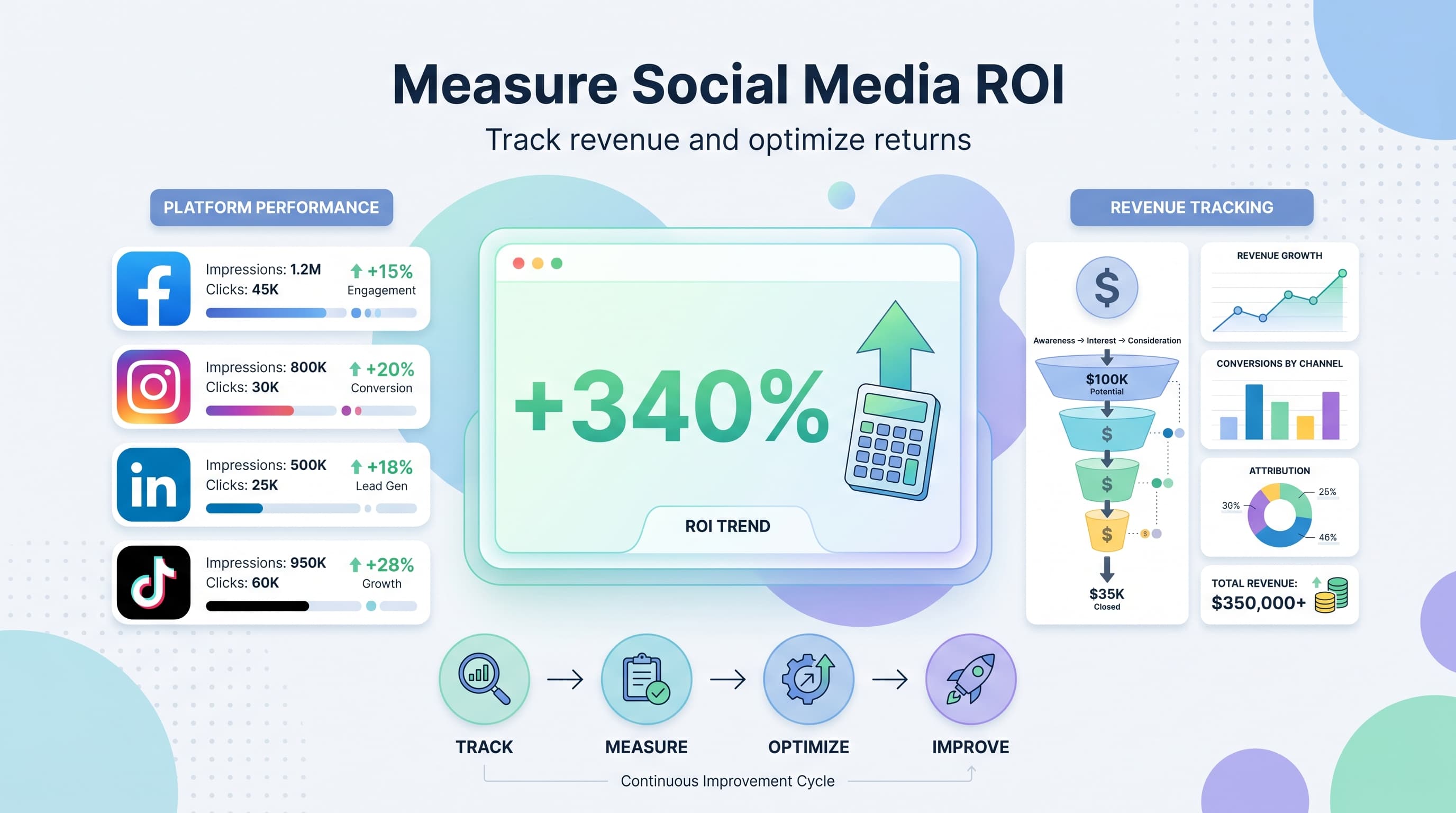
You're spending hours on social media marketing, but can you prove it's actually working? Most businesses struggle to connect their social media efforts to real revenue, leaving executives questioning whether the investment is worth it. Learn more about LinkedIn scheduling.
See It in Action
This is what scheduling a LinkedIn post looks like in Schedulala
Here's the thing: social media ROI isn't just a nice-to-have metric anymore. It's essential for justifying budgets, optimizing campaigns, and scaling successful strategies. Yet 73% of marketing executives believe their social media marketing is 'somewhat effective' at best, largely because they can't measure true ROI. Try our ai social media post.
This guide breaks down exactly how to calculate social media ROI, which metrics actually matter, and the practical steps to improve your returns. You'll get formulas, tools, and real examples you can implement immediately. See our cross-platform analytics track 9 guide.
Try Schedulala for free
Schedule posts to Bluesky, Twitter, and 8 other platforms from one dashboard.
Get started for free→What is social media ROI and why it matters
Social media ROI (Return on Investment) measures the profit generated from your social media activities relative to the amount you invested. It's expressed as a percentage and tells you whether your social media efforts are profitable. Our social media scheduling tools can help.
The basic formula looks simple: ROI = (Revenue Generated - Investment) / Investment × 100. But the devil is in the details of what counts as 'revenue generated' and 'investment.'. Learn more about best time to post on linkedin.
Why measuring social media ROI is challenging
Unlike paid search ads where someone clicks and immediately purchases, social media often works through multiple touchpoints. A customer might see your Instagram post, visit your website weeks later through Google search, then finally purchase after reading your email newsletter. Try our linkedin hashtag generator.
This attribution challenge means traditional last-click models often undervalue social media's contribution. You need tracking systems that capture the full customer journey.
Companies with documented social media ROI strategies are 60% more likely to achieve their revenue goals. They're also better positioned to defend budgets during economic downturns and scale successful campaigns.
Essential metrics for social media ROI calculation
Before diving into ROI calculations, you need to track the right metrics. Not all social media metrics contribute to revenue, and focusing on vanity metrics like follower count can mislead your ROI assessment.
Revenue metrics (the money makers)
- Direct sales from social media: Purchases where social media was the last click before conversion
- Assisted conversions: Sales where social media played a role in the customer journey, even if not the final touch
- Lead value: Qualified leads generated through social media, multiplied by your average lead-to-customer conversion rate and customer value
- Customer lifetime value (CLV): Total revenue a customer generates over their relationship with your business
Cost metrics (what you're spending)
- Ad spend: Money paid to platforms for promoted posts, ads, and boosted content
- Tool costs: Social media management platforms, analytics tools, design software subscriptions
- Labor costs: Employee time spent creating content, engaging with followers, and managing accounts (calculate hourly rate × hours spent)
- Content creation costs: Photography, videography, graphic design, influencer partnerships
A SaaS company found their true social media costs were 340% higher than their ad spend alone when they included labor and tool costs. This revelation changed their entire approach to campaign budgeting.
Engagement metrics that predict revenue
While engagement metrics don't directly equal revenue, certain types correlate strongly with eventual purchases:
- Click-through rates to your website: Shows intent to learn more
- Video completion rates: Indicates genuine interest in your content
- Shares and saves: Suggest content resonated enough for users to revisit or recommend
- Comments with questions: Show active consideration of your products/services
| Metric Type | Example | Revenue Connection |
|---|---|---|
| Direct Revenue | Sales from Instagram Shopping | Immediate |
| Lead Generation | Email signups from Facebook | Short-term |
| Brand Awareness | Reach and impressions | Long-term |
| Engagement Quality | Comments asking about pricing | Medium-term |
Step-by-step social media ROI calculation methods
There are several ways to calculate social media ROI depending on your business model and what you're trying to measure. Here are the most effective methods, from simple to advanced.
1. Simple ROI calculation
Formula: (Revenue from Social Media - Social Media Investment) / Social Media Investment × 100
Example: You spent $2,000 on social media marketing last month (including ads, tools, and labor). Your analytics show $8,000 in revenue directly attributed to social media.
ROI = ($8,000 - $2,000) / $2,000 × 100 = 300%
This means every dollar invested in social media returned $3 in profit.
2. Customer acquisition cost (CAC) method
This method focuses on how much it costs to acquire a customer through social media versus their lifetime value.
Formula: Social Media Investment / Number of New Customers Acquired = CAC
Example: $3,000 monthly social media spend acquired 30 new customers. CAC = $3,000 / 30 = $100 per customer.
If your average customer lifetime value is $500, your ROI is: ($500 - $100) / $100 × 100 = 400%
3. Attribution-based ROI
This advanced method assigns partial credit to social media for sales that involved multiple touchpoints.
First-touch attribution: Gives full credit to the first interaction (social media gets credit if someone discovered you there)
Multi-touch attribution: Divides credit among all touchpoints in the customer journey
Example: A customer discovers you on Instagram, clicks to your website, subscribes to your email list, then purchases after an email campaign. Multi-touch attribution might give social media 40% credit for that sale.
4. Lead value calculation
For B2B companies or businesses with longer sales cycles, measuring lead quality and value often makes more sense than immediate sales.
Formula: Number of Qualified Leads × Lead-to-Customer Conversion Rate × Average Customer Value = Social Media Revenue
Example: Social media generated 50 qualified leads. Your typical conversion rate is 20%, and average customer value is $2,000.
Revenue = 50 × 0.20 × $2,000 = $20,000
If you invested $4,000 in social media: ROI = ($20,000 - $4,000) / $4,000 × 100 = 400%
A marketing agency increased their social media ROI from 150% to 420% simply by switching from last-click attribution to multi-touch attribution. They discovered social media was driving 60% more revenue than originally credited.
Setting up tracking and analytics for ROI measurement
Accurate ROI calculation requires proper tracking infrastructure. Without the right setup, you're essentially flying blind. Here's how to build a measurement system that captures real social media impact.
1. Google Analytics 4 configuration
GA4 should be your foundation for social media ROI tracking. Set up these essential components:
- Enhanced ecommerce tracking: Tracks the complete purchase funnel
- Conversion events: Define what counts as a conversion (purchases, lead forms, newsletter signups)
- UTM parameter strategy: Create consistent tracking codes for all social media links
- Custom dimensions: Track additional data like customer segments or campaign types
Create a UTM naming convention like: utm_source=facebook&utm_medium=social&utm_campaign=spring-sale&utm_content=video-ad
2. Social media platform analytics
Each platform provides native analytics that complement your website tracking:
- Facebook/Instagram Insights: Track reach, engagement, and website clicks
- Twitter Analytics: Monitor link clicks and engagement rates
- LinkedIn Analytics: Focus on professional engagement and lead generation
- TikTok Analytics: Track video performance and profile visits
- YouTube Analytics: Monitor watch time and subscriber growth
3. CRM integration for lead tracking
Connect your social media efforts to your customer relationship management system to track the full customer journey:
- Tag leads with their original source (Facebook, Instagram, LinkedIn)
- Track progression through your sales funnel
- Calculate actual revenue generated from social media leads
- Identify which platforms generate the highest-value customers
| Tracking Method | Best For | Implementation Difficulty |
|---|---|---|
| UTM Parameters | All businesses | Easy |
| Facebook Pixel | Ecommerce | Medium |
| Google Analytics Goals | Lead generation | Medium |
| CRM Attribution | B2B companies | Hard |
An ecommerce brand discovered they were missing 40% of their social media revenue because they weren't tracking users who clicked from social media but purchased days later. Proper attribution tracking revealed social media's true impact.
Platform-specific ROI strategies
Each social media platform has unique characteristics that affect ROI calculation and optimization. Understanding these differences helps you allocate budget more effectively and set realistic expectations.
Facebook and Instagram ROI
Best for: Ecommerce, local businesses, and B2C brands
Average ROI: $4.20 for every $1 spent on Facebook ads
Key metrics to track:
- Cost per click (CPC) - typically $0.97 across industries
- Conversion rate - varies by industry but averages 9.21%
- Return on ad spend (ROAS) - aim for 4:1 minimum
- Customer lifetime value from social referrals
Optimization tips: Use lookalike audiences based on your highest-value customers. Test video content, which generates 48% more views than static images.
LinkedIn ROI for B2B
Best for: B2B lead generation, professional services, recruitment
Average cost per lead: $75 (higher than other platforms but leads are typically higher quality)
Key metrics to track:
- Lead quality score - track how LinkedIn leads convert vs other sources
- Cost per qualified lead - focus on leads that meet your ideal customer profile
- Engagement rate on company posts - LinkedIn's algorithm favors engaging content
- Employee advocacy reach - posts shared by employees get 5x more engagement
ROI insight: While LinkedIn generates fewer leads than Facebook, they typically have 2x higher conversion rates and 3x higher average deal value for B2B companies.
TikTok and YouTube ROI
Best for: Brand awareness, younger demographics, viral content
ROI measurement challenge: These platforms excel at top-funnel awareness but attribution to sales can be difficult
Key metrics to track:
- Brand mention increases - track how viral content affects brand searches
- Website traffic spikes - correlate video performance with site visits
- Hashtag performance - measure reach and user-generated content
- Subscriber growth and watch time for YouTube
ROI calculation tip: Use brand lift studies and correlation analysis rather than direct attribution for these awareness-focused platforms.
Twitter/X ROI measurement
Best for: Customer service, thought leadership, real-time engagement
Unique ROI considerations: Twitter's value often comes from customer service cost savings and reputation management
Key metrics to track:
- Customer service ticket reduction - measure issues resolved on Twitter vs traditional channels
- Response time and resolution rate
- Share of voice in industry conversations
- Influencer engagement and retweet reach
| Platform | Best ROI Use Case | Primary Metric | Typical ROAS |
|---|---|---|---|
| Ecommerce sales | Purchase conversion | 4.2:1 | |
| Brand awareness | Engagement rate | 3.8:1 | |
| B2B lead gen | Cost per qualified lead | 2.8:1 | |
| TikTok | Viral marketing | Brand mention lift | Varies |
| YouTube | Product demos | View-through rate | 2.5:1 |
Common ROI measurement mistakes and how to avoid them
Even companies with sophisticated analytics often make critical errors that skew their social media ROI calculations. These mistakes can lead to cutting successful campaigns or doubling down on ineffective strategies.
Mistake 1: Only tracking last-click attribution
The problem: Last-click attribution gives all credit to the final touchpoint before purchase, severely undervaluing social media's role in customer discovery and consideration.
Real impact: A furniture retailer found that switching from last-click to first-click attribution increased social media's attributed revenue by 280%. Social media was driving discovery, but customers often purchased weeks later through email or direct visits.
The fix: Implement multi-touch attribution models or use platform-specific attribution windows. Facebook's default 7-day click, 28-day view window often captures more accurate social media impact.
Mistake 2: Forgetting to include all costs
The problem: Many businesses only count ad spend in their ROI calculations, ignoring labor, tools, content creation, and management costs.
Hidden cost examples:
- Employee time spent creating and posting content (often 10-15 hours per week)
- Social media management tool subscriptions ($50-500+ monthly)
- Graphic design and video production costs
- Influencer partnerships and sponsored content
- Photography and product staging
The fix: Create a comprehensive cost tracking spreadsheet that includes all social media-related expenses, not just ad spend.
Mistake 3: Measuring ROI too early
The problem: Social media often has longer conversion cycles than search or email marketing. Measuring ROI after just a few weeks can make successful campaigns appear ineffective.
Industry benchmarks:
- B2C ecommerce: 1-7 days typical conversion window
- B2B software: 30-90 days average sales cycle
- High-consideration purchases (cars, homes): 3-12 months
- Subscription services: 14-30 days trial-to-paid conversion
The fix: Set attribution windows that match your actual sales cycle. Don't judge campaign performance until sufficient time has passed for conversions to occur.
Mistake 4: Ignoring lifetime value
The problem: Focusing only on initial purchase value misses the long-term revenue impact of social media customer acquisition.
Example: A subscription box company found that customers acquired through Instagram had 40% higher lifetime value than those from Google Ads, despite lower initial conversion rates. Social media customers were more engaged with the brand and had lower churn rates.
The fix: Calculate customer lifetime value (CLV) for customers acquired through each social media platform. Factor CLV into your ROI calculations for a true picture of long-term impact.
Strategies to improve your social media ROI
Once you can accurately measure ROI, the next step is optimization. These proven strategies can significantly improve your returns without necessarily increasing your budget.
1. Optimize your content mix for conversions
The 80/20 rule for social content: 80% valuable, non-promotional content that builds trust and engagement; 20% direct promotional content that drives sales.
High-converting content types:
- User-generated content: Posts featuring customer photos/videos convert 7x more than brand-created content
- Behind-the-scenes content: Builds trust and humanizes your brand
- Educational tutorials: Position your product as the solution while providing value
- Social proof posts: Customer testimonials, reviews, and case studies
- Limited-time offers: Create urgency while providing clear value
Content optimization example: A skincare brand increased Instagram ROI by 340% by shifting from product-only posts to 70% educational content about skincare routines, with subtle product integration.
2. Improve targeting and audience quality
Better targeting often trumps bigger budgets when it comes to ROI. Focus on reaching the right people rather than more people.
Advanced targeting strategies:
- Lookalike audiences: Create audiences similar to your highest-value customers
- Behavioral targeting: Target based on purchase behavior, not just demographics
- Retargeting campaigns: Re-engage website visitors with specific messaging
- Exclusion audiences: Exclude existing customers from acquisition campaigns
- Sequential messaging: Show different ads based on previous interactions
ROI impact: A B2B software company reduced their cost per lead by 65% simply by excluding job seekers and students from their LinkedIn campaigns, focusing only on decision-makers.
3. Optimize posting timing and frequency
When and how often you post significantly impacts engagement rates and, ultimately, ROI.
Platform-specific timing insights:
- Facebook: Tuesday-Thursday, 9 AM-10 AM and 3 PM-4 PM
- Instagram: Monday-Friday, 11 AM-2 PM
- LinkedIn: Tuesday-Thursday, 8 AM-10 AM and 12 PM-2 PM
- Twitter: Tuesday-Friday, 9 AM-10 AM
- TikTok: Tuesday-Thursday, 6 AM-10 AM
Frequency guidelines: Most brands see diminishing returns after 1-2 posts per day per platform. Quality and consistency beat quantity.
Pro tip: Use platform analytics to find your audience's specific activity patterns rather than relying only on general best practices.
4. Implement conversion rate optimization
Improving what happens after the social media click can dramatically boost ROI without increasing traffic.
Landing page optimization:
- Create platform-specific landing pages that match your social media content
- Use social proof elements (testimonials, customer count, reviews)
- Implement clear, single call-to-action buttons
- Ensure mobile optimization (70%+ of social traffic is mobile)
- Test different headlines, images, and form lengths
Email capture optimization: Even if visitors don't purchase immediately, capturing emails for retargeting can improve long-term ROI by 25-40%.
5. Leverage automation and AI tools
Smart automation can improve ROI by reducing manual labor costs while maintaining posting consistency.
ROI-boosting automation opportunities:
- Scheduled posting: Maintain consistent presence without manual daily work
- Automated responses: Handle common customer service questions instantly
- Dynamic product ads: Automatically show relevant products to interested users
- Bid optimization: Let AI adjust ad bids for maximum ROI
- Content curation: Automate sharing of relevant industry content
A social media management platform can reduce the labor costs included in your ROI calculation while improving posting consistency.
| Optimization Strategy | Expected ROI Improvement | Implementation Time | Difficulty Level |
|---|---|---|---|
| Better targeting | 30-60% | 1-2 weeks | Medium |
| Content optimization | 20-40% | 1 month | Easy |
| Landing page improvements | 15-35% | 2-4 weeks | Medium |
| Posting time optimization | 10-25% | 1 week | Easy |
| Automation implementation | 25-50% | 2-6 weeks | Hard |
Tools and templates for ROI tracking
The right tools can automate much of your ROI calculation and provide deeper insights than manual tracking. Here are the essential tools for different business sizes and needs.
Free tools for basic ROI tracking
Google Analytics 4: Essential for tracking website conversions from social media. Set up goals for lead forms, purchases, and other valuable actions.
Google UTM Builder: Create consistent tracking parameters for all your social media links. This ensures accurate attribution in your analytics.
Platform native analytics: Facebook Insights, Instagram Analytics, LinkedIn Analytics provide free data about your organic and paid performance.
Google Sheets ROI calculator: Create a simple spreadsheet that automatically calculates ROI when you input your costs and revenue data.
Paid tools for advanced tracking
HubSpot ($50-3,200/month): Complete attribution tracking from social media to closed deals. Excellent for B2B companies with longer sales cycles.
Sprout Social ($249-399/month): Social media management with built-in ROI reporting. Tracks conversions and calculates cost per acquisition across platforms.
Hootsuite ($99-739/month): Social scheduling and analytics with conversion tracking capabilities. Good for agencies managing multiple clients.
Triple Whale ($120-1,200/month): Ecommerce-focused attribution platform that specializes in tracking social media ROI for online stores.
ROI tracking spreadsheet template
Create a monthly tracking sheet with these columns:
- Platform: Facebook, Instagram, LinkedIn, etc.
- Ad Spend: Money paid to the platform
- Tool Costs: Portion of monthly software costs
- Labor Costs: Hours spent × hourly rate
- Total Investment: Sum of all costs
- Revenue Generated: Tracked through analytics
- ROI Percentage: (Revenue - Investment) / Investment × 100
- Cost Per Acquisition: Total Investment / New Customers
- Customer Lifetime Value: Average CLV of social media customers
Formula examples for your spreadsheet:
ROI Cell: =(F2-E2)/E2*100 (where F2 is revenue, E2 is investment)
CPA Cell: =E2/G2 (where G2 is number of new customers)
Creating ROI reports that drive action
Raw ROI numbers mean nothing if they don't lead to better decisions. Effective ROI reporting tells a story that helps stakeholders understand what's working, what isn't, and what to do next.
Essential elements of an ROI report
Executive summary (1-2 paragraphs): Lead with the bottom line. State overall ROI, whether it's trending up or down, and the main reason why.
Platform performance breakdown: Show ROI by platform, highlighting the best and worst performers with specific numbers.
Campaign-level analysis: Identify which types of content, audiences, or campaigns generated the highest returns.
Actionable recommendations: Always end with 2-3 specific actions to improve ROI, based on your data.
Frequency and timing for ROI reports
Monthly detailed reports: Full analysis including all platforms, campaigns, and optimization recommendations.
Weekly performance snapshots: High-level metrics showing whether you're on track to meet monthly ROI goals.
Quarterly strategic reviews: Deep dive into trends, competitive analysis, and budget reallocation recommendations.
Real-time dashboards: For paid campaigns, set up alerts when ROI drops below acceptable thresholds.
Visualizing ROI data effectively
ROI trend charts: Show month-over-month ROI changes to identify patterns and seasonal effects.
Platform comparison charts: Bar charts comparing ROI across different social media platforms.
Cost breakdown pie charts: Show how social media investment is distributed across platforms and activities.
Attribution flow diagrams: Visualize the customer journey from social media touchpoint to conversion.
A SaaS company increased their social media budget by 200% after presenting ROI data that showed social media customers had 60% higher lifetime value than other channels. Clear reporting led directly to bigger investment.
Advanced ROI optimization techniques
Once you've mastered basic ROI measurement and optimization, these advanced techniques can help you squeeze even more value from your social media investment.
Customer segment ROI analysis
Not all customers are equally valuable. Analyzing ROI by customer segment helps you focus on acquiring the most profitable audiences.
Segmentation approaches:
- Demographic segments: Age, gender, location, income level
- Behavioral segments: First-time vs. repeat customers, high vs. low spenders
- Psychographic segments: Interests, values, lifestyle preferences
- Lifecycle segments: New leads, trial users, paying customers, churned customers
Example insight: An online course company discovered that LinkedIn-acquired customers had 3x higher lifetime value than Facebook customers, even though Facebook had lower acquisition costs. This insight shifted 60% of their budget to LinkedIn.
Predictive ROI modeling
Use historical data to predict future ROI and optimize budget allocation proactively.
Modeling inputs:
- Historical ROI by platform and campaign type
- Seasonal trends and cyclical patterns
- Competitive activity and market saturation
- Economic indicators affecting your industry
- Platform algorithm changes and reach trends
Application: Create 'what-if' scenarios for budget allocation. For example, 'If we move 30% of Facebook budget to TikTok, what's the predicted ROI impact?'
Cross-platform attribution modeling
Modern customers interact with multiple platforms before purchasing. Advanced attribution helps you understand the true role each platform plays.
Attribution models to consider:
- Time decay: More recent touchpoints get more credit
- Position-based: First and last touchpoints get 40% credit each, middle touchpoints split 20%
- Data-driven: Uses machine learning to assign credit based on conversion probability
- Custom: Create rules based on your specific business model
Implementation tip: Use Google Analytics 4's built-in attribution modeling or invest in dedicated attribution software like Triple Whale or Northbeam for ecommerce businesses.
Incrementality testing
Test whether your social media campaigns are truly driving additional sales or just capturing customers who would have purchased anyway.
How to run incrementality tests:
- Create matched test and control groups based on demographics and behavior
- Run social media campaigns only to the test group
- Measure sales differences between test and control groups
- Calculate true incremental ROI based on additional sales generated
Reality check: A retail brand discovered that 40% of their attributed social media sales were incremental, meaning 60% would have happened anyway. This finding led to more realistic ROI expectations and budget optimization.
Try Schedulala for free
Schedule posts to Bluesky, Twitter, and 8 other platforms from one dashboard.
Get started for free→