TikTok for Business: Complete Setup Guide to Grow Your Brand
Complete TikTok for business setup guide. Learn how to create a business account, optimize your profile, and grow your brand on TikTok with proven strategies.

TikTok isn't just for dance videos anymore. With over 1 billion monthly active users and 150 million daily active users in the US alone, it's become a goldmine for businesses ready to tap into its massive potential. Try our TikTok scheduling.
See It in Action
This is what scheduling a TikTok post looks like in Schedulala
But here's the thing: most businesses are doing TikTok wrong. They're treating it like Facebook or Instagram, posting polished corporate content that gets buried in the algorithm. The brands that succeed on TikTok understand it's a different beast entirely. Try our cross-platform analytics track 9.
Try Schedulala for free
Schedule posts to Bluesky, Twitter, and 8 other platforms from one dashboard.
Get started for free→Why TikTok matters for your business
The numbers don't lie. TikTok users spend an average of 95 minutes per day on the platform. That's more time than they spend on Instagram and Snapchat combined. Gen Z and millennials make up 60% of TikTok's user base, and they have serious buying power. Try our telegram engagement tips get.
What makes TikTok different from other platforms is its algorithm. Unlike Instagram or Facebook, where your reach depends heavily on your follower count, TikTok gives every video a chance to go viral. A brand new account can get millions of views on their first post if the content resonates. Try our the best time to.
TikTok vs. other platforms: The key differences
Content style: Raw and authentic beats polished and professional. Users want to see behind the scenes, not another glossy advertisement. Try our best time to post on tiktok.
Video length: While you can post up to 10 minutes, the sweet spot is 15-60 seconds. Quick, punchy content performs best. Learn more about tiktok engagement calculator.
Discoverability: TikTok's For You Page is algorithm-driven, not follower-based. Great content gets seen regardless of account size.
Brands like Chipotle, Gymshark, and Ocean Spray have built massive followings by understanding these differences. They create content that feels native to the platform rather than repurposing content from other channels.
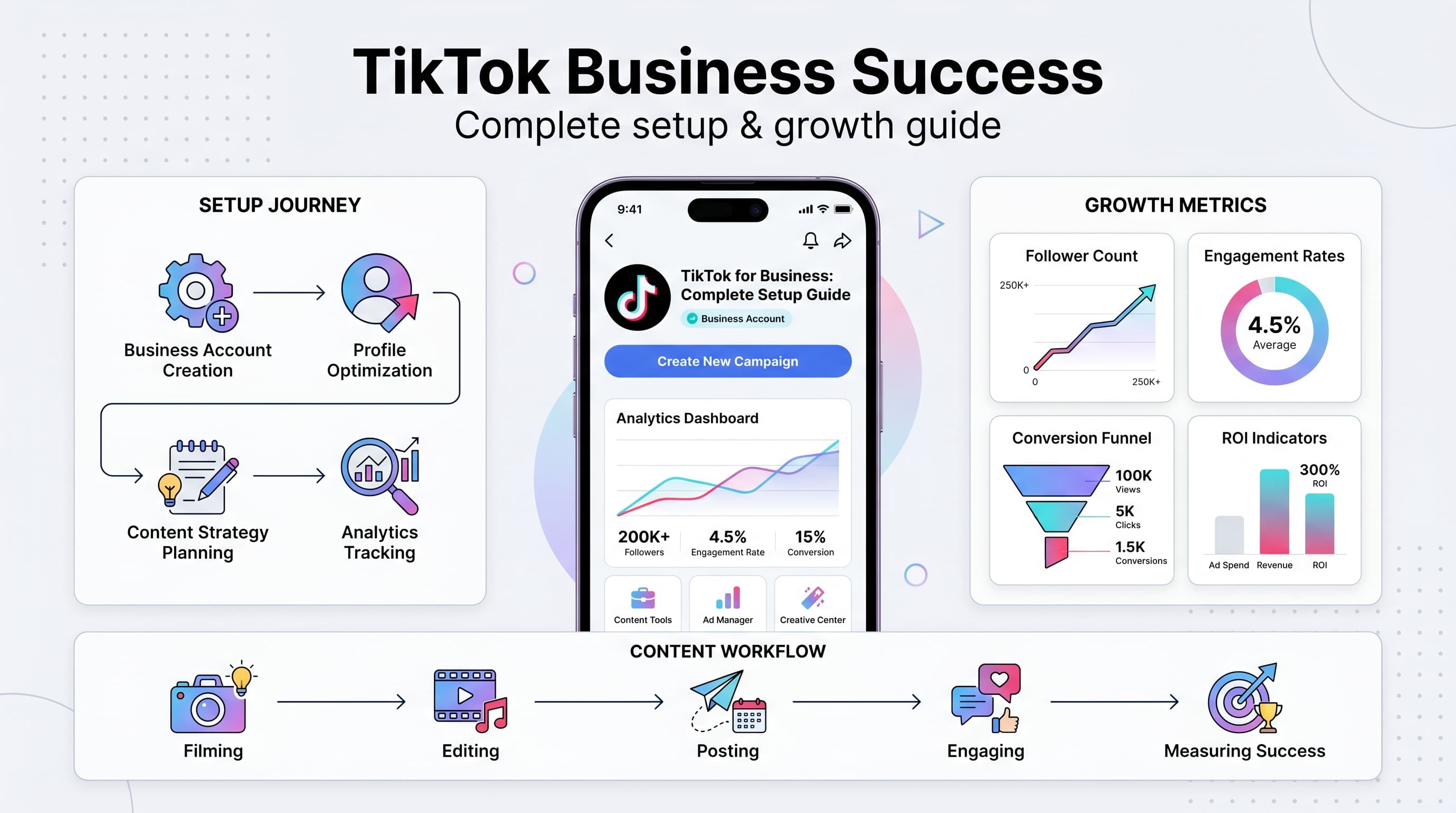
Setting up your TikTok business account
Before you start creating content, you need to set up your account properly. TikTok offers two account types: personal and business. While personal accounts have access to more music and sounds, business accounts come with analytics, advertising options, and contact information features.
1. Download and install TikTok
Start by downloading the TikTok app from the App Store or Google Play Store. While you can view TikTok content on desktop, you'll need the mobile app to create and manage your business account effectively.
Create your account using your business email address. Avoid using personal emails as this will be tied to your business presence on the platform.
2. Switch to a business account
Once your account is created, go to your profile and tap the three lines in the top right corner. Select 'Settings and privacy,' then 'Manage account,' and finally 'Switch to Business Account.'
Choose your business category carefully. This affects what features you'll have access to and how TikTok categorizes your content. Categories include retail, education, healthcare, entertainment, and more.
You'll be asked to provide a business phone number or email. This information may be displayed publicly, so use your main business contact details.
3. Complete your business verification
TikTok offers business verification for qualifying accounts. This adds a gray checkmark to your profile and provides additional credibility. To qualify, you need to have a complete profile, follow community guidelines, and represent a legitimate business.
The verification process can take several weeks, so apply early. You'll need to provide business registration documents and prove you're an authorized representative of the company.
Optimizing your TikTok business profile
Your profile is your digital storefront on TikTok. Most users will check your profile after seeing one of your videos, so it needs to make a strong first impression. Here's how to optimize every element for maximum impact.
1. Choose the right profile picture
Your profile picture should be your company logo or a recognizable brand symbol. Keep it simple and bold since it will appear small in most contexts. Avoid text-heavy logos that become unreadable at small sizes.
The image should be 200x200 pixels and under 20MB. TikTok will crop it into a circle, so make sure the important elements are centered.
Test how your profile picture looks alongside your content. It appears next to every video you post, so it should complement your visual brand without clashing.
2. Craft a compelling bio
You have 80 characters to explain what your business does and why people should follow you. Skip generic phrases like 'leading provider' or 'innovative solutions.' Instead, focus on the specific value you provide.
Good bio formula: What you do + Who it's for + What makes you different. For example: 'Skincare that actually works for sensitive skin 🌿 Dermatologist-tested • Made for Gen Z'
Use emojis strategically to add personality and break up text. They can also help convey information quickly in the limited character space.
Include relevant keywords that your target audience might search for, but make sure they flow naturally in the sentence.
3. Add your contact information
Business accounts can add contact buttons that make it easy for potential customers to reach you. You can add email, phone, and website links directly to your profile.
The website link is particularly valuable since TikTok doesn't allow clickable links in video captions. This is often your only opportunity to drive traffic to your website.
Consider creating a dedicated landing page for TikTok traffic. This lets you track conversions and create content specifically designed for users coming from TikTok.
4. Design cohesive highlights
While TikTok doesn't have Instagram-style highlights, you can pin up to three videos to the top of your profile. Choose videos that best represent your brand and showcase different aspects of your business.
Pin videos that answer common questions, show your products in action, or demonstrate your brand personality. These should be your strongest performing content that still feels relevant months later.
Update your pinned videos regularly to keep your profile fresh and reflect current offerings or seasonal campaigns.
Understanding TikTok's algorithm
TikTok's algorithm is what makes the platform so addictive and powerful for businesses. Unlike other social platforms where you need followers to get reach, TikTok evaluates every video independently and can push it to millions of users if it performs well.
The algorithm considers three main factors when deciding which videos to show users: user interactions, video information, and device/account settings. Understanding how each factor works helps you create content that gets discovered.
User interaction signals
Likes, comments, and shares: These are the strongest signals that your content is engaging. Comments are particularly valuable because they indicate deeper engagement than passive consumption.
Complete views and replays: If users watch your entire video or replay it, TikTok sees this as high-quality content worth showing to more people.
Follows from video: When users follow your account directly from a video, it's a strong signal that your content resonated with them.
Time spent on video: Even if users don't finish your video, spending more time watching (rather than scrolling past immediately) is a positive signal.
Video information factors
Sounds and music: Using trending sounds can help your content get discovered. TikTok promotes videos that use popular audio, especially when the trend is just starting to take off.
Captions and text: The algorithm can read text in your captions and on-screen text in your videos. Use relevant keywords naturally in your descriptions.
Hashtags: While not as important as on other platforms, relevant hashtags still help categorize your content and connect it with interested users.
Video length: Shorter videos often perform better because they have higher completion rates, but longer videos can be valuable if they keep viewers engaged throughout.
How to work with the algorithm
Post consistently: The algorithm favors active accounts. Aim for at least one post per day, but prioritize quality over quantity.
Engage authentically: Respond to comments quickly and genuinely. High engagement in the first hour after posting is particularly important.
Hook viewers immediately: Your first 3 seconds determine whether users keep watching. Start with your most compelling content, not slow introductions.
Study your analytics: TikTok Pro accounts get detailed analytics showing when your audience is most active and what content performs best.
Creating your TikTok content strategy
Random posting won't cut it on TikTok. You need a strategic approach that balances entertainment with business objectives. The most successful brands on TikTok have found ways to be valuable, entertaining, and authentic while still promoting their products or services.
The 80/20 rule for TikTok content
Follow the 80/20 rule: 80% of your content should entertain, educate, or inspire your audience without directly promoting your business. The remaining 20% can be more promotional.
This approach builds trust and keeps your audience engaged. Users don't come to TikTok to see advertisements, so your promotional content needs to be creative and valuable.
Examples of 80% content: Behind-the-scenes videos, industry tips, employee spotlights, trending challenges, educational content, and entertaining skits related to your niche.
Examples of 20% content: Product launches, special offers, customer testimonials, and direct calls-to-action to visit your website or make a purchase.
Content pillars for business success
Educational content: Share knowledge and expertise related to your industry. This positions your brand as an authority and provides genuine value to viewers.
Behind-the-scenes: Show the human side of your business. People love seeing how products are made, meeting your team, or understanding your company culture.
User-generated content: Encourage customers to create content featuring your products. This provides social proof and authentic testimonials.
Trending participation: Jump on relevant trends, sounds, and challenges while putting your own spin on them. This helps with discoverability.
Problem-solving: Address common customer questions or industry problems. This type of content often gets saved and shared, extending its reach.
Planning your content calendar
Daily posting schedule: Identify the best times to post based on your analytics. Most businesses see success posting between 6-10 AM and 7-9 PM when users are most active.
Weekly themes: Consider assigning themes to different days. For example: Monday Motivation, Tutorial Tuesday, Behind-the-scenes Wednesday, Throwback Thursday, Fun Friday.
Seasonal planning: Plan content around holidays, industry events, and seasonal trends relevant to your business. Start creating content for major holidays at least a month in advance.
Trend monitoring: Dedicate time each week to research trending hashtags, sounds, and challenges. The key is jumping on trends early while they're still growing.
| Content Type | Posting Frequency | Best Performance Time | Primary Goal |
|---|---|---|---|
| Educational | 3-4x per week | Morning (6-10 AM) | Build authority |
| Entertainment | Daily | Evening (7-9 PM) | Increase engagement |
| Behind-the-scenes | 2-3x per week | Lunch (11 AM-1 PM) | Humanize brand |
| Promotional | 1-2x per week | Weekend mornings | Drive conversions |
TikTok video production essentials
You don't need expensive equipment to create engaging TikTok videos, but you do need to understand what makes content perform well on the platform. The best TikTok videos feel authentic and native to the platform rather than overly polished or corporate.
Essential equipment and tools
Smartphone with good camera: Most successful TikTok creators use nothing more than their phone's camera. Modern smartphones shoot high-quality video that's perfect for the platform.
Tripod or phone stabilizer: Shaky footage is distracting and looks unprofessional. A basic tripod costs under $20 and dramatically improves video quality.
Good lighting: Natural light is best, but if you're filming indoors, invest in a simple ring light or softbox. Proper lighting makes your videos look more professional instantly.
External microphone: While not essential, a clip-on microphone can significantly improve audio quality, especially for talking-head videos or tutorials.
Editing apps: TikTok's built-in editor is powerful, but apps like CapCut, InShot, or Canva can provide additional features for more complex edits.
Video format best practices
Vertical orientation: Always shoot in 9:16 aspect ratio. Horizontal videos look amateurish on TikTok and take up less screen space.
High resolution: Film in at least 1080p resolution. Higher quality videos are favored by the algorithm and look better on all devices.
Optimal length: While TikTok allows videos up to 10 minutes, most successful business content is 15-60 seconds. Longer videos need exceptional storytelling to maintain engagement.
File size limits: Keep videos under 72MB for uploads up to 60 seconds, and under 287MB for longer videos. Compress files if needed to maintain upload quality.
Creating engaging content
Strong hooks: The first 3 seconds determine whether users keep watching. Start with your most compelling information, a surprising statement, or an intriguing question.
Quick cuts and pacing: TikTok users expect fast-paced content. Use quick cuts, transitions, and scene changes to maintain visual interest throughout your video.
Text overlays: Add text to highlight key points, ask questions, or provide context. Many users watch with sound off, so text ensures your message gets across.
Clear call-to-action: End videos with a specific action you want viewers to take, whether that's following your account, visiting your profile link, or commenting with their thoughts.
Consistent branding: While you want content to feel native to TikTok, maintain consistent visual elements like colors, fonts, or logos that reinforce your brand identity.
Growing your TikTok following
Building a meaningful following on TikTok requires more than just posting regularly. You need to understand your audience, create content that resonates, and engage authentically with the community. Focus on attracting the right followers rather than just maximizing numbers.
Understanding your target audience
Demographic research: Use TikTok Analytics to understand who's currently engaging with your content. Look at age ranges, gender splits, geographic locations, and when they're most active.
Interest mapping: Identify what other types of content your audience engages with. This helps you understand their broader interests beyond your specific niche.
Language and tone: Pay attention to how your audience communicates in comments. Adapt your content style to match their preferred tone and vocabulary.
Pain points and interests: Create content that addresses specific problems your audience faces or topics they're curious about. Educational content often performs exceptionally well.
Engagement strategies that work
Respond to every comment: At least in your early days, respond to every single comment on your videos. This signals to the algorithm that your content generates meaningful engagement.
Ask questions: End videos with questions that encourage comments. Simple questions like 'What do you think?' or 'Have you tried this?' can significantly boost engagement.
Create response videos: When you get interesting comments or questions, create follow-up videos addressing them. This shows you value your community's input.
Collaborate with other creators: Partner with creators in adjacent niches for duets, collaborations, or joint challenges. This exposes your brand to new audiences.
Participate in comments: Don't just post and disappear. Spend time commenting on other videos in your niche to increase visibility and build relationships.
Hashtag strategy for growth
Mix hashtag sizes: Use a combination of large trending hashtags, medium-sized niche hashtags, and smaller specific hashtags. This gives you the best chance of discovery.
Create branded hashtags: Develop unique hashtags for your business and encourage customers to use them. This helps build community and makes user-generated content easier to find.
Research before using: Click on hashtags before using them to see what type of content is associated with them. Some hashtags may not align with your brand image.
Location-based hashtags: If you have a local business, use location-specific hashtags to connect with users in your area.
Limit hashtag count: Unlike Instagram, TikTok performs better with fewer, more relevant hashtags. Use 3-5 strategic hashtags rather than the maximum allowed.
Cross-platform promotion
Instagram integration: Share your TikTok videos on Instagram Stories and Reels to drive cross-platform traffic. Make sure to adapt the content format appropriately.
Email marketing: Include your best TikTok videos in email newsletters to encourage existing customers to follow your account.
Website integration: Embed TikTok videos on your website or blog posts. This provides additional context and encourages website visitors to follow your account.
Other social platforms: Share behind-the-scenes content about your TikTok creation process on platforms like LinkedIn or Twitter to attract professional audiences.
Try Schedulala for free
Schedule posts to Bluesky, Twitter, and 8 other platforms from one dashboard.
Get started for free→TikTok advertising and paid promotion
While organic reach on TikTok can be substantial, paid advertising allows you to reach specific audiences and scale your results. TikTok's advertising platform has evolved rapidly and now offers sophisticated targeting options comparable to Facebook and Google Ads.
Types of TikTok ads
In-Feed Ads: These appear in users' For You feed and look like regular TikTok videos. They can be up to 60 seconds long and include a call-to-action button.
Branded Hashtag Challenges: Create a custom hashtag challenge that encourages user-generated content. These campaigns can generate massive engagement and brand awareness.
Branded Effects: Develop custom AR effects, filters, or stickers that users can apply to their own videos. This creates organic brand exposure through user-generated content.
TopView Ads: These premium placements appear when users first open TikTok. They're expensive but guarantee maximum visibility and impact.
Spark Ads: Promote your existing organic TikTok videos as ads. This is often more effective than creating separate ad content since it looks more native.
Setting up TikTok Ads Manager
Account setup: Visit ads.tiktok.com and create your business advertising account. You'll need to provide business information and payment details.
Pixel installation: Install the TikTok Pixel on your website to track conversions and build custom audiences based on website behavior.
Campaign structure: TikTok uses a three-level structure: Campaigns (objectives), Ad Groups (targeting and budgets), and Ads (creative content).
Budget planning: Start with smaller budgets to test what works. TikTok recommends minimum daily budgets of $20 for ad groups and $50 for campaigns.
Creative requirements: Ensure your video ads meet TikTok's specifications: 9:16 aspect ratio, 540x960 minimum resolution, MP4 or MOV format.
Targeting and optimization
Audience targeting: TikTok offers demographic, interest, and behavioral targeting similar to other platforms. You can also create custom audiences based on website visitors or existing customers.
Lookalike audiences: Create audiences similar to your best customers. Upload customer email lists or use website pixel data to build these audiences.
Automatic optimization: TikTok's algorithm can optimize for various objectives including impressions, clicks, conversions, or app installs. Let the algorithm learn for at least 50 conversions before making major changes.
A/B testing: Test different creative variations, audiences, and bidding strategies. TikTok's young audience responds differently than users on other platforms.
Performance monitoring: Track key metrics like cost per click, conversion rate, and return on ad spend. TikTok's reporting can be integrated with Google Analytics for deeper insights.
| Ad Type | Best For | Typical Cost | Minimum Budget |
|---|---|---|---|
| In-Feed Ads | Conversions, traffic | $0.50-2.00 CPC | $20/day |
| Hashtag Challenge | Brand awareness | $150,000+ | Custom pricing |
| Branded Effects | Engagement | $100,000+ | Custom pricing |
| TopView | Maximum reach | $65,000+ | Custom pricing |
Measuring success and analytics
TikTok provides comprehensive analytics for business accounts, but the key is knowing which metrics actually matter for your business goals. Vanity metrics like total views can be misleading if they're not converting to meaningful business outcomes.
Key performance indicators to track
Engagement rate: Calculate total engagements (likes, comments, shares) divided by views. A good engagement rate on TikTok is 3-9%, significantly higher than other platforms.
Average watch time: This indicates how compelling your content is. Aim for at least 50% average watch time, with 70%+ being excellent.
Profile visits: Track how many people visit your profile after seeing your videos. This indicates interest beyond casual consumption.
Follower growth rate: Monitor both the speed of growth and the quality of new followers. Rapid growth from irrelevant audiences won't help your business.
Click-through rate: For business accounts, track how many people click your website link or contact information from your profile.
Using TikTok Analytics effectively
Overview tab: Provides high-level metrics about your account performance over the last 7-28 days. Use this for quick health checks.
Content tab: Shows performance data for individual videos. Identify your top-performing content to understand what resonates with your audience.
Followers tab: Reveals demographic information about your audience and when they're most active. Use this to optimize your posting schedule.
Video analytics: Each video has detailed metrics including watch time graphs that show exactly where viewers drop off. Use this to improve future content.
Export data: Download your analytics data to create custom reports or integrate with other business intelligence tools.
Connecting TikTok to business outcomes
UTM tracking: Use UTM parameters on links in your bio to track TikTok traffic in Google Analytics. This helps measure actual conversions and revenue.
Promo codes: Create TikTok-specific discount codes to track sales directly attributed to the platform. This provides clear ROI measurement.
Customer surveys: Ask new customers how they heard about you. Many businesses underestimate TikTok's impact because attribution can be challenging.
Brand awareness tracking: Monitor branded search volume and mentions across the web to measure TikTok's impact on overall brand awareness.
Sales cycle consideration: TikTok often influences purchase decisions without being the final touchpoint. Factor this into your attribution models.
Common TikTok mistakes to avoid
Many businesses fail on TikTok because they approach it like other social media platforms. Understanding what doesn't work is just as important as knowing what does. Here are the most common mistakes that can sabotage your TikTok success.
Content and strategy mistakes
Being too promotional: TikTok users can smell a sales pitch from miles away. Content that feels like traditional advertising performs poorly and can damage your brand reputation.
Ignoring trends: While you don't need to jump on every trend, completely ignoring what's popular makes your content feel out of touch and reduces discoverability.
Posting irregularly: The algorithm favors consistent creators. Posting sporadically makes it harder to build momentum and audience expectations.
Using the wrong hashtags: Copying hashtags from other platforms or using irrelevant trending tags can actually hurt your reach and brand image.
Focusing only on followers: Chasing follower count instead of engagement often leads to attracting the wrong audience who won't convert to customers.
Technical and production errors
Poor audio quality: TikTok is an audio-visual platform. Bad sound quality can kill otherwise good content. Always test audio before posting.
Wrong video orientation: Posting horizontal or square videos makes your content look amateurish and takes up less screen real estate.
Slow starts: Taking too long to get to the point causes viewers to scroll away. You have 3 seconds maximum to hook viewers.
Overly long videos: Unless you're telling an incredibly compelling story, videos over 60 seconds often see significant drop-off in viewership.
Inconsistent branding: While content should feel native to TikTok, completely abandoning your brand identity can confuse potential customers.
Community and engagement mistakes
Ignoring comments: Not responding to comments signals to both users and the algorithm that you're not engaged with your community.
Generic responses: Copy-pasting the same response to different comments feels impersonal and can hurt your brand image.
Deleting negative feedback: Unless comments are abusive, deleting criticism can backfire. Address concerns professionally and publicly when possible.
Not engaging with others: Only posting without engaging with other creators' content makes you seem self-promotional and limits your reach.
Buying fake engagement: Purchasing likes or followers can get your account penalized and attracts the wrong audience for your business.
Advanced TikTok strategies for businesses
Once you've mastered the basics, these advanced strategies can help you scale your TikTok presence and generate more significant business results. These tactics require more planning and resources but can provide substantial competitive advantages.
Influencer partnerships and collaborations
Micro-influencer strategy: Partner with creators who have 10K-100K followers in your niche. They often have higher engagement rates and lower costs than mega-influencers.
Long-term partnerships: Instead of one-off posts, develop ongoing relationships with creators. This builds more authentic endorsements and better brand association.
Employee advocacy: Encourage employees to create TikTok content about working at your company. Behind-the-scenes content from real employees performs exceptionally well.
Customer collaborations: Feature satisfied customers in your content. User-generated content and testimonials feel more authentic than branded content.
Cross-industry partnerships: Collaborate with businesses in complementary industries to reach new audiences and create unique content angles.
Advanced content formats
Educational series: Create multi-part educational content that keeps viewers coming back for more. This builds loyal followings and positions your brand as an expert.
Live streaming: TikTok Live allows real-time interaction with your audience. Use it for product launches, Q&A sessions, or behind-the-scenes tours.
Interactive content: Use TikTok's polling, Q&A, and quiz features to create content that requires active participation from viewers.
Storytelling campaigns: Develop longer narrative arcs across multiple videos. This keeps viewers engaged with your brand over time rather than just individual posts.
Seasonal campaigns: Plan comprehensive campaigns around major holidays or industry events, creating content that builds anticipation and drives specific business outcomes.
Data-driven optimization
A/B testing content: Systematically test different hooks, video lengths, posting times, and content styles to optimize performance based on data rather than assumptions.
Audience segmentation: Use TikTok's analytics to identify different audience segments and create tailored content for each group's preferences and behaviors.
Competitor analysis: Regularly analyze successful competitors' content strategies, posting patterns, and engagement tactics to identify opportunities and gaps.
Trend forecasting: Use tools like TikTok's Creator Portal and third-party analytics platforms to identify emerging trends before they peak.
ROI optimization: Continuously refine your content strategy based on which types of videos drive the most valuable business outcomes, not just engagement.
Integration with broader marketing strategy
Omnichannel campaigns: Coordinate TikTok content with email marketing, paid advertising, and other social platforms for maximum impact.
Content repurposing: Adapt your best TikTok content for other platforms, and vice versa. This maximizes the value of your content creation efforts.
Customer journey mapping: Understand where TikTok fits in your customers' path to purchase and create content that supports each stage of the journey.
Brand consistency: Maintain consistent messaging and values across all platforms while adapting the format and tone for TikTok's unique culture.
Attribution modeling: Develop sophisticated tracking to understand TikTok's role in driving conversions, even when it's not the last touchpoint before purchase.
Future of TikTok for business
TikTok continues to evolve rapidly, with new features and opportunities for businesses launching regularly. Staying ahead of these changes can provide significant competitive advantages for early adopters.
Emerging features and opportunities
TikTok Shopping: The platform is heavily investing in e-commerce integration, allowing users to purchase products directly within the app. This creates new opportunities for product-based businesses.
TikTok for Business Suite: Enhanced tools for businesses including better analytics, content scheduling, and team collaboration features are constantly being added.
AR and VR integration: As augmented and virtual reality become more mainstream, TikTok is positioning itself at the forefront of these technologies for marketing applications.
AI-powered content creation: Tools that help businesses create and optimize content using artificial intelligence are becoming more sophisticated and accessible.
Advanced targeting options: TikTok's advertising platform continues to add more sophisticated targeting and optimization features comparable to established platforms.
Try Schedulala for free
Schedule posts to Bluesky, Twitter, and 8 other platforms from one dashboard.
Get started for free→