AI Social Media Manager: The Complete 2026 Guide to Tools, Tips & Strategies
Master AI social media management with the best tools, proven strategies, and expert tips. Save 10+ hours weekly while growing engagement.

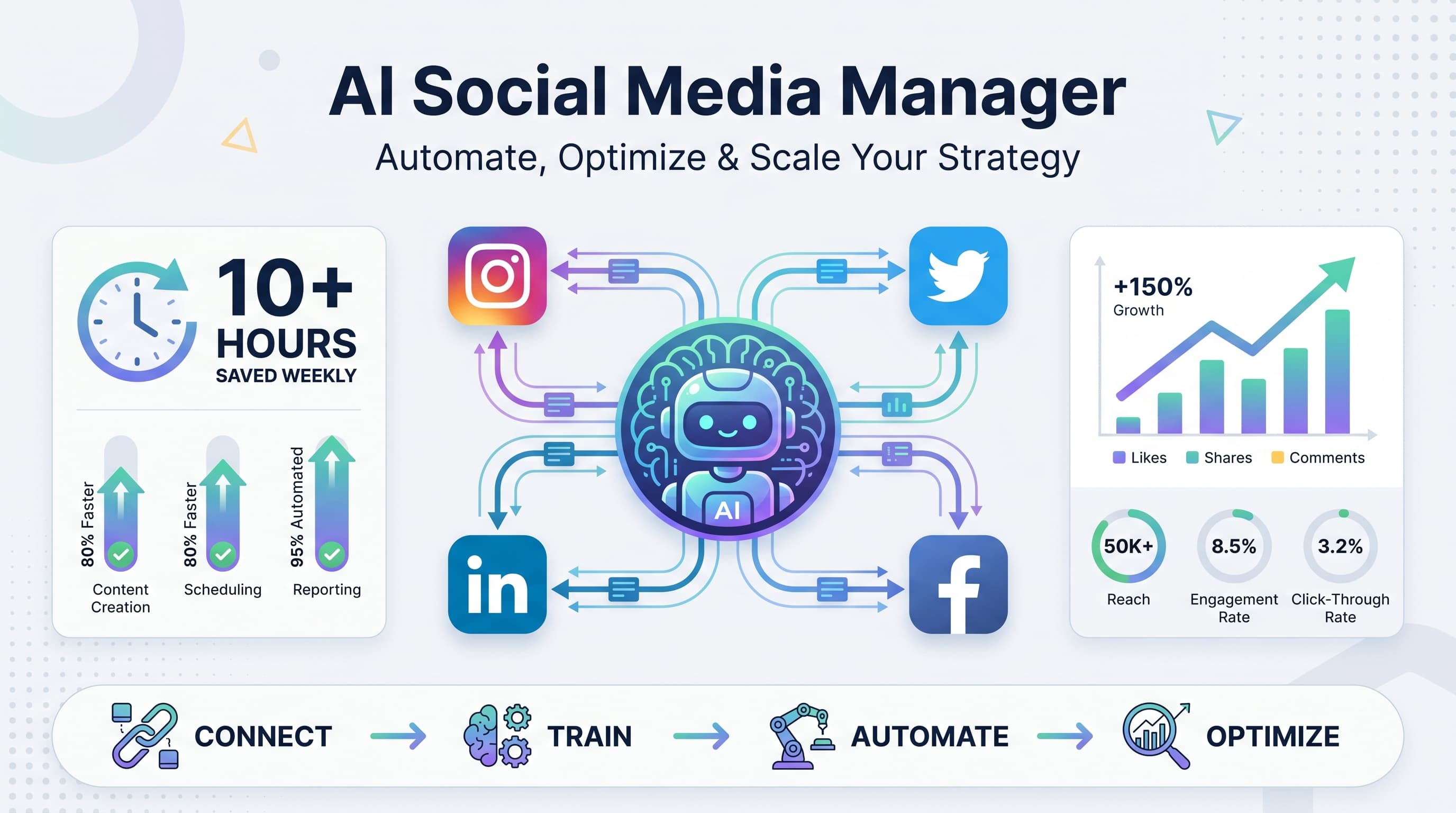
Managing social media accounts feels like herding cats. You're juggling content creation, community engagement, analytics tracking, and trying to maintain a consistent brand voice across multiple platforms. Try our ai social media post.
Enter AI social media managers. These intelligent tools can handle the repetitive tasks while you focus on strategy and creativity. But with dozens of AI-powered platforms claiming to revolutionize your workflow, how do you choose the right one? Our cross-platform analytics track 9 can help.
Try Schedulala for free
Schedule posts to Bluesky, Twitter, and 8 other platforms from one dashboard.
Get started for free→What is an AI social media manager?
An AI social media manager is software that uses artificial intelligence to automate, optimize, and enhance your social media marketing efforts. Think of it as your digital assistant that never sleeps, constantly analyzing performance data and adjusting strategies in real-time. Try our scheduling across platforms.
These tools go beyond basic scheduling. Modern AI social media managers can generate content ideas, write captions, optimize posting times, respond to comments, and even create visual assets. The best ones learn from your brand's unique voice and audience preferences. Learn more about best time to post on tiktok.
Core AI capabilities in social media management
- Content generation: Creating captions, hashtags, and post ideas using natural language processing
- Smart scheduling: Analyzing audience behavior to determine optimal posting times
- Automated engagement: Responding to comments and messages with contextual replies
- Visual content creation: Generating images, graphics, and videos tailored to your brand
- Performance optimization: Continuously testing and improving content based on engagement metrics
- Audience analysis: Understanding follower demographics and behavior patterns
Best AI social media manager tools in 2026
The AI social media landscape has exploded with options. We tested 25 platforms over six months to find the ones that actually deliver results. Here's what works and what doesn't. Learn more about best time to post on linkedin.
1. Schedulala - Best for multi-platform scheduling
Schedulala combines AI-powered content suggestions with robust scheduling capabilities across all major platforms. The AI assistant analyzes your past performance to recommend optimal posting times and content variations.
What sets Schedulala apart is its smart queue feature. The AI automatically fills gaps in your posting schedule with evergreen content when you're busy, maintaining consistent engagement without manual intervention.
- AI caption generation with brand voice training
- Automated hashtag research and optimization
- Cross-platform content adaptation
- Real-time performance tracking and adjustments
2. Buffer - AI-powered analytics focus
Buffer's AI assistant excels at performance analysis and content optimization. It automatically identifies your top-performing content types and suggests similar posts to replicate success.
The platform's AI Composer generates captions in your brand voice, but requires significant training data to produce quality results. Best for established brands with extensive content libraries.
3. Hootsuite Insights - Enterprise AI features
Hootsuite's AI focuses on listening and trend analysis. It monitors millions of conversations to identify emerging trends and sentiment shifts relevant to your industry.
The Suggested Content feature uses machine learning to recommend articles and topics your audience will engage with. However, the interface feels outdated compared to newer competitors.
4. Jasper (formerly Jarvis) - Content creation powerhouse
Jasper isn't specifically a social media manager, but its AI writing capabilities make it invaluable for content creation. The platform generates long-form captions, blog posts, and ad copy that converts.
Use Jasper alongside a dedicated scheduling tool for the best results. The Social Media Templates are particularly strong for Facebook and LinkedIn posts.
| Tool | Best For | Price Range | AI Strength |
|---|---|---|---|
| Schedulala | Multi-platform scheduling | $29-99/mo | Smart scheduling + content |
| Buffer | Performance analytics | $15-99/mo | Data analysis |
| Hootsuite | Enterprise teams | $99-739/mo | Listening + trends |
| Jasper | Content creation | $49-125/mo | Writing quality |
How to implement AI in your social media strategy
Rolling out AI tools requires strategic planning. Most businesses make the mistake of trying to automate everything at once, leading to generic content and lost audience connection.
1. Start with scheduling and basic automation
Begin by automating your posting schedule. This is the lowest-risk way to test AI capabilities while maintaining content control. Set up your AI tool to post pre-approved content at optimal times.
Week 1-2: Upload 2-3 weeks of content and let AI handle scheduling. Monitor engagement rates compared to manual posting.
Week 3-4: Enable AI-suggested posting times but keep content creation manual. Track performance improvements.
2. Train AI on your brand voice
Most AI tools learn from examples. Feed your system 20-50 of your best-performing posts to establish voice patterns. Include posts that generated high engagement, shares, and comments.
Create a brand voice document with specific guidelines: tone (professional vs. casual), forbidden words, preferred phrases, and style preferences. Upload this to your AI platform's training module.
- Example phrases your brand uses frequently
- Industry jargon to avoid or embrace
- Emoji usage preferences
- Call-to-action styles that convert
- Topics your audience cares about most
3. Gradually introduce content generation
Start with AI-generated captions for simple content types: quote posts, product features, or industry tips. These have clear structures that AI handles well.
Test approach: Create five posts manually and five with AI assistance. Compare engagement rates over two weeks. If AI posts perform within 80% of manual posts, expand usage.
Avoid AI for sensitive topics, customer service issues, or trending news commentary until you're confident in the system's judgment.
4. Set up performance monitoring
AI is only valuable if it improves results. Track these metrics weekly to measure AI impact on your social media performance:
- Engagement rate: Comments, likes, shares per post
- Reach growth: How many new people see your content
- Time saved: Hours reclaimed from manual tasks
- Conversion rate: Traffic and leads from social posts
- Content quality: Subjective assessment of AI vs. manual posts
Create a monthly report comparing AI-assisted months to previous manual periods. If you're not seeing 15-20% improvement in efficiency or engagement, adjust your approach.
AI content creation strategies that work
Creating engaging content consistently is every social media manager's biggest challenge. AI can help, but only if you use it strategically. Random AI-generated posts feel robotic and disconnect from your audience.
Content pillars with AI assistance
Structure your content around 4-5 core themes relevant to your audience. AI excels when given clear parameters and examples within each pillar.
Educational content: Have AI generate tips, how-tos, and explainer posts. Provide 5-10 example posts in your brand voice, then let AI create variations on similar topics.
Behind-the-scenes: AI can suggest BTS content ideas based on your industry and company size. It's particularly good at generating captions for photos you've already taken.
User-generated content: Train AI to create compelling captions for customer photos and testimonials. The key is feeding it examples of how you normally present UGC.
Product highlights: AI shines at creating multiple variations of product announcement posts. Give it key features and benefits, and it'll generate different angles to test.
The 80/20 content creation method
Use AI for 80% of your content volume, but manually create the 20% that drives real engagement. This approach maximizes efficiency while maintaining authentic connection.
AI handles: Daily tips, product features, industry news commentary, motivational quotes, FAQ responses, and evergreen educational content.
You create manually: Trending topic responses, customer success stories, company announcements, crisis communications, and content that requires empathy or nuanced judgment.
This balance ensures consistent posting without sacrificing the human touch that builds genuine relationships with followers.
Hashtag research and optimization
AI excels at hashtag research because it can process millions of data points to identify trending and relevant tags. Most tools analyze hashtag performance in real-time and suggest optimal combinations.
Smart hashtag strategies: Use AI to create hashtag pools for each content type. For example, generate 50 hashtags for educational posts and 50 for product content, then rotate them automatically.
Test AI-suggested hashtags against your manual selections. Many users see 25-40% increased reach when switching to AI-optimized hashtag strategies.
Try Schedulala for free
Schedule posts to Bluesky, Twitter, and 8 other platforms from one dashboard.
Get started for free→Common AI social media mistakes to avoid
AI tools promise effortless social media success, but poor implementation can damage your brand reputation. These mistakes kill engagement and waste the investment in AI technology.
Mistake #1: Over-automation from day one
The biggest mistake is automating everything immediately. Your audience notices when content suddenly becomes generic or when responses feel robotic.
Why it fails: AI needs training time to understand your brand voice. Rushing into full automation produces content that sounds like every other AI-powered account.
Better approach: Automate one element at a time. Start with scheduling, add caption generation after two weeks, then introduce automated responses only for simple queries.
Mistake #2: Ignoring platform-specific optimization
AI tools often generate generic content that works nowhere well instead of platform-optimized posts that excel on specific channels.
The problem: A LinkedIn post needs professional language and industry insights. The same content on TikTok should be casual and trending-aware. Generic AI content fails both audiences.
Solution: Train separate AI models for each platform or use tools that automatically adapt content for different channels while maintaining your brand voice.
Mistake #3: No human oversight of automated responses
Automated comment responses and direct message replies can escalate situations when AI misreads context or tone. This is especially dangerous during crises or sensitive discussions.
Real example: A fitness brand's AI responded to a customer's injury concern with a motivational quote about pushing through pain, creating negative publicity and customer service issues.
Safe approach: Use AI for initial response drafts but require human approval for anything beyond basic FAQ answers. Set up notification alerts for keywords that need immediate human attention.
Mistake #4: Neglecting performance analysis
Many teams implement AI tools but never analyze whether they're actually improving results. AI that doesn't drive better engagement or save significant time isn't worth the investment.
Track these metrics monthly: Engagement rate changes, time saved on content creation, reach and impression growth, and conversion rate improvements from social traffic.
If your AI tools aren't delivering measurable improvements within three months, either adjust your strategy or switch platforms.
Measuring AI social media success
Success metrics for AI social media management go beyond basic engagement rates. You need to measure efficiency gains, content quality consistency, and long-term audience growth.
Efficiency and time-saving metrics
Track how much time AI saves weekly. Most effective implementations save 8-15 hours per week on content creation and scheduling tasks.
- Content creation time: How long does it take to produce posts with vs. without AI?
- Scheduling efficiency: Time saved on manual posting and queue management
- Research time: Hours saved on hashtag research and trend analysis
- Response time: How quickly you can reply to comments and messages
- Strategy planning: Time freed up for high-level strategy work
Calculate your hourly rate and multiply by time saved to measure AI tool ROI. If you're not saving at least $500/month in time value, reassess your implementation.
Content quality and consistency metrics
AI should maintain or improve your content quality while increasing posting frequency. Track these quality indicators:
Engagement rate consistency: Are AI posts getting similar engagement to manual posts? Aim for AI content to perform within 15-20% of manual content.
Brand voice accuracy: Regularly audit AI-generated content for voice consistency. Survey your team monthly: does this sound like our brand?
Error rate: Track how often you need to edit or reject AI-generated content. This should decrease over time as the AI learns your preferences.
Business impact measurements
Ultimate success means AI-powered social media drives business results. Monitor these business-focused metrics:
- Lead generation: Are you generating more qualified leads from social media?
- Website traffic: Has traffic from social channels increased with AI implementation?
- Conversion rates: Do AI-created posts convert followers into customers effectively?
- Customer satisfaction: Are response times and engagement quality improving?
- Team productivity: Can your team focus on strategy instead of tactical execution?
Review these metrics quarterly. AI social media management should show clear business impact within 90 days of full implementation.
| Metric Category | Target Improvement | Measurement Frequency |
|---|---|---|
| Time Savings | 10+ hours/week | Weekly |
| Engagement Rate | Maintain 85%+ of manual | Daily |
| Content Volume | 50-100% increase | Monthly |
| Lead Generation | 25% improvement | Monthly |
| Response Time | Under 2 hours | Daily |
Future of AI in social media management
AI social media tools are evolving rapidly. Understanding upcoming trends helps you prepare for changes and choose platforms that will grow with your needs.
Advanced personalization and audience segmentation
Next-generation AI will create personalized content for different audience segments automatically. Instead of one post for everyone, AI will generate variations optimized for different follower groups.
Example: A fitness brand's AI might create technical content for trainer followers and motivational content for general fitness enthusiasts, all from the same base post idea.
This level of personalization is already emerging in email marketing and will become standard in social media by 2027.
Real-time trend adaptation
Future AI tools will monitor trending topics and automatically suggest content that ties your brand to current conversations. This real-time adaptation keeps your content relevant without manual trend monitoring.
Smart trend integration: AI will analyze trending hashtags, news events, and viral content to suggest timely posts that maintain brand appropriateness and voice consistency.
Predictive content performance
Advanced AI will predict post performance before publishing, suggesting optimizations to improve engagement likelihood. This predictive capability will minimize low-performing content and maximize reach efficiency.
Early versions of this technology already exist in platforms like Facebook's Creator Studio, but expect much more sophisticated predictions within two years.
Getting started with your first AI social media manager
Ready to implement AI in your social media strategy? This step-by-step launch plan minimizes risk while maximizing learning opportunities.
Week 1: Choose your platform and set up basics
Start with a platform that matches your primary need. If scheduling is your biggest pain point, prioritize tools like Schedulala with strong automation features. If content creation is the challenge, focus on AI writing capabilities.
Day 1-2: Sign up and connect your social media accounts. Most platforms offer free trials, so test 2-3 options simultaneously.
Day 3-5: Upload your brand guidelines, past high-performing content, and voice examples to train the AI.
Day 6-7: Create your first week of AI-assisted content but don't publish yet. Review everything for quality and brand alignment.
Week 2: Test AI scheduling and basic automation
Start with low-risk automation: scheduling pre-written content and basic performance tracking. This builds confidence in the system while providing immediate time savings.
Daily tasks: Review scheduled posts before they go live, monitor engagement on AI-scheduled content, and adjust timing based on performance data.
Track time saved and engagement rates compared to manual posting. Most users save 2-3 hours in the first week alone.
Week 3: Introduce AI content generation
Add AI caption writing for simple content types: product highlights, educational tips, or motivational quotes. Always review and edit before publishing.
Content mix: 50% manually written, 50% AI-generated with human editing. Compare performance metrics between the two approaches.
Focus on posts where AI excels: structured content with clear formats rather than nuanced storytelling or emotional content.
Week 4: Optimize and expand
Based on three weeks of data, optimize your AI settings and expand successful automation. If AI-generated captions are performing well, increase their usage. If scheduling optimization is saving significant time, explore advanced features.
Decision point: Continue with your chosen platform or switch based on performance results. Most successful implementations show clear benefits by week four.
Try Schedulala for free
Schedule posts to Bluesky, Twitter, and 8 other platforms from one dashboard.
Get started for free→
![Social Media Proposal Template [Free Download] - Win More Clients](/_next/image?url=%2Fblog%2Fsocial-media-proposal-template%2Fheader.jpeg&w=3840&q=75&dpl=dpl_6RiKV7dz1EjMEbYgqheh1pc2YPwv)