How Much to Spend on Social Media Marketing: The Complete Budget Guide for 2026
Learn how to set the perfect social media marketing budget. Complete guide with benchmarks, formulas, and real examples to maximize your ROI.

You're staring at a blank spreadsheet wondering how much money to throw at social media marketing. Too little and you'll get crickets. Too much and you'll blow through your budget faster than a viral TikTok trend dies. See our LinkedIn scheduling guide.
See It in Action
This is what scheduling a LinkedIn post looks like in Schedulala
The truth is, there's no magic number that works for everyone. But there are proven formulas, industry benchmarks, and smart strategies that can help you nail your social media marketing budget without the guesswork. Learn more about ai social media post.
Try Schedulala for free
Schedule posts to Bluesky, Twitter, and 8 other platforms from one dashboard.
Get started for free→The current state of social media marketing budgets
Before we dive into specific numbers, let's look at what businesses are actually spending on social media marketing in 2026. According to recent industry data, companies allocate between 20% to 50% of their total marketing budget to social media activities. Our batch content creation can help.
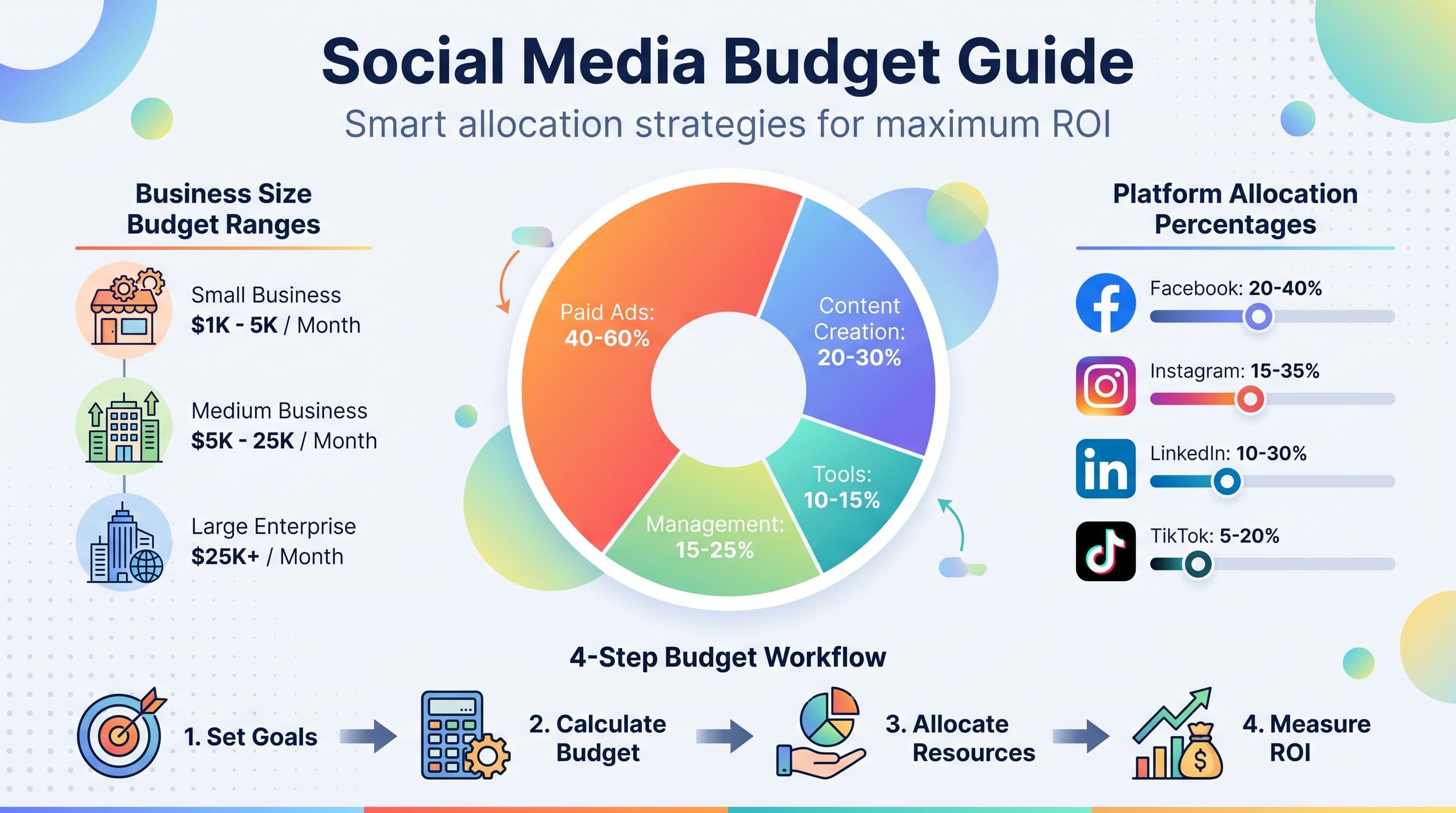
Here's the breakdown by business size:
| Business Size | Average Social Media Budget | % of Total Marketing Budget |
|---|---|---|
| Small Business (1-50 employees) | $1,000-$5,000/month | 25-35% |
| Medium Business (51-500 employees) | $5,000-$25,000/month | 20-30% |
| Large Enterprise (500+ employees) | $25,000-$100,000+/month | 15-25% |
But these averages don't tell the whole story. Your ideal budget depends on your industry, goals, audience, and current marketing maturity. A B2B software company will have completely different needs than a local restaurant or e-commerce fashion brand. Learn more about ai twitter posts complete.
How to calculate your social media marketing budget
There are four main approaches to setting your social media marketing budget. Each has its place depending on your business situation and goals. Try our best time to post on linkedin.
1. Percentage of revenue method
This is the most common approach. You allocate a fixed percentage of your total revenue to marketing, then dedicate a portion of that to social media. Our linkedin line break generator can help.
The formula: Total Revenue × Marketing % × Social Media %
For example: A company with $1 million annual revenue might allocate 10% ($100,000) to marketing, with 30% of that ($30,000) going to social media.
Industry benchmarks for marketing spend:
- B2B Software: 15-20% of revenue
- E-commerce: 8-12% of revenue
- Professional Services: 6-10% of revenue
- Healthcare: 3-8% of revenue
- Manufacturing: 3-5% of revenue
Pros: Scalable, predictable, easy to budget. Cons: Doesn't account for growth phases or competitive pressures.
2. Goal-based budgeting
Start with your specific objectives and calculate backward to determine the required investment. This method works best when you have clear, measurable goals.
Example calculation: You want to generate 100 new leads per month from social media. Your current cost per lead is $50. You need $5,000 monthly for ads, plus $2,000 for content creation and management.
Key metrics to consider:
- Cost per lead (CPL)
- Customer acquisition cost (CAC)
- Lifetime value (LTV)
- Conversion rates by platform
- Average deal size
Pros: Directly tied to business outcomes, easier to justify ROI. Cons: Requires good historical data and established conversion tracking.
3. Competitive analysis approach
Research what your competitors are spending and use that as a baseline. Tools like Facebook Ad Library, SEMrush, and SimilarWeb can give you insights into competitor ad spend.
Look for competitors with similar business models, target audiences, and market position. Don't just copy their spend - understand their strategy and adapt it to your unique situation.
How to research competitor budgets:
- Use Facebook Ad Library to see active campaigns
- Monitor competitor posting frequency and content quality
- Track their promoted posts and sponsored content
- Estimate their team size from LinkedIn
- Use paid tools for more detailed analytics
Pros: Market-informed decisions, competitive positioning. Cons: You might copy their mistakes, doesn't account for your unique advantages.
4. Available budget method
This is often how startups and small businesses approach budgeting. You allocate whatever funds are available after covering essential business expenses.
While not ideal from a strategic standpoint, this method can work if you're disciplined about tracking ROI and scaling up successful campaigns.
Making the most of limited budgets:
- Focus on organic content first
- Test small paid campaigns to find what works
- Prioritize platforms where your audience is most active
- Repurpose content across multiple channels
- Use scheduling tools to maximize efficiency
Pros: Works with cash flow constraints, allows for testing. Cons: May limit growth potential, harder to scale systematically.
Breaking down your social media budget
Once you have your total social media budget, you need to allocate it across different activities and platforms. Here's how successful businesses typically split their spend:
| Budget Category | Recommended % | What It Includes |
|---|---|---|
| Paid Advertising | 40-60% | Platform ads, boosted posts, influencer partnerships |
| Content Creation | 20-30% | Graphics, videos, photography, copywriting |
| Tools & Software | 10-15% | Scheduling tools, analytics, design software |
| Team & Management | 15-25% | Staff salaries, agencies, freelancers |
| Testing & Experiments | 5-10% | New platforms, ad formats, creative testing |
The exact percentages depend on your business model and maturity. B2B companies often spend more on content creation, while e-commerce businesses typically allocate more to paid advertising.
Platform-specific budget considerations
Not all social media platforms are created equal. Your budget allocation should reflect where your audience spends time and which platforms drive the best results for your business goals.
Facebook and Instagram
These Meta-owned platforms typically get the largest share of social media budgets due to their massive reach and sophisticated targeting options.
Average cost benchmarks: Facebook CPM (cost per 1,000 impressions) ranges from $5-15, while Instagram tends to be 20-30% higher. Cost per click averages $1-3 across industries.
Budget considerations: Plan for higher costs during Q4 holiday season. Instagram Stories and Reels often deliver lower costs than feed placements. Video content typically performs better but costs more to produce.
Recommended budget split: 60% paid ads, 25% content creation, 15% tools and management.
LinkedIn has the highest cost per click but also the highest-quality B2B leads. It's worth the premium if you're targeting professionals and decision-makers.
Average cost benchmarks: LinkedIn CPM ranges from $15-25, with cost per click often $5-10. Lead generation campaigns can cost $50-100 per lead.
Budget considerations: Start with smaller budgets to test messaging and targeting. Organic content performs well on LinkedIn, so balance paid and organic efforts.
Recommended budget split: 50% paid ads, 35% content creation, 15% tools and management.
TikTok and YouTube
Video-first platforms require higher content production budgets but can deliver exceptional reach and engagement, especially for younger demographics.
Average cost benchmarks: TikTok CPM ranges from $3-8, making it cost-effective for reach. YouTube ads vary widely from $2-10 CPM depending on targeting and format.
Budget considerations: Video production costs can be significant. Consider user-generated content campaigns to stretch your budget. Test organic content first before investing in paid promotion.
Recommended budget split: 35% paid ads, 45% content creation, 20% tools and management.
Twitter and emerging platforms
These platforms often require smaller budgets but can be highly effective for specific niches and real-time engagement.
Budget considerations: Focus on organic engagement and community building. Paid options are limited but can be cost-effective for the right audience.
Recommended budget split: 20% paid promotion, 50% content creation, 30% community management and tools.
Budget planning by business type and size
Your social media budget strategy should align with your business model and growth stage. Here are specific recommendations for different types of businesses:
Startups and small businesses (under $1M revenue)
Recommended budget: $500-$3,000 per month
Focus areas: Organic content creation, community building, and small-scale testing of paid ads. Prioritize 1-2 platforms where your ideal customers are most active.
Budget breakdown example ($2,000/month):
- $800 - Content creation and design
- $600 - Paid advertising testing
- $400 - Scheduling tools and software
- $200 - Freelance help or training
Key strategies: Use templates and batch content creation. Focus on engagement over reach. Test everything in small amounts before scaling.
Growing businesses ($1M-$10M revenue)
Recommended budget: $3,000-$15,000 per month
Focus areas: Scaling successful campaigns, expanding to additional platforms, and investing in higher-quality content production.
Budget breakdown example ($8,000/month):
- $4,000 - Paid advertising across 2-3 platforms
- $2,000 - Content creation and video production
- $1,000 - Social media management tools and analytics
- $1,000 - Part-time social media manager or agency support
Key strategies: Develop platform-specific content strategies. Invest in video content. Begin testing influencer partnerships.
Established businesses ($10M+ revenue)
Recommended budget: $15,000-$50,000+ per month
Focus areas: Sophisticated targeting and retargeting campaigns, brand awareness initiatives, and comprehensive social commerce strategies.
Budget breakdown example ($25,000/month):
- $12,000 - Multi-platform paid advertising campaigns
- $5,000 - Professional content production
- $3,000 - Advanced tools, analytics, and software
- $3,000 - Dedicated social media team
- $2,000 - Influencer partnerships and collaborations
Key strategies: Develop omnichannel campaigns. Invest in live streaming and interactive content. Create platform-specific creative assets.
Tools and software budget planning
Your social media tools can make or break your budget efficiency. The right software stack can help you manage larger campaigns with fewer people, while the wrong tools can drain your budget without delivering results.
Here's how to allocate your tools budget effectively:
| Tool Category | Monthly Cost Range | When You Need It |
|---|---|---|
| Scheduling & Publishing | $20-$200 | From day one - essential for consistency |
| Analytics & Reporting | $50-$500 | Once you have consistent traffic and conversions |
| Design & Video Creation | $20-$100 | When you're creating 10+ posts per week |
| Social Listening | $100-$1,000 | For brands with active communities or reputation management needs |
| Influencer Management | $100-$500 | When managing 5+ influencer relationships |
| Social Commerce | $30-$300 | For e-commerce businesses with direct social sales |
Essential tool stack for most businesses: Start with a reliable scheduling platform like Schedulala, basic design software, and built-in platform analytics. This foundation typically costs $50-150 per month and covers 80% of your needs.
When to upgrade: Add advanced tools when you're managing multiple platforms consistently, have budget for paid advertising, or need specific features like automated reporting or advanced audience analysis.
Measuring and optimizing your social media ROI
The best budget is worthless if you're not tracking its performance. Here's how to measure your social media marketing ROI and optimize your spend:
Essential metrics to track
Revenue metrics: Track direct sales, lead generation, and customer lifetime value attributed to social media. Use UTM parameters and conversion tracking to get accurate attribution.
Cost metrics: Monitor cost per click, cost per lead, customer acquisition cost, and overall return on ad spend (ROAS). Aim for at least 3:1 ROAS, with 4:1+ being excellent.
Engagement metrics: While vanity metrics like likes and follows don't directly drive revenue, they indicate content quality and audience fit. Track engagement rate, click-through rate, and social share of voice.
Efficiency metrics: Measure cost per post, time spent on content creation, and team productivity. These help you identify areas to streamline and reinvest savings.
Budget optimization strategies
Weekly budget reviews: Check your top-performing campaigns and content types. Shift budget from underperforming areas to what's working best.
Seasonal adjustments: Plan for higher costs during competitive periods (holidays, industry events). Build a 20% buffer for these peak times.
Platform rotation: Test new platforms with 10% of your budget. If they outperform established channels, gradually shift more resources.
Creative refresh cycles: Plan to refresh ad creative every 2-3 weeks to avoid ad fatigue. Budget 15% of your ad spend for new creative production.
Red flags that indicate budget problems
Rising costs without improved results: If your cost per lead is increasing month over month without better lead quality, you need to refresh your targeting or creative.
Inconsistent posting: If you're missing posting schedules due to budget constraints, you're probably underfunding content creation.
Tool sprawl: Using multiple tools that do similar things indicates budget inefficiency. Consolidate your tool stack regularly.
No testing budget: If 100% of your budget goes to 'proven' campaigns, you're missing opportunities to discover better approaches.
Common social media budgeting mistakes
Learning from others' mistakes can save you thousands of dollars and months of frustration. Here are the most expensive social media budgeting errors and how to avoid them:
Mistake #1: Setting and forgetting your budget
Many businesses set their social media budget once and never adjust it. This leads to missed opportunities during high-performance periods and wasted spend during slow times.
The fix: Review your budget monthly and make tactical adjustments weekly. If a campaign is delivering 5:1 ROAS, increase its budget. If another is struggling at 1:1, pause or optimize it.
Mistake #2: Spreading budget too thin across platforms
Trying to be everywhere at once often means you're nowhere effectively. Small budgets spread across five platforms won't generate meaningful results on any of them.
The fix: Start with 1-2 platforms where your audience is most active. Master those before expanding. A $2,000 budget works better on two platforms than six.
Mistake #3: Ignoring organic content investment
Some businesses put everything into paid ads while neglecting organic content quality. This creates expensive, unsustainable growth that collapses when ad budgets tighten.
The fix: Maintain a 60/40 split between paid and organic content investment. Strong organic content improves paid campaign performance and provides a sustainable growth foundation.
Mistake #4: Not factoring in content production costs
Many budget plans focus only on ad spend and forget about the cost of creating content. High-performing social media requires consistent, quality content that costs time and money to produce.
The fix: Budget 25-40% of your total social media spend for content creation. Include design software, stock photos, video production, and copywriting in this calculation.
Mistake #5: Chasing vanity metrics instead of revenue
Optimizing for likes, follows, and impressions instead of leads and sales leads to budgets that grow audiences but not revenue.
The fix: Set revenue-based goals first, then work backward to determine the right budget allocation. Track customer acquisition cost and lifetime value as your primary success metrics.
Try Schedulala for free
Schedule posts to Bluesky, Twitter, and 8 other platforms from one dashboard.
Get started for free→Creating your social media budget template
Here's a practical template you can use to plan and track your social media marketing budget. Customize it based on your business needs and goals:
Monthly budget planning template
Total Monthly Social Media Budget: $______
Platform Allocation:
- Facebook/Instagram: $______ (recommended: 40-50% of total)
- LinkedIn: $______ (for B2B: 20-30%)
- TikTok/YouTube: $______ (for video-focused brands: 20-30%)
- Other platforms: $______ (testing budget: 5-10%)
Spend Category Breakdown:
- Paid advertising: $______ (40-60% of total)
- Content creation: $______ (20-30% of total)
- Tools and software: $______ (10-15% of total)
- Team/management: $______ (15-25% of total)
- Testing/experiments: $______ (5-10% of total)
Quarterly review checklist
Performance Analysis:
- Calculate ROI for each platform and campaign type
- Identify top-performing content formats and topics
- Review cost trends and budget efficiency
- Assess team productivity and tool effectiveness
Budget Adjustments:
- Reallocate budget from low-performing to high-performing areas
- Plan for seasonal changes and upcoming campaigns
- Evaluate new platform opportunities
- Update tool stack based on current needs