Social Media Retainer Pricing: How to Structure Rates That Actually Make You Money
Learn how to structure social media retainer pricing with real tier examples, formulas, and scope templates that protect your margins.

You quoted a client $1,200 a month for "social media management." Three weeks in, they're asking for a TikTok strategy, two extra platforms, weekly reporting calls, and a same-day turnaround on a crisis post. You're now making less than minimum wage on this account, and you have no idea how it happened. Try our LinkedIn scheduling.
See It in Action
This is what scheduling a LinkedIn post looks like in Schedulala
This is the single most common failure point in agency and freelance social media work: pricing the retainer before pricing the scope. Get the structure right and a retainer becomes predictable, scalable income. Get it wrong and every client becomes a slow-motion pay cut. Try our content calendar.
This guide walks through how to build a social media retainer pricing model that holds up, including what to charge, how to tier your packages, what belongs in scope versus what should cost extra, and the mistakes that quietly destroy agency margins. Our social media content approval can help.
Try Schedulala for free
Schedule posts to Bluesky, Twitter, and 8 other platforms from one dashboard.
Get started for free→Why retainers beat hourly and project pricing for social media
Social media isn't a project with a start and an end. It's an ongoing operational function, more like payroll or rent than a one-time deliverable. That's why retainers make sense as the default pricing structure, but only if you set them up to reflect the actual work involved. Try our the best media workflow:.
Hourly billing punishes efficiency. The faster you get at batching content or writing captions, the less you earn. Clients also tend to scrutinize hourly invoices line by line, which creates friction every single month. Project pricing works for a one-off campaign or a content audit, but social media management is recurring, so pricing it like a one-time project undersells the ongoing strategy, community management, and reporting work that never really stops. See our best time to post on linkedin guide.
A well-structured retainer gives you predictable revenue, gives the client predictable costs, and lets both sides plan around a fixed scope instead of renegotiating every month. The problem isn't the retainer model itself. It's that most freelancers and small agencies set their first retainer price based on what sounds reasonable rather than what the work costs, and then they never go back and fix it. Our linkedin line break generator can help.
The four retainer pricing models
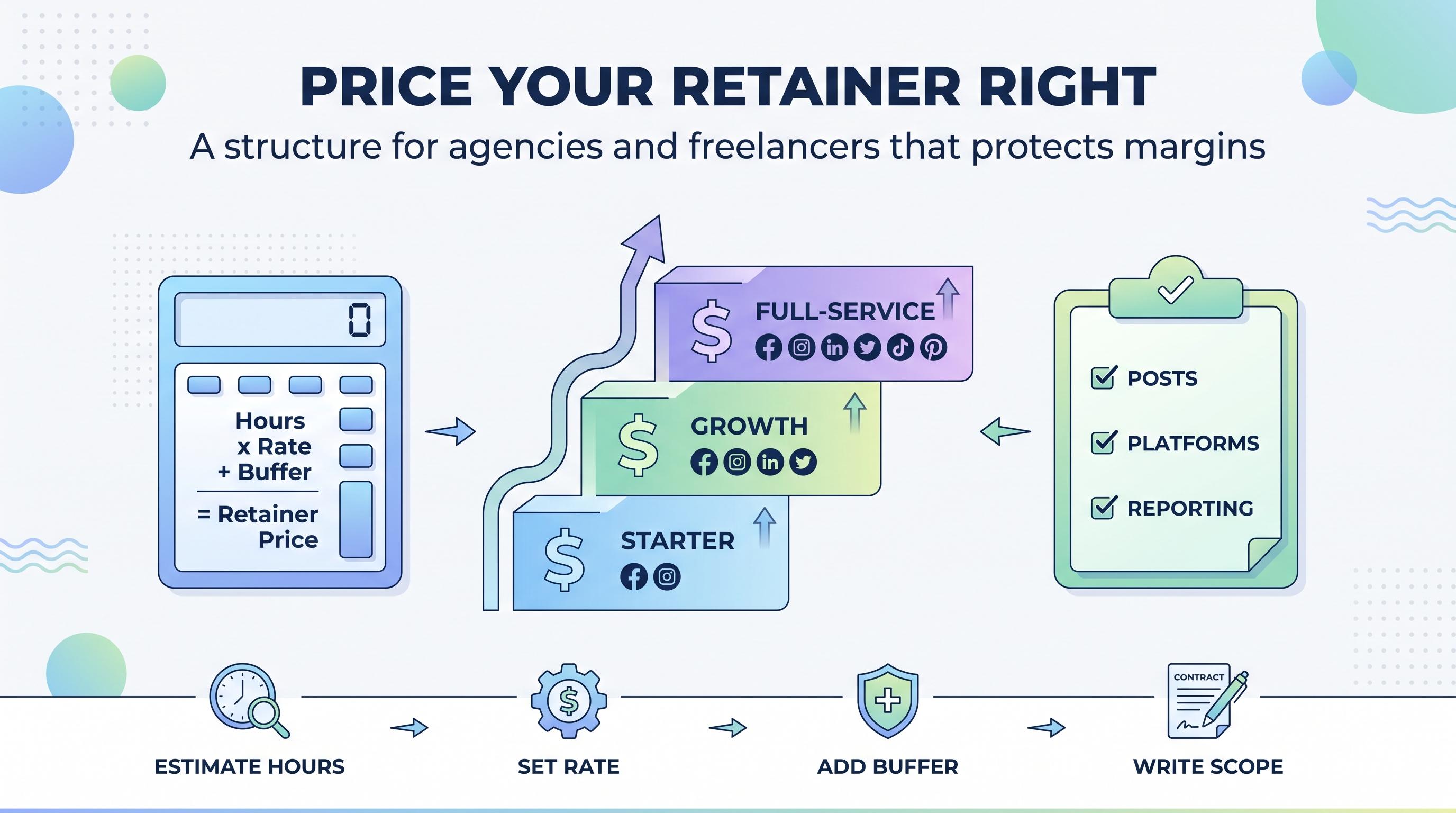
1. Flat monthly retainer
One price, fixed scope, delivered every month. This is the easiest model for clients to understand and the easiest for you to invoice, which is why it's the most common structure in the industry. It works best when the client's needs are stable: a set number of posts per platform, a known content type, and predictable turnaround.
The risk with flat retainers is scope creep. Without a written-down deliverable list, "manage our Instagram" can expand to mean anything the client thinks of that week. You need a scope document, not just a price tag.
2. Tiered packages
You build three or four pre-set packages (commonly labeled something like Starter, Growth, and Full-Service) with clear deliverables and clear prices attached to each. Clients pick the tier that fits their budget and needs, and upgrading mid-contract is a simple conversation rather than a renegotiation from scratch.
Tiered pricing is the fastest way to close new clients because it removes the back-and-forth of custom quoting. It also makes upselling easier: once a client sees what's in the next tier up, the upgrade pitch writes itself.
3. Hybrid retainer plus add-ons
A base retainer covers the core deliverables (strategy, a set number of posts, basic reporting), and everything outside that scope gets priced as an add-on: paid ad management, influencer outreach, video production, extra platforms, rush content. This model protects your margin on scope creep because the pricing for "more" already exists before the client asks for it.
This is the model most experienced agencies land on eventually, because it gives you the simplicity of a flat retainer with the flexibility to say yes to extra work without eating the cost.
4. Value-based retainer
Instead of pricing based on hours or deliverables, you price based on the business outcome the client cares about: leads generated, follower growth tied to a launch, or a percentage of revenue attributable to social. This model can produce the highest margins, but it only works with clients who have clean attribution and a track record you can point to.
Most agencies aren't set up to prove value-based results cleanly enough to justify this pricing, so it's usually reserved for established agencies with case studies and an existing relationship with the client.
How to calculate your retainer rate
Most freelancers price retainers by guessing a number that feels fair. That's backwards. Price it from the bottom up, starting with the actual cost of delivering the work, then layer on margin.
Step 1: Estimate hours per deliverable
Break the scope into individual tasks: content planning, writing captions, designing graphics, scheduling, community management, monthly reporting, and client calls. Estimate the hours each task takes. If you've never tracked this, start tracking it now, even loosely, because guessing here is where most pricing errors start.
Step 2: Set your target hourly rate
Figure out what you need to earn per hour to hit your income goals after accounting for taxes, software costs, non-billable admin time, and time off. A common mistake is setting this rate based on what a full-time job pays, without factoring in that freelancers and agency owners also cover their own overhead and don't bill 40 hours a week of pure client work.
Step 3: Multiply and add a buffer
Total hours multiplied by your target rate gives you a baseline. Add 15-20% on top as a buffer for revision rounds, unplanned client requests, and the inevitable emergency post that comes in on a Friday afternoon. Clients rarely stay exactly within scope, and the buffer is what keeps that reality from eating your profit.
Step 4: Sanity-check against the market
Once you have a number built from real costs, compare it to what similar agencies in your niche and region charge. If you're wildly below market, you're likely underestimating your hours or your overhead. If you're far above, make sure your scope and results genuinely justify the premium.
Sample retainer tier structure
Here's an example of how a three-tier structure might look for a small agency managing social media for local service businesses and small e-commerce brands. These numbers are illustrative, meant as a starting framework, not a universal rate card. Adjust based on your market, niche, and cost structure.
| Tier | Monthly price | Platforms covered | Posts per month | Reporting | Add-on ready |
|---|---|---|---|---|---|
| Starter | $800 - $1,200 | 1-2 platforms | 8-12 posts | Monthly summary | Limited |
| Growth | $1,500 - $2,500 | 3-4 platforms | 16-24 posts | Monthly + mid-month check-in | Yes |
| Full-Service | $3,000 - $5,000+ | 4-6 platforms | 30+ posts, Stories/Reels included | Live dashboard + strategy call | Yes, plus paid media option |
Notice that "platforms covered" and "posts per month" scale together with price. This is the single most important discipline in retainer pricing: never increase the number of platforms a client gets without increasing the price. Every additional platform has its own content format, posting cadence, audience behavior, and community management overhead. Treating Instagram, TikTok, and LinkedIn as interchangeable line items on the same retainer is how agencies end up doing triple the work for the same fee.
What belongs in scope (and what should cost extra)
Scope creep is the quiet killer of retainer profitability. The fix isn't to say no to everything, it's to have a written scope document that spells out exactly what's included, so that anything outside of it has an obvious, pre-agreed price attached.
Standard inclusions
- A fixed number of posts per platform per month
- Content calendar planning and approval
- Caption writing and basic graphic design
- Scheduling and publishing
- Basic community management (replying to comments, not DMs or crisis response)
- One monthly reporting document
Common add-ons (price these separately)
- Paid social ad management and budget oversight
- Video production or editing beyond basic repurposing
- Influencer outreach and partnership management
- Additional platforms beyond the contracted number
- Rush turnaround or same-day crisis posts
- On-location content shoots
- Extra revision rounds beyond the agreed limit
Put this list directly into your proposal or statement of work. Clients rarely push back on add-on pricing when it's stated upfront and framed as normal, versus trying to introduce a surprise fee three months into the relationship after they've already gotten used to free extras.
Pricing by niche: what actually changes
Retainer pricing isn't one-size-fits-all across industries. A local plumber and a venture-backed e-commerce brand have wildly different expectations, content needs, and budgets, even if the deliverable list looks similar on paper.
Local service businesses (contractors, dentists, restaurants) typically want consistency over creativity. They need a steady presence, basic engagement, and the occasional seasonal promotion. These clients are usually well served by a Starter or Growth tier, and they're price-sensitive, so your margin here comes from efficient, repeatable production, not custom strategy work.
E-commerce brands need content that drives clicks and sales, which means more platforms, more frequent posting, and often paid social integration. They're used to paying for performance, so a hybrid retainer with clear reporting tied to traffic or conversions tends to land well and supports higher prices.
B2B and professional services clients (law firms, consultants, SaaS companies) usually want fewer, higher-quality posts, heavy LinkedIn focus, and thought-leadership content tied to their founder or executive team. Volume matters less here than polish and strategic positioning, which justifies premium per-post pricing even with a lower overall post count.
Tools that make retainer delivery actually profitable
Your pricing can be perfect on paper and still lose money if your delivery process is inefficient. The biggest hidden cost in agency social media work isn't strategy or creative, it's the operational grind of logging into a dozen platforms, re-uploading the same content in six formats, and manually tracking what's been approved and scheduled.
This is where your tech stack directly affects your margin. If you're managing content for 8 clients across an average of 4 platforms each, that's 32 separate accounts to coordinate. Doing that manually, or worse, through each platform's native scheduler, eats hours every single week that you're not billing for.
A scheduling platform built for agency workloads changes the math. Schedulala covers all 12 major platforms (Instagram, TikTok, Twitter/X, LinkedIn, YouTube, Facebook, Threads, Bluesky, Pinterest, Telegram, Mastodon, and Google Business Profile), and its Agency plan at $99/month gives you 100 social accounts to allocate however your client roster actually breaks down, whether that's four platforms across 25 clients or ten platforms across ten. There's no per-seat fee and no per-channel surcharge eating into your retainer margin, and every plan, including the entry-level Personal tier, includes unlimited scheduled posts.
When you're pricing retainer tiers, this matters practically: if your scheduling tool charges you more as you add clients or platforms, that cost needs to be baked into your pricing model from day one. A flat account count that you can spend across any combination of clients and platforms is a lot easier to budget around than a tool that nickel-and-dimes you per channel.
Common mistakes in retainer pricing
Pricing the client, not the work
"They seem like they can afford $2,000" is not a pricing strategy. Price what the scope costs to deliver profitably, then let the client decide if that fits their budget. If it doesn't, offer a smaller tier rather than discounting the full scope.
No written scope document
A verbal agreement about "managing their social media" leaves everything open to interpretation. Put the exact platform list, post count, revision limit, and reporting cadence in writing, attached to the invoice or contract.
Never raising rates on existing clients
Costs go up every year. Your skills improve, your tools cost more, inflation happens. If you haven't raised a client's retainer in over 12 months, you're effectively giving them a pay cut to you, personally, every single month.
Underpricing the discovery/strategy phase
Many agencies fold strategy work into the first month's retainer for free to win the client. That strategy work (audience research, competitor analysis, content pillars) takes real hours and should either be a separate onboarding fee or clearly accounted for in the first month's higher effective rate.
Treating every platform as equal work
A TikTok video takes longer to produce than a text-based LinkedIn post. A Pinterest pin strategy is nothing like a Threads conversation strategy. If your pricing doesn't reflect the actual production time per platform, you'll end up subsidizing your highest-effort platforms with your lowest-effort ones.
When and how to raise retainer rates
Rate increases are uncomfortable to bring up, but they're a normal part of running a sustainable business, and most clients expect them if framed correctly. The key is timing it around a contract renewal or a demonstrated result, not dropping it on an invoice with no warning.
A good rule of thumb: review pricing annually, and plan for increases in the 5-10% range to track cost of living and skill growth, with larger jumps (15-20%+) reserved for scope expansion or a documented track record of strong results. Give at least 30 days' notice, explain the reasoning briefly (increased scope, inflation, added capabilities), and offer the client the option to adjust scope down if the new price doesn't fit their budget rather than losing them outright.
If a client pushes back hard on every increase no matter how small, that's useful information. It usually means the account was underpriced from the start and the client has been anchored to an unsustainable number. Sometimes the right move is to let that client go and replace them with one priced correctly from day one.
Putting it together: a pricing checklist
- List every deliverable and estimate the hours it actually takes, including revisions and admin time
- Set a target hourly rate that covers your income goals, taxes, and overhead
- Calculate a base price, then add a 15-20% buffer for scope flexibility
- Build three to four tiers with platform count and post volume scaling clearly with price
- Write a scope document listing inclusions and priced add-ons
- Build your software and tool costs into the base rate, not as an afterthought
- Set a calendar reminder to review every client's pricing annually
- Compare your final numbers against market rates in your niche before sending the proposal
If you're managing multiple client accounts and the admin side of social media is already cutting into your margins, it's worth auditing your workflow before your next pricing conversation. The hours you save on scheduling and reporting are hours you can either bill elsewhere or give back to yourself.
Try Schedulala for free
Schedule posts to Bluesky, Twitter, and 8 other platforms from one dashboard.
Get started for free→