Social Media SLA Template: What to Include and How to Build One That Actually Gets Followed
Build a social media SLA template that defines response times, approval steps, and reporting so clients and teams stay aligned.

A client messages on a Thursday afternoon asking why their Instagram post hasn't gone up yet. Your team thought it was due Friday. The client thought it was due that morning. Nobody's wrong exactly, but everyone's annoyed, and the relationship takes a small hit it didn't need to take. Learn more about cross-platform analytics track 11.
This is what happens when a social media relationship runs without a service level agreement. Not a vague one-liner in a proposal, but an actual document that spells out response times, posting windows, approval steps, and what happens when something goes wrong. If you manage social for clients, or you run an in-house team that answers to stakeholders who expect fast turnarounds, you need one of these. This guide covers exactly what to put in it. Learn more about scheduling across platforms.
Who actually needs a social media SLA
If you're a solo creator posting for your own brand, you can skip this. An SLA exists to manage expectations between two parties, so it only matters once there's a client, a boss, or a cross-functional team depending on your output. Learn more about how to repurpose content.
You need one if you're a social media agency managing accounts for multiple clients, an in-house marketer reporting to leadership or sales teams who expect certain response times on social, a freelancer juggling several retainer clients at once, or a team lead managing community managers who field customer service questions through social channels. In every one of these setups, an SLA is the document people point to when there's a disagreement about what should have happened and when. Try our best time to post on instagram.
Try Schedulala for free
Schedule posts to Bluesky, Twitter, and 8 other platforms from one dashboard.
Get started for free→What a social media SLA actually is
A social media SLA is a written agreement that defines the specific, measurable standards both sides commit to for social media work. It's not a contract covering scope and pricing (that's your Master Service Agreement or Statement of Work). It's the operational layer underneath: how fast you respond to a comment, how many revision rounds a client gets, what counts as a crisis and how fast you'll react to one. Try our best time to post on tiktok.
Think of it as the thing that prevents 'ASAP' and 'soon' from meaning five different things to five different people. When it's written down with actual numbers attached, like '2 business hours' instead of 'quickly,' arguments mostly disappear because there's nothing left to argue about.
Why skipping this costs you more than you think
Teams that operate without a social SLA tend to hit the same three problems repeatedly. First, scope creep: a client asks for 'just one more edit' and then another, because nobody ever defined how many revisions are included. Second, missed deadlines that feel like broken promises even though the deadline was never formally agreed on. Third, crisis mismanagement, where a negative comment sits unanswered for six hours because nobody owns weekend monitoring.
Each of these erodes trust in a way that's hard to rebuild. A missed revision deadline is annoying. A mishandled PR situation on social can cost a client real money and real reputation. An SLA won't prevent every mistake, but it gives you a documented standard to measure against and a framework for accountability when things slip.
The core sections every social media SLA needs
1. Response time commitments
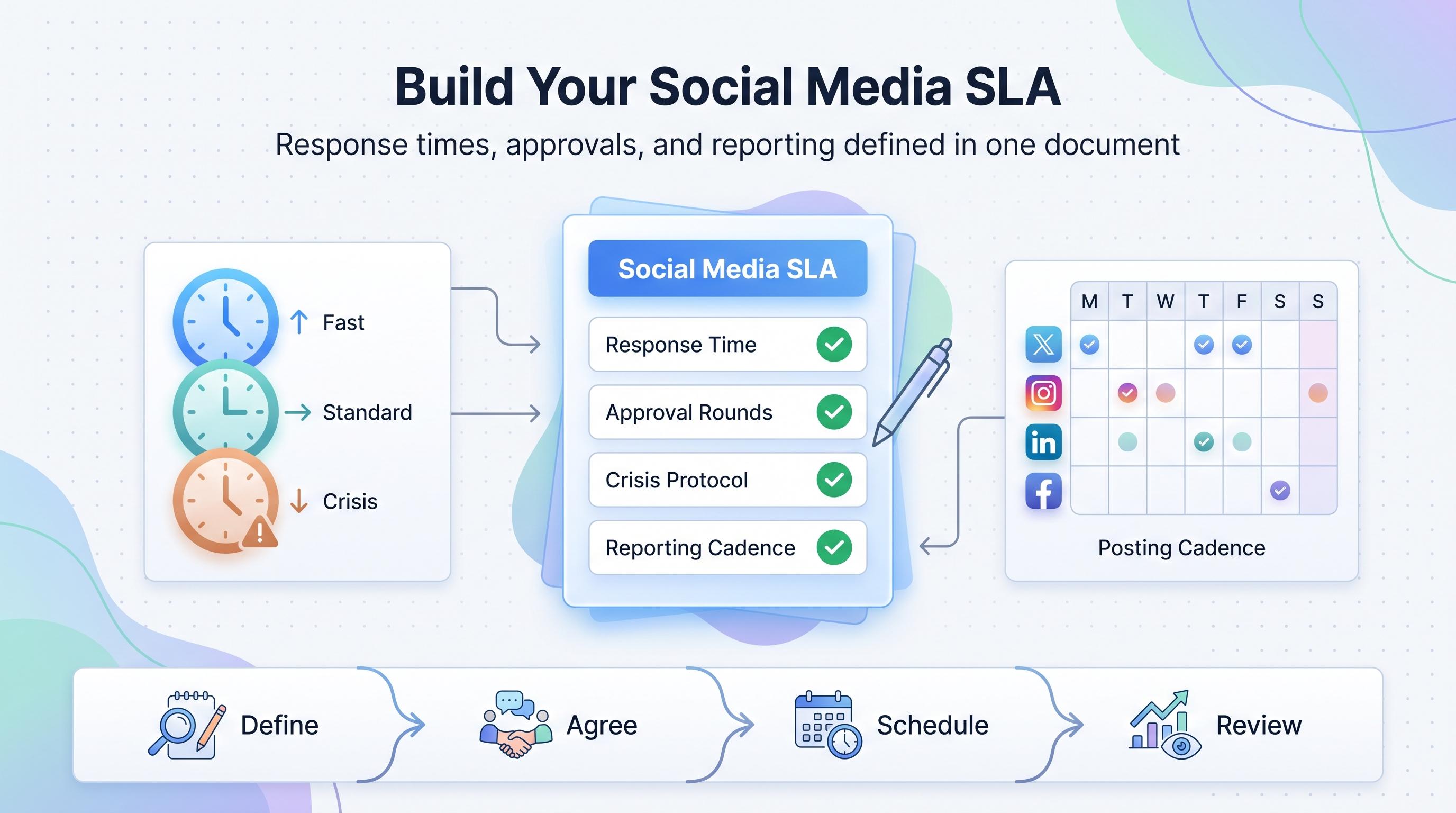
This is the heart of most SLAs. Define, in writing, how fast your team responds to different inputs: client messages, comments on posts, direct messages from followers, and crisis-level mentions.
Break it down by severity. A routine comment asking about shipping times doesn't need the same urgency as a public complaint tagging the brand. A workable structure looks like: standard comments and DMs answered within 4 business hours, client feedback requests answered within 2 business hours, and crisis-flagged mentions (anything involving safety, legal risk, or viral negative sentiment) escalated and acknowledged within 30 minutes, 24/7.
2. Posting cadence and scheduling windows
Spell out exactly what gets posted, where, and how often. Is it 3 posts per week on Instagram, daily Stories, 2 LinkedIn posts per week, and one TikTok per week? Write the actual cadence per platform rather than a vague 'regular posting' line.
Also define when content needs to be scheduled by. For example: all content for the following week is scheduled by end of day Thursday, with final client approval needed by Wednesday at noon. This gives both sides a working rhythm instead of a last-minute scramble every Friday.
3. Approval workflow and revision limits
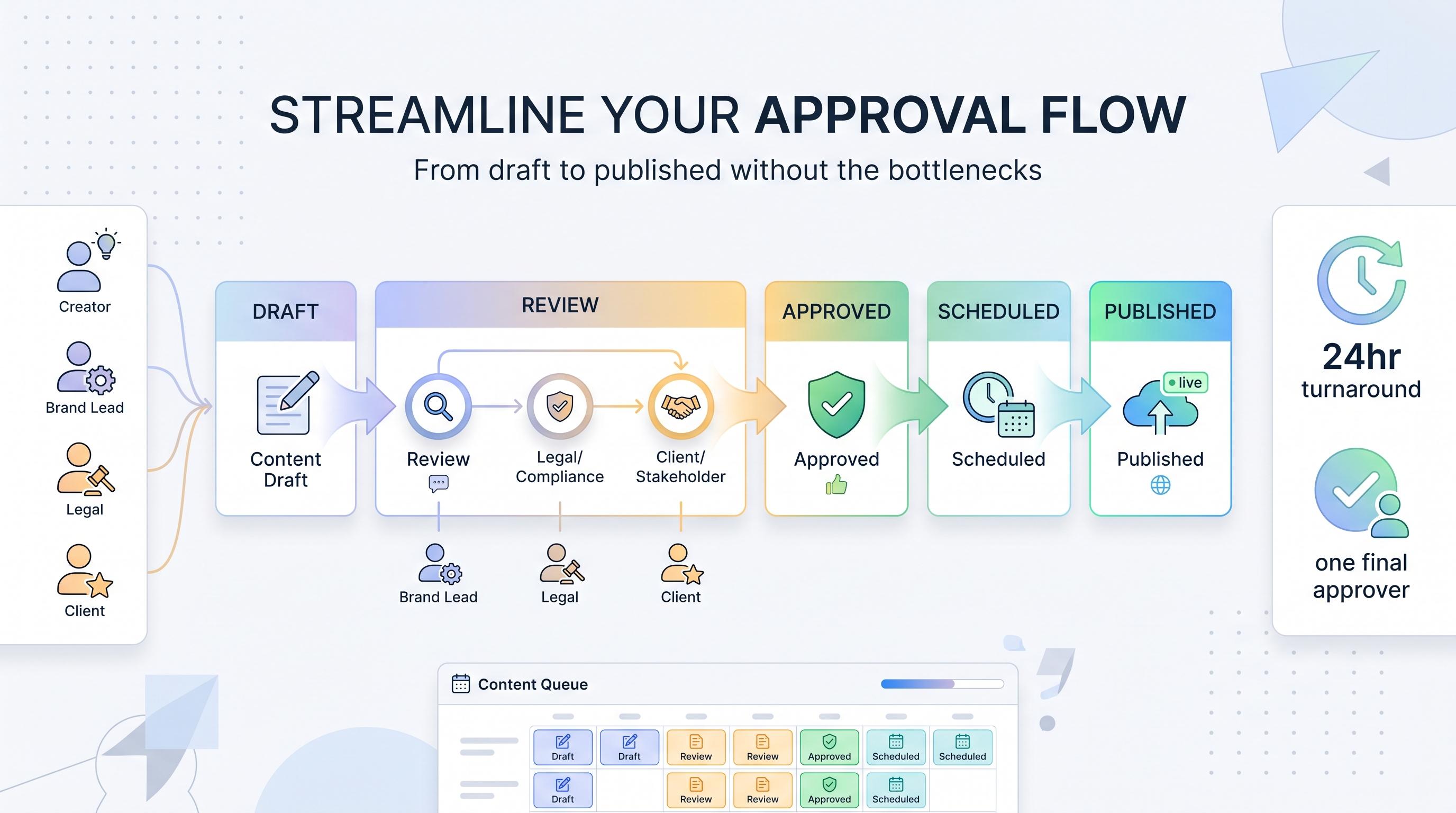
This is where most client relationships quietly go sideways. Without a written limit, 'a couple of revisions' becomes seven rounds of back and forth over caption wording. State the number of revision rounds included per piece of content (two is standard), the turnaround time the client has to approve or request changes (24 to 48 hours is reasonable), and what happens if the client goes silent: does the content get auto-approved, or does it get pulled from the schedule?
That last part matters more than people think. If a client doesn't respond and you don't have an auto-approval clause, content sits in limbo and your whole calendar backs up.
4. Crisis and escalation protocol
Define what qualifies as a crisis (a wave of negative comments, a factual error in a published post, a complaint that's gaining traction, a mention from a journalist or influencer with a large following). Then define the chain of command: who gets notified first, how fast, and who has authority to pull a post or issue a public response without waiting for sign-off.
Without this section, the natural instinct during a crisis is to wait for approval from someone who's unreachable, which is exactly when things get worse.
5. Reporting and performance review cadence
State how often you deliver performance reports (monthly is standard, weekly for high-spend accounts), what metrics are included (reach, engagement rate, follower growth, link clicks, whatever ties back to the client's actual goals), and the format you'll deliver it in.
Also set a cadence for strategy review meetings. Quarterly works for most retainers. This keeps the relationship from drifting into pure execution mode where nobody steps back to ask if the strategy still makes sense.
6. Roles and responsibilities
List who owns what on both sides. Who writes copy, who designs graphics, who approves final content, who owns the brand voice guidelines, who monitors comments after hours. If a client assumes you're monitoring DMs overnight and you're not, that gap only shows up after something's already gone wrong.
7. Tools, access, and platform ownership
Specify which scheduling tool or platform the work runs through, who owns admin access to the social accounts, and what happens to that access if the contract ends. This section also covers whether the client needs to grant access to ad accounts, analytics, or a shared content calendar.
8. Content ownership and usage rights
Clarify who owns the final content once it's published. Does the client own all rights immediately, or does the agency retain rights to use it in a portfolio? This belongs in the SLA even though it overlaps with contract language, because it's an operational question people forget to settle until a dispute forces the issue.
A sample SLA structure you can copy
Here's a simplified version of how these sections come together in an actual document. Use this as a starting skeleton and adjust the numbers to match your team's real capacity. Never put a response time in writing that you can't actually hit on a bad week.
| Section | Example commitment |
|---|---|
| Standard comment/DM response | Within 4 business hours |
| Client feedback response | Within 2 business hours |
| Crisis-level mention | Acknowledged within 30 minutes, 24/7 |
| Content scheduled by | Thursday EOD for the following week |
| Client approval deadline | 48 hours before scheduled publish |
| Revision rounds included | 2 per asset |
| Monthly performance report | Delivered by the 5th of each month |
| Strategy review meeting | Quarterly |
Mistakes that make an SLA useless
- Writing response times you can't actually hit. A 1-hour response time looks great on paper until your team is managing 15 accounts and burns out trying to meet it every single day.
- Treating it as a one-time document. Review it every 6 to 12 months. Team size changes, client expectations shift, new platforms get added. An SLA from two years ago probably doesn't reflect how you actually work now.
- Leaving out weekends and holidays. If your standard SLA doesn't explicitly address what happens Saturday through Monday, assume the client will expect the same response time anyway, and you'll be the one explaining why that's unreasonable after the fact.
- No consequence for missed SLA terms. If there's genuinely no penalty or remedy when you (or the client) miss a commitment, the document is just a wish list. Even something simple, like a credit toward the next invoice for repeated misses, gives it real weight.
- Burying it in legal language nobody reads. The whole point is that people reference it. Keep it in plain English with a table they can scan in two minutes.
How the right scheduling setup makes your SLA easier to keep
An SLA is only as good as your team's ability to actually deliver on it, and a lot of missed deadlines come down to a clunky workflow rather than a lack of effort. If your posting cadence commitment is 3 Instagram posts and 2 LinkedIn posts a week across 10 client accounts, you need a system that lets you batch, schedule, and track all of that from one place instead of logging into a dozen native apps.
This is where a tool like Schedulala fits into the SLA conversation. It schedules content across all 12 major platforms, including Instagram, TikTok, LinkedIn, Facebook, Threads, Bluesky, Pinterest, Telegram, Mastodon, YouTube, Twitter/X, and Google Business Profile, from a single calendar view. Unlimited scheduled posts are included on every plan, so your posting cadence commitment doesn't suddenly cost you more as volume grows.
For agencies managing SLAs across several client accounts, Schedulala's plans are built around a flat account count you can split however you want: 10 social accounts on Personal ($29/month), 25 on Team ($49/month), or 100 on Agency ($99/month). That count can be spread across any mix of platforms and clients, so you're not locked into a rigid bundle that doesn't match how your actual client roster looks. Annual billing on any plan gets you two months free. There's a 7-day free trial to test it against your actual SLA commitments before you commit a card to a full subscription.
Putting it into practice
Don't try to write the perfect SLA in one sitting. Start with the two or three sections causing you the most pain right now, probably response times and revision limits if you're like most teams, and get those in writing with your current clients this week. Add the rest over the next month.
Once it's written, the next step is the one most people skip: actually walking the client through it instead of just emailing a PDF. A five-minute conversation where you say 'here's what you can expect from us, and here's what we need from you' does more for the relationship than the document itself.
Try Schedulala for free
Schedule posts to Bluesky, Twitter, and 8 other platforms from one dashboard.
Get started for free→